|
MICHAEL SCOGGINS Page 1 | 2 | Biography |
||||
|
||||
|
MICHAEL SCOGGINS, �Recent Drawings�, March 7 � April 8, 2006, Freight + Volume, New York With his most recent body of work, Georgia-based Michael Scoggins continues to expand the definition of drawing through his use of monumental sheets of hand-drawn notebook paper, which hang crumpled and tattered from the wall. This familiar icon, with its blue lines and spiral bound edges, has become the signature image for the artist � a place where he offers what writer Lara Herndon described as �a poignant glimpse of the emotional landscape of childhood filtered through a mature sensibility.� |
||||
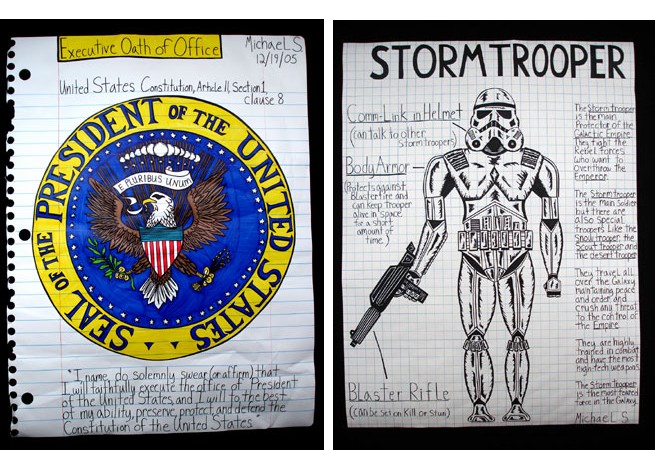
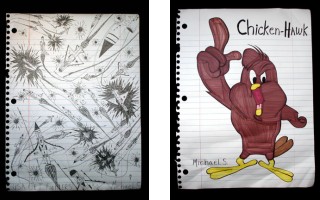
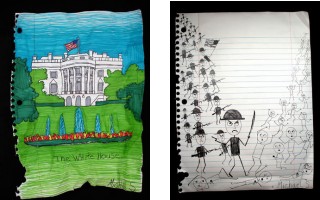
Images (L-R) from top : Michael Scoggins, Oath and Seal , 2006 marker, prismacolor on paper, 67 x 51� Michael Scoggins, Stormtrooper, 2006, marker, prismacolor on paper, 67 x 51� Michael Scoggins, Fighter Jets, 2006, marker, prismacolor on paper, 67 x 51� Michael Scoggins, Chicken Hawk, 2005, marker, prismacolor on paper, 67 x 51� Michael Scoggins, The White House, 2006, marker, prismacolor on paper, 67 x 51� Michael Scoggins, USA Army Invasion, 2006, marker, prismacolor on paper, 67 x 51� |
As iconic artifacts from American culture, Scoggins� notebook pages and his appreciation of the everyday conjure associations with a range of Pop artists from Andy Warhol to Claus Oldenburg / Coosje van Bruggen, while his slightly sinister sense of humor and use of fragmented, confessional text are reminiscent of artists like Richard Prince and Christopher Wool. Employing a variety of jokes, doodles, political slogans, proclamations, comic-book characters, angry rants, and teary-eyed journal entries, the artist takes aim at everyone from himself to past girlfriends to the American mentality towards war. In his book The Pleasure of the Text, Roland Barthes wrote, �I am interested in text because it wounds and seduces me.� Barthes�s words resonate when encountering Scoggins� work; through the voyeuristic and pleasurable nature of reading, as a viewer one is seduced by the sincerity of the text and at the same time wounded by the underlying sadness in many of his letters.
|
|||
|
||||
re-title.com
International contemporary art
SIGN UP FOR NEWSLETTERS

 SIGN UP for ARTIST MEMBERSHIP
SIGN UP for GALLERY MEMBERSHIP
SIGN UP for ARTIST MEMBERSHIP
SIGN UP for GALLERY MEMBERSHIP
Click on the map to search the directory