|
Ray Rapp Page 1 | Biography |
||||
|
||||
|
PERSISTENCE OF VISION - The human eye retains an image for a fraction of a second after it views the image. This property (called persistence of vision) is essential to all visual display technologies. Video is comprised of a sequence of images. Single still frames are presented at a rate high enough so that persistence of vision integrates these still frames into motion. Motion pictures set the frame rate at 24 frames per second. When NTSC television standards were introduced, the frame rate was moved to 29.97 frames per second. Glitch. For some reason, the brighter the still image, the shorter the persistence of vision. So, bright pictures require more frequent repetition. If the space between pictures is too long, then the image flickers. |
||||
Large bright theater projectors avoid this problem by placing rotating shutters in front of the image in order to increase the repetition changing the actual images. Since there is no easy way to �put a shutter� in front of a television broadcast, a single frame is scanned twice. This 'interlacing' creates two �flashes� per frame. Aberrations, however, do occur. These include misalignment (the horizontal edges of one scan do not match with the next), and interline flicker (slight mismatches between subsequent lines cause a shimmering effect). Another potential problem is rapid motion. If the still frame images are presented at too low a rate, rapid motion becomes jerky and odd looking. |
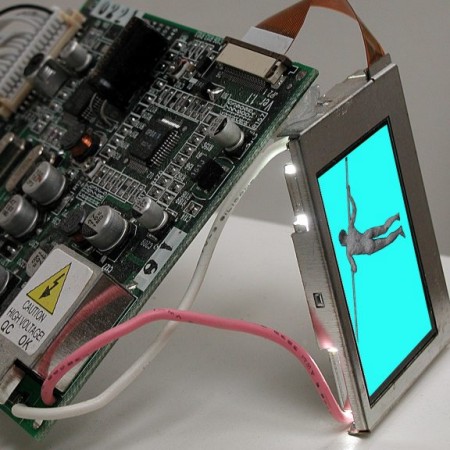
I have attempted to utilize these aberrations by altering the frame rate of the video or by changing the number and sequence of still images presented in any given animation. Alternating positive and negative images creates a pronounced flicker, sometimes called 'strobing'. With careful persistence of vision one may detect the anomalies between the alternating positive and negative images.
manwalkfast |
|||
|
||||
re-title.com
International contemporary art
SIGN UP FOR NEWSLETTERS

 SIGN UP for ARTIST MEMBERSHIP
SIGN UP for GALLERY MEMBERSHIP
SIGN UP for ARTIST MEMBERSHIP
SIGN UP for GALLERY MEMBERSHIP
Click on the map to search the directory