|
Air de Paris: CHANNA HORWITZ || JOSEPH GRIGELY AND AMY VOGEL - 23 May 2015 to 19 July 2015 Current Exhibition |
||||
|
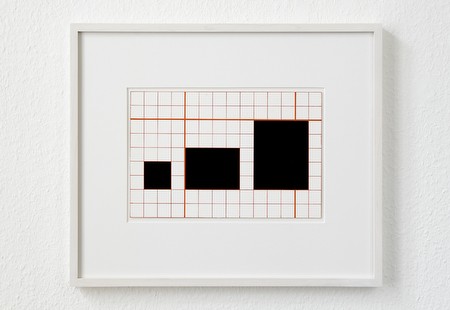
Channa HORWITZ, Language Series, 2003�04
Plaka on cardboard, framed |
|||
|
||||
|
Channa HORWITZ Playing in Time 23 mai – 19 juillet, 2015 Vernissage le 23 mai, 18h – 21h Pendant plus de quarante ans, Channa Horwitz a produit des dessins, peintures et installations ; elle a inventé un vocabulaire formel structuré, construit sur une grille standardisée (celle du papier millimétré) et un procédé de notations allant des chiffres 1 à 8 correspondant chacun à une couleur. Ce système, que l’artiste appelle « Sonakinatography » a été développé afin de marquer et d’exprimer le temps, le mouvement et le rythme. Plusieurs de ses œuvres ont d’ailleurs été initialement imaginées comme des partitions — détaillant des notations pour des danseurs et musiciens. Le processus de création des dessins et la minutie de leur réalisation suggèrent l’enregistrement du temps, du travail et de la pensée même de l’artiste. Les fortes contraintes qui président à l’élaboration des œuvres d’Horwitz ouvrent la porte d’un univers en mouvement aux couleurs foisonnantes. Conçues comme des systèmes autonomes, elles développent de nombreux liens avec l’art conceptuel et performatif des années 1960 et 70 mais encore davantage avec les Oulipiens.[1] Channa Horwitz a travaillé dans un isolement et un anonymat relatif pendant des années. À la fin de sa vie, son travail a été largement reconnu et notamment grâce à son engagement auprès d’une jeune génération d’artistes ayant émergé à une époque définie par les algorithmes et le code. Channa Horwitz (1932–2013, Los Angeles) bénéficie jusqu’au 25 Mai d’une rétrospective au KW, Berlin. Elle a également été invitée avec Guy de Cointet et Henri Chopin à l’occasion de l’exposition en trio « A Void », à la Kunsthalle de Düsseldorf en 2013. Ses œuvres ont été exposées lors de grands événements internationaux tels que la Whitney Biennal (2014), la 55ème biennale de Venise (2013). 1.] « In this regard, her work has much more in common with the work of conceptualists Sol LeWitt, Richard Kostelanetz, and Mel Bochner ; and still more in common with algorithmic language experiments conducted by George Perec, Harry Matthews, and other members of the famed French writing group, Oulipo ». Chris Kraus, A Void, Catalogue Kunsthalle de Düsseldorf en 2013 -- Channa HORWITZ Playing in Time May 23rd – July 19th, 2015 Opening May 23rd, 6pm – 9pm For over four decades, Channa Horwitz produced drawings, paintings and installations, she invented a rigid formal vocabulary, built on a standardized grid (that of graph paper) and a process of notations based on the numbers 1 through 8, each assigned its own color. This system, which the artist termed “Sonakinatography,” was developed by Horwitz as a way of expressing time, movement, and rhythm. Many of her works were originally intended as scores—detailed notations for dancers and musicians. The process of creating the drawings suggests the recording of the artist’s own time, labor, and thought. The strong constraints that govern the development of Horwitz’s works open the door of a moving universe with abundant colors. Conceived as autonomous systems, they develop many links with conceptual art and performances from the 1960s and 70s, but even more with Oulipians.[2] Channa Horwitz worked in relative isolation and obscurity for decades. It was not until the last years of her life that her work was widely recognized—due in part to the way it engages with a younger generation of artists who have emerged in an era defined by algorithms and code. Counting in Eight, Moving by Color, first retrospective of Channa Horwitz (1932-2013, Los Angeles) is on view at KW, Berlin until May 25th. She was also part of the group show « A Void » with Guy de Cointet and Henri Chopin at Kunsthalle, Düsseldorf in 2013. Her works were exhibited in important international exhibitions such as Whitney Biennal (2014), 55th Venice Biennal (2013). 2.] “In this regard, her work has much more in common with the work of conceptualists Sol LeWitt, Richard Kostelanetz, and Mel Bochner; and still more in common with algorithmic language experiments conducted by George Perec, Harry Matthews, and other members of the famed French writing group, Oulipo.” Chris Kraus, A Void, Catalogue Kunsthalle de Düsseldorf en 2013 --- Joseph Grigely and Amy Vogel Inside the Outside (2013) Du 23 mai au 19 juillet 2015 / From May 23rd to July 19th, 2015 Cette œuvre de Joseph Grigely et Amy Vogel se réfère à Air de Paris de Marcel Duchamp. L'ampoule de verre, re-titrée «Inside the Outside», disposée dans la vitrine d'Air de Paris offre une mise en abîme amusée des espaces d'expositions qu'ils soient intérieurs et/ou extérieurs. This work by Joseph Grigely and Amy Vogel refers to Marcel Duchamp’s Air de Paris. Re-titled “Inside the Outside”, it evokes through a glass vessel, the air outside was brought inside, and transfigures by the threshold, the space between. Exhibited in Air de Paris’ window, it offers an amused mise en abyme of exhibition spaces those which are inside and/or outside. |
||||
|
||||
re-title.com
International contemporary art
SIGN UP FOR NEWSLETTERS

 SIGN UP for ARTIST MEMBERSHIP
SIGN UP for GALLERY MEMBERSHIP
SIGN UP for ARTIST MEMBERSHIP
SIGN UP for GALLERY MEMBERSHIP
Click on the map to search the directory