|
Barbara Weiss: Mai-Thu Perret : Bikini - 14 June 2008 to 26 July 2008 Current Exhibition |
||||
|
|
|||
|
||||
|
||||
|
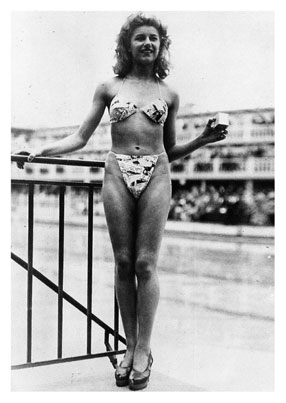
Mai-Thu Perret Bikini June 14 � July 26, 2008 Opening: Friday, Juni 13, 2008, 7�9 pm Gallery hours: Tuesday-Saturday, 11 am�6 pm The oeuvre of Swiss artist Mai-Thu Perret (born in 1976), who works in New York and Geneva, operates within ideological and visual frames of reference pertaining to modernism and its revolutionary potential. From the perspective of the producing recipient � Perret did not formally study fine art, but rather English literature, only later to take part in the Whitney Independent Study Program � the artist is interested in twentieth-century avant-garde movements and their vocabulary, insofar as it stands for emancipation and a belief in progress. Since 1999 Perret has been writing The Crystal Frontier, a fictional report in the form of a journal about a group of young women who have founded an secluded alternative commune somewhere in the desert in New Mexico. In conjunction with writing, Perret also creates sculptures and installations, often as hybrids between art, handicraft, design, and literature, which she identifies as hypothetical products by the protagonists of this fictional community. Perret transfers her own artistic authorship onto imaginary subjects that she herself has created. Following on from Perret�s 2006 exhibition Apocalypse Ballet (2006), in which the artist transformed the exhibition space into an avant-garde stage set with four paper mach� mannequins in frozen dance movements, Galerie Barbara Weiss is now pleased to present a second solo show by Perret entitled Bikini. Perret�s work enjoys international renown, and she recently exhibited in the Kunst Halle Sankt Gallen and in the Bonnefanten Museum in Maastricht. On 1 July 1946, a US American B-29 dropped the first post-war atom bomb onto Bikini Atoll, thus marking the start of extensive testing. Only a few days later the French fashion designer Louis R�ard sent model Micheline Bernardini down the catwalk in Paris, wearing only four small triangles of fabric that were printed with newspaper reports about the dropping of the bomb. Thus Bikini Atoll gave the name to a new fashion in bathing suits. The taboo was broken, and the striking name, which translates as �land of the coconuts,� itself had the effect of a bomb. The very skimpy new bathing suit � �like the bomb the bikini is small and devastating� � was greeted with similar moral outrage to the American atom bomb testing on Bikini. By choosing this loaded and historically significant name for her exhibition title, Mai-Thu Perret refers to precisely these events. She places three varnished sculptures shaped like atomic mushroom clouds in the centre of the gallery, alluding to a well-known and often reproduced 1946 photo. This shows Admiral Blandy, the officer who was responsible for the test, and his wife celebrating the completion of the Operation Crossroads test series with an enormous edible �atomic cake�. By citing precisely this cake, Mai-Thu Perret recalls the inflationary and unscrupulous belief in progress that was current in the USA at the time, an ideology that had no notion of sustainability. The original atomic cake was a remarkably naive object created with simple non-technological means, and an ambivalent and provocative symbol of a narcissistic belief in simple and straightforward progress. Translated into artistic/applied art products, Perret�s atomic cakes go a step further. They appear to be simple, childish handicrafts, a �cake-like� approach to sculpture in a frozen varnished piece of art. The colour textile banners that Perret has hung on the gallery walls are similarly ambivalent. The embroidered brick motiv is dissolved by the softness of the fabric and the folds of the material. In addition, Mai-Thu Perret shows a silkscreen print with the pattern of the first bikini designed by Louis R�ard and original drawings from her Black Noise Book, which is part of a series that she published together with John Armleder and Amy Granat in memory of their deceased friend Steven Parrino. As the artist herself says, the exhibited objects are not directly connected to The Crystal Frontier. But they do have some similarities; they share a fascination for mystical phenomena (in this case the possibility of the total destruction of identity by the atom bomb) and also the creative reduction of symbols to simple techniques and motifs. The question of the significance of the female body is also a key concern of the artist in Bikini. A further aspect that connects the Bikini exhibition with The Crystal Frontier is the fact that later American nuclear tests took place in the North American deserts, in Death Valley or New Mexico. As Perret�s invented women�s commune is also supposed to be located somewhere there, then this represents a certain continuity � of secrecy and isolation. Barbara Buchmaier With kind support by Pro Helvetia, Schweizer Kulturstiftung. Mai-Thu Perret Bikini 14. Juni � 26. Juli 2008 Ausstellungser�ffnung: Feitag, 13. Juni 2008, 19�21 Uhr �ffnungszeiten Di�Sa, 11�18 Uhr Die Werke der in New York und Genf arbeitenden Schweizer K�nstlerin Mai-Thu Perret (geb. 1976) bewegen sich innerhalb ideologischer und visueller Referenzsysteme, die Belange der Moderne und ihr revolution�res Potential umkreisen. Aus der Perspektive der produzierenden Rezipientin � Perret hat nicht Bildende Kunst, sondern Englische Literatur und sp�ter am Whitney Independent Study Program studiert � interessiert sich die K�nstlerin f�r avantgardistische Bewegungen des zwanzigsten Jahrhunderts und ihre Vokabularien, sofern diese Emanzipation und Fortschrittsglauben repr�sentieren. So schreibt Perret seit 1999 an The Crystal Frontier, einem fiktionalen Bericht in Tagebuchform �ber eine Gruppe junger Frauen, die, abgesondert vom Rest der Welt, irgendwo in der W�ste von New Mexico eine alternative Kommune gegr�ndet haben. Ihre parallel zum Schreiben entstehenden Skulpturen und Installationen, oft Hybride zwischen Kunst, Handwerk, Design und Literatur, l�sst Perret als hypothetische Produkte der Protagonistinnen dieser fiktionalen Alternativgemeinschaft erscheinen. Perret �bertr�gt ihre eigene k�nstlerische Autorschaft auf von ihr selbst erschaffene, imagin�re Subjekte. Ankn�pfend an die Ausstellung Apocalypse Ballet (2006), in der Perret den Ausstellungsraum in ein avantgardistisches B�hnenbild mit vier in Tanzbewegungen verharrten Pappmach�-Mannequins verwandelte, freut sich die Galerie Barbara Weiss, unter dem Titel Bikini eine zweite Einzelpr�sentation mit der international erfolgreichen K�nstlerin, die ihre Werke zuletzt in der Kunst Halle Sankt Gallen und im Bonnefanten Museum in Maastricht ausstellte, zu zeigen. Am 1. Juli 1946 warf eine US-amerikanische B-29 �ber dem Bikini-Atoll die erste Atombombe der Nachkriegszeit ab und l�utete damit eine umfassende Testreihe ein. Nur wenige Tage sp�ter schickte der franz�sische Modemacher Louis R�ard das Model Micheline Bernardini, bekleidet mit nur vier kleinen, mit Zeitungsmeldungen �ber diesen Atombombenabwurf bedruckten Stoffdreiecken, �ber den Laufsteg in Paris. Das Bikini-Atoll gab somit den Ausschlag f�r die Namensgebung einer neuen Bademode. Das Tabu war gebrochen, der brisante Name, der �bersetzt �Land der Kokosn�sse� bedeutet, schlug ein wie eine Bombe. Die Wirkung, die dieses knapp geschnittene Badegewand hervorrief - �like the bomb the bikini is small and devastating� - wurde mit einer �hnlichen moralischen Entr�stung betrachtet wie die amerikanischen Atombombenversuche auf Bikini. Mit der Wahl dieses aufgeladenen und zeitgeschichtlich bedeutenden Begriffs als Ausstellungstitel verweist Mai-Thu Perret genau auf diese Ereignisse. Indem sie drei glasierte Skulpturen in der Form von Atompilzen ins Zentrum des Galerieraums stellt, referiert sie auf ein vielfach reproduziertes Foto aus dem Jahr 1946. Dieses zeigt Admiral Blandy, den damals f�r die Atomtest zust�ndigen Offizier und seine Frau, wie sie den Abschluss der Testreihe Operation Crossroads mit einer riesigen essbaren �Atomtorte� zelebrieren. Mit dem Zitat genau dieser Torte ruft Mai-Thu Perret die damals in den USA grassierende, skrupellose und gleichzeitig nicht nachhaltig gedachte Fortschrittsfaszination in Erinnerung. Die originale Atomtorte � schon damals ein unglaublich naives und mit einfachsten Mitteln fern jeglicher Technologie hergestelltes Objekt � war ein ambivalentes und provokatives Symbol eines selbstverliebten Glaubens an Fortschritt ohne Widerspruch. �bersetzt in k�nstlerisch-kunsthandwerkliche Produkte gehen Perrets �Atomic Cakes� noch einen Schritt weiter. Sie erscheinen wie eine kindliche, �kuchen-artige� Ann�herung an Skulptur, in einer erstarrten, glasierten Kunstform. �hnlich ambivalent erscheinen auch Perrets an den Galeriew�nden h�ngende, farbige Textilbanner. Die eingestickte Mauerstruktur wird durch die Weichheit und die Falten des Stoffes aufgel�st. Erg�nzend zeigt Mai-Thu Perret einen Siebdruck mit dem Muster des ersten Bikini sowie Originalzeichnungen aus ihrem Black Noise Book, das Teil einer Publikationsreihe ist, die sie zusammen mit John Armleder und Amy Granat in Erinnerung an den verstorbenen Freund Steven Parrino herausgegeben hat. Wie die K�nstlerin erkl�rt, stehen die ausgestellten Objekte nicht in direkter Verbindung zu The Crystal Frontier. Gleichzeitig tragen sie jedoch �hnliche Z�ge. Sie teilen die Faszination f�r mystische Ph�nomene � hier die M�glichkeit der totalen Ausl�schung von Identit�t durch die Atombombe � und die gestalterische Reduktion von Symbolen in einfache Techniken und Motive. Auch die Frage nach der Bedeutung des weiblichen K�rpers ist in Bikini ein zentrales Anliegen der K�nstlerin. Ein weiterer Aspekt, der die Ausstellung Bikini mit The Crystal Frontier verbindet, ist die Tatsache, dass sp�tere US-Atomtests in den nordamerikanischen W�sten, in Death Valley oder New Mexico stattfanden. Wenn man sich erinnert, dass auch die Perrets Frauenkommune irgendwo dort ihren Standort haben soll, gibt es auch hier Kontinuit�t, n�mlich die von Geheimhaltung und Entlegenheit. Barbara Buchmaier Mit freundlicher Unterst�tzung von Pro Helvetia, Schweizer Kulturstiftung. |
||||
re-title.com
International contemporary art
SIGN UP FOR NEWSLETTERS

 SIGN UP for ARTIST MEMBERSHIP
SIGN UP for GALLERY MEMBERSHIP
SIGN UP for ARTIST MEMBERSHIP
SIGN UP for GALLERY MEMBERSHIP
Click on the map to search the directory