|
Belfast Exposed Photography: WHAT YOU CAN�T SEE - 6 May 2009 to 16 June 2009 Current Exhibition |
||||
|
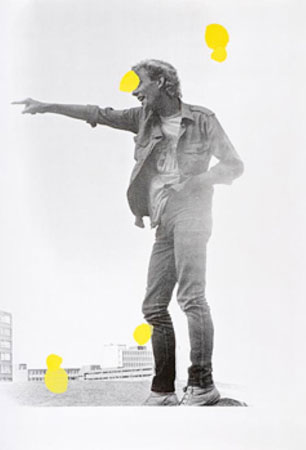
Duncan Campbell, Falls Burns Malone Fiddles, 2003
|
|||
|
||||
|
||||
|
WHAT YOU CAN�T SEE By Duncan Campbell, Ines Schaber, Stefan Pente and Jean-Gabriel P�riot Exhibition Preview - 7 May 7-9pm - Artists talk 6pm Exhibition Run - 6 May - 16 June 2009 This exhibition brings together three enigmatic film works created around photography archives. The artists, turned febrile investigators, draw out the processes whereby solitary photographs and found materials become the fabric of a compelling narration, which unravels before our eyes. The starting point of the exhibition is Fall Burns Malone Fiddles (2003), a film about 1970�s and 80�s youth culture in Belfast by Irish-born Duncan Campbell. The film pieces together photographs of young working class people and depressed neighbourhoods taken in Belfast during the Troubles. Far from being the iconic representations of violence and political unrest that come to mind, these images make place for everyday existence; the hairstyles, fashions and aspirations of the moment. As the film unfolds animated diagrams, geometrical shapes and protest symbols penetrate the images on the screen as an alien body. Duncan's work is constructed from photographs of Belfast Exposed community archive and Community Visual Images and partakes in and comments on the DIY aesthetic that comes with these sources. The soundtrack to the montage is a voice-over in a near-impenetrable Scottish accent by actor Ewen Bremner who monologues about the relationship between photography, reality, the individual and society. Ines Schaber & Stefan Pente�s Unnamed Series (2008) revisits Aby Warburg�s famous lecture on the Pueblo Indian snake ritual. In 1895, during a trip to North America taken when he was almost thirty years old, German historian Aby Warburg spent several months among the Pueblo and Navaho peoples of New Mexico. Though this trip (which profoundly altered his view of art history) took place at the end of the nineteenth century, he did not speak publicly about his experience there until thirty years later, as he was recovering from a mental breakdown at a sanatorium in Switzerland. In his lifetime Warburg made clear that the lecture and accompanying slide show should never be published. This material has however been the subject of a recent book. In the film and installation piece Untitled Series Schaber and Pente interact with the images of the Pueblo Indians taken by Warburg, both physically and symbolically. They speculate on a latent activity within the photographs, knowing that they will not be able to make them disappear but hoping that they can help them become something else. Jean-Gabriel P�riot�s remarkable Nijuman No Borei (200,000 Phantoms) (2007) is an expressionistic documentary on the dropping of the atomic bomb on Hiroshima. The indomitable focal point of the film is the preserved ruin of a building by Czech architect Jan Letzel known today as the Atomic Bomb Dome in Hiroshima - extraordinarily still standing despite being just 150 metres from the epicentre of the bomb. When the World Heritage Commission met in 1996 to accord World Heritage Site status to the ruin America objected, concerned at the nomination�s �lack of historical perspective�. P�riot�s film layers archival photographs of the building from 1914 to the present day, chronologically superimposed on top of each other, pivoting around and anchored by multiple views of the preserved ruin. As images move from black and white into colour, the building�s skeleton becomes the locus of memorialisation as well as a memorial itself. It remains, amidst the optimism of modern architecture, the subject of repeated preservation attempts and, significantly, as an image repeated to the extent that it becomes almost tangible, the very materialisation of historical perspective. Acknowledgements 'What you Can't See' is supported by Arts Council Northern Ireland, Belfast City Council and the Esmee Fairbairn Foundation For more information, please contact Anna Lomax, Communications Manager on 028 9023 0965 or [email protected] |
||||
re-title.com
International contemporary art
SIGN UP FOR NEWSLETTERS

 SIGN UP for ARTIST MEMBERSHIP
SIGN UP for GALLERY MEMBERSHIP
SIGN UP for ARTIST MEMBERSHIP
SIGN UP for GALLERY MEMBERSHIP
Click on the map to search the directory