|
CUE Art Foundation: Michael Minelli | Greg Wilken - 26 Jan 2012 to 10 Mar 2012 Current Exhibition |
||||
|
� Michael Minelli
|
|||
|
||||
|
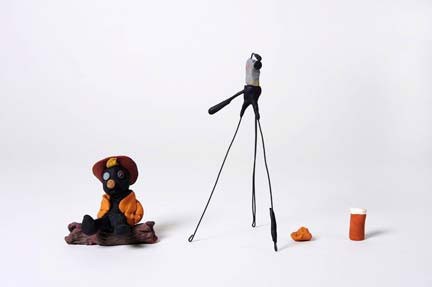
Michael Minelli Curated by Sowon Kwon January 26 – March 10, 2012 (Opening reception Saturday, January 26, 6-8pm) “ Michael Minelli’s work is carefully and singularly made …its modesty in this regard is as purposeful as its engagement with the big, the bang, the speed and polish of our world as mediated by mass culture. His work lays bare the extent to which we are irrevocably made, remade and struck dumb in mass culture’s wake.” —Sowon Kwon Los Angeles-based artist Michael Minelli’s first solo exhibition in New York City—on view at CUE Art Foundation—will include a selection of works from his most recent series, Souvenirs (2007 – 2011). Minelli’s practice, which includes object making, drawing, writing, photography and performance, is as much about engagement with consumerist culture as it is about engagement with material itself. He pushes his materials, from gaffers tape and sequins to plaster and cast urethane, to do unexpected things, sussing out a certain internal, material logic. Using Sculpey brand polymer clay for the Souvenirs series, Minelli investigates the material while drawing upon a rich archive of references—the clay itself reminiscent of childhood crafts and 19 th century folk while the miniature figures depict subjects ranging from Michael Jackson to the victims of Abu Ghraib, from a banana peel and rubber chicken to Kim Phuc (the child horribly burned by napalm and depicted in the Pulitzer-Prize winning photograph taken during the Vietnam War). His work, as curator Sowon Kwon writes, “counters consumerist spectacle and bombast without reproducing it (a neat trick), and without cynicism, sanctimony, or panic.” Minelli’s practice is rooted in an exploration of materiality, both literally—as he seeks to understand something through the process of making it—and culturally, through his use of media-derived imagery. Minute in scale, Minelli’s Souvenirs sit casually in opposition to the medium’s macho history of grand gestures and epic proportions. Small, handworked, and crafted out of an ordinary material, the Souvenirs series demands an intimacy with America’s uncomfortable and recent history of unjust war, torture, and celebrity culture. Each Souvenir , stunningly straightforward in its presentation, carefully oscillates between sinister and playful, funny and dark, irreverent yet startlingly candid—an honest invitation to more closely examine our relationship to, and complicity in, a culture of mass media and consumption. Michael Minelli’s practice is sculpturally based, insofar as he believes meaning is both created and informed by the material relationships we encounter in our daily lives. Minelli’s work includes object making, drawing, writing, photography and performance, all with an eye upon the prickly alliance between popular media discourse and the individual subject. As a member of the artists’ collective REHAB, Minelli’s video and performance work were part of a weekly broadcast on Manhattan Public Access Television from 1987-89. In 1993, Minelli participated in the Whitney Museum’s Independent Study Program and went on to receive his MFA in Sculpture at UCLA in 1999. Minelli has exhibited his work in the United States and Europe since 1987. In 2006, he was commissioned by The Wexner Center for the Arts to create a unique work for the exhibition Shiny . This work was exhibited in the 2010 international exhibition Only Now at the Design Museum of Holon in Israel. Minelli is a founding member of WPA in Los Angeles, a collective exhibition space formed in 2009 in response to the rhetoric and reality of fiscal depression. His exhibition Black Boxes opened at WPA in November 2011. This marks his first solo exhibition in New York City. Greg Wilken Curated by Sharon Lockhart January 26 – March 10, 2012 (Opening reception Saturday, January 26, 6-8pm) Artist's Statement The Road of a Thousand Wonders I first came across "The Road of a Thousand Wonders" researching something else entirely. While looking through newspaper clippings in a local archive, a postcard fell out. The image was of a striking Neo-Baroque building with a tall central clock tower, pointed terracotta arches, abundant windows, and circular turrets. It seemed to call out to you from the 19th century. The dark rusticated blocks of red sandstone were imposing; it looked built to last. It didn't. The first large courthouse in Los Angeles, it was erected in 1888 and razed in 1936. The upper right hand corner of the image read "On the Road of a Thousand Wonders". During the early 20th century, "The Road of a Thousand Wonders" was the promotional name given to the Southern Pacific railroad line running from Los Angeles, California to Portland, Oregon. This particular line, like many others still in use today, was surveyed and first laid out in the 19th century, before the advent of the automobile. These early surveyors relied heavily on old walking trails, following the traces of previous travelers. They found their way through the landscape by following a path of least resistance; drawing a line that utilized natural grades that were not too steep, curves mild enough for the trains of the time, and maximizing level ground. The routes of that time were laid upon, rather than through, the landscape. Automobile roads would later follow the first rail lines. Over time, new roads realigned the old routes. The highways grew wider and straighter, bypassing small communities. We know the old roads today as "business loops" and "scenic byways". "The Road of a Thousand Wonders" follows roughly the original Camino Real upon which Spanish missionaries built a system of religious outposts up the Southern California coast. Portions of highway 101 would later be built to follow this course. Farther north, Interstate 5 pursues the old line. These roads are literal palimpsests, offering traces of man's movement through the land. The history of these early railroad lines contributed to the public's perception of the West. Early 20th century boosterism enticed western migration, which increased railroad ticket sales. The Southern Pacific Railroad Company invested heavily in printing postcards that depicted views along their routes. "The Road of a Thousand Wonders" series is a visual record of a particular kind of looking at a particular time. The traditional landscapes and city views traffic in, while simultaneously helping to establish, the clichés of western imagery. What might traveling that road look like today? Where might it take us? Curator's Statement by Sharon Lockhart At this point, it is a cliché to say that we live in an era of information overload. With all the emails, web-surfing and media each person faces in a day, it is a fact of life. Yet in all that information, there is much that is overlooked. We are more likely to look forward for new forms and content than carefully back at the information stream itself. Greg Wilken's investigations of lost or overlooked archival material involve detailed research and conceptual analysis. He looks for those places in which the information society becomes explicit: in which histories define the landscape, in which the bureaucracy attempts to cover up it's tracks, in which media shape the nature of spectacle. Almost all his projects involve elegant self-published books in addition to photographs and/or films. His work is literary in the sense that it is fascinated with the language of images and archives, and it carefully mines, both looking for ways to pick apart that language and see how it relates to economic, political, and social histories. Greg Wilken in a Los Angeles based artist. He received a BFA with a concentration in photography from Otis College of Art & Design and an MFA from the University of Southern California. Sharon Lockhart is a Los Angeles based artist working in photography and film. Her work has been the subject of solo exhibitions at institutions worldwide, including the Hammer Museum in Los Angeles, Kunsthalle Zürich, Kunstverein Hamburg, the Mildred Lane Kemper Art Musem in St. Louis, and the Vienna Secession. In the fall of 2011, her installation Lunch Break will be on view at MUMOK in Vienna and the San Francisco Museum of Modern Art, and the Espai d'art Contemporani in Castelló, Spain in the winter of 2012. Her latest exhibition, SHARON LOCKHART NOA ESHKOL, will open at the Israel Museum, Jerusalem in December 2011, followed by the Los Angeles County Museum of Art in May 2012 |
||||
|
||||
re-title.com
International contemporary art
SIGN UP FOR NEWSLETTERS

 SIGN UP for ARTIST MEMBERSHIP
SIGN UP for GALLERY MEMBERSHIP
SIGN UP for ARTIST MEMBERSHIP
SIGN UP for GALLERY MEMBERSHIP
Click on the map to search the directory