|
CUE Art Foundation: David Krueger : Curated by Judy Pfaff | Cynthia Miller : Curated by Ron Silliman - 24 Apr 2008 to 31 May 2008 Current Exhibition |
||||
|
David Krueger
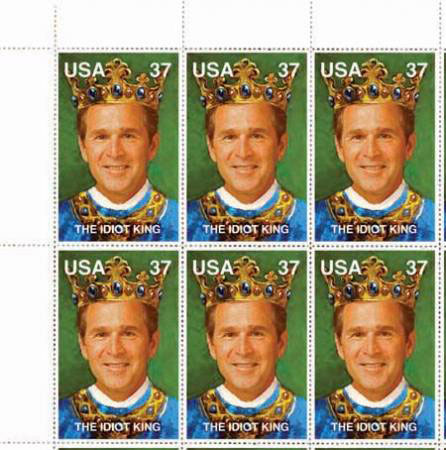
Idiot King [detail], 2001 - Sheet of perforated, laser printed stamps, 8 �� x 11� |
|||
|
||||
|
||||
|
David Krueger Curated by Judy Pfaff As a boy I collected stamps. For several years, we lived two blocks from my maternal grandmother who gave me my first stamps and stamp book before I started elementary school. After we moved away, frequently I would receive lavender scented envelopes in the mail filled with beautiful stamps. In my teens, my paternal grandmother became the Postmaster of Encinal, TX. I loved going to the old wooden clapboard post office on the town square; the feeling it had was incredible. The building was the hub of local communication with people coming to pick up or drop off their mail while sharing the latest gossip. Occasionally I was allowed to help put the mail in the boxes and I would examine the stamps on the envelopes, hoping to see something new or from a far off exotic place. I never lost that attraction. I love the way stamps have the ability to travel around the world, miniature pieces of art, often barely noticed. Today I buy commemorative stamps to use for my postage. Commemorative stamps were conceived as a way of celebrating great individuals, as well as high ideals, values and achievements of society. In my eyes, those values have disappeared, replaced instead by corruption, greed and cruelty. Therefore, it seems to be a natural choice for me to use the form of a stamp as a way to "commemorate" these new qualities and values. My first stamp "commemorating" the 2000 presidential election carried an image of George W.Bush, crowned and decorated, with the words "Idiot King" emblazoned on his chest. Created on the computer, laid out in grids and perforated using a manual machine from 1918, these tiny art works could be pulled apart and given away, a simple means of distribution. This installation recreates the old post office where I spent so much time as a child. To me, it represents the disconnect between the past "ideal" and the loss of trust, privacy and human rights that I see today. Much of the installation is made from cardboard covered with an encaustic paint, infused with a bit of lavender oil to bring back those warm memories of my grandmother and simpler, idyllic times. The post office doors and working vending machines were purchased on eBay. The vending machines sell my stamps. Curator's Statement by Judy Pfaff Arriving in Houston, TX early in 2007, landing at the George Bush Airport, passing Halliburton's headquarters, on my way to Rice University Art Gallery, I remember feeling a certain apprehension. I was not in liberal territory anymore. I think back now at how fortuitous and prophetic it was to meet David Krueger. He was the preparator for The Rice University Art gallery, the kind of person whose job it is to facilitate the construction and success of the installations of the invited artists. I found in him a curious character, humble and intense, and over the two weeks we worked together, he was inordinately helpful to me. The first works that I saw of his were in his office, casually up on the walls, looking like wallpaper. They were postage stamps or more accurately, facsimiles of postage stamps, convincing enough to be government issued. Upon inspection they were not as expected, offering up a scathing critique of the current administration. His political outrage has been, it seems, evolving and increasing for some time. Ironically, he is an extremely gentle man, empathic, soft spoken and generous. He cuts an un-stereotypical image of political radical. There was another more personal aspect to my choice. When I was quite young I lived in Sweetwater, TX with my Air Force husband during the Vietnam War. It was a strange time and I was in an equally strange landscape ? dry, red, harsh to the touch, a landscape unfamiliar to me. David Krueger was born in Odessa, TX. He is indelibly Texan, the likes of whom I did not meet in the 1960's. Some of the violence that was my experience was mirrored in his experience ? violence that he endured in his own life. So forty years later, I get to revisit and find an artist who gives imagery to the lunacy of our policies then and now, full circle. I had been approached by CUE Art Foundation to select an artist for an exhibition. Seemingly an easy decision since I know so many young, incredibly talented, deserving artists from teaching for so many years and from my own life as an artist. It was not easy. If the right time and place means anything, choosing David was, to me, obvious once I understood his specific story and his relative anonymity in the art world. I find his work timely and personal, talking and working out ideas within a structure variable enough to include all that passed in his life and the world at large. His work does make me shudder and it finds its way inside ? funny and angry. This installation of David's has this other ingredient, being a flashback to his small-town post office. I think this show is timely and has poignancy to provoke more thought. Artist's Bio David Krueger was born in Odessa, TX. He received his MFA from the University of Houston, TX in 2003. His solo exhibitions include Nature/Nurture (2005), Commerce Street Art Warehouse, Houston, TX and Parallel Lives (2001), ArtCar Museum, Houston, TX. Group exhibitions include, My God Wants to Kill Your God, Rice University Media Center, Houston, TX; Frontera 450+, Station Museum, Houston, TX; unReal, University of Texas at Dallas, Richardson, TX; Red Fall, Station Museum, Houston, TX; Spacemakers, The Suburban Political Poster Project, Space for Contemporary Art, Munich, Germany; Secret Wars, ArtCar Museum and Great Texas Shootout, Houston Center for Photography, Houston, TX. Krueger is the Preparator for the Rice University Art Gallery, Houston, TX. The exhibition at CUE Art Foundation marks Krueger's first solo show in New York. Curator's Bio Judy Pfaff was born in London, England. She received her MFA from Yale University, New Haven, CT in 1973. Pfaff is currently the Richard B. Fisher Professor of Art at Bard College, Annandale-on-Hudson, NY since 1994 ? present. Her solo exhibitions began in 1974 at Artists Space, New York, NY and continued with the Holly Solomon Gallery, New York, NY from 1979 ? 1990. She has made site-specific work for the Whitney Biennial, Whitney Museum of American Art, New York, NY; USA Representative to the 1998 Bienal de Sao Paulo, Brazil. Her work can be found in the permanent collections of the Museum of Modern Art, New York, NY; Whitney Museum of American Art; Tate Gallery, London, UK; Brooklyn Museum of Art, NY; Detroit Institute of Arts and others. Her work has been commissioned by the Pennsylvania Convention Center, Philadelphia, PA; the GTE Corporation, Irving, TX; Wacoal, Tokyo, Japan and set design for Brooklyn Academy of Music, NY and the opera, Regina, commissioned by the American Symphony Orchestra, Fisher Center, Bard College. Pfaff was the recipient of the MacArthur Fellowship in 2004 and is presently represented by the Ameringer & Yohe Fine Art, New York, NY. Cynthia Miller Curated by Ron Silliman This current work includes mixed-media paintings on paper and on canvas. The combined materials of acrylic paint, chalk pastels with oil paint stick and graphite create an intensity of color layered with pattern and texture. Imagery is derived from direct observation and invention. Inspired by a poetic impulse to examine the language of painting in the immediacy of daily life, the mostly long, horizontal paintings may include two or more unrelated images in a parataxis that points to a new paradigm. Repeating motifs include natural elements of the Southwest desert region: pomegranates, antlers, birds and pinecones from the mountains, as well as simple houses, furniture and household goods. Patterns and objects depicted reference artworks as diverse as William Morris' wallpapers, Guatemalan pottery, Ukrainian folk art, and Native American textiles. Curator's Statement by Ron Silliman Blending so-called high and low genre, the Arts & Crafts Movement anticipated much that we now think of as postmodern. Many of the forms that concerned William Morris, for example, including wallpaper, carpets and floor runners, were not only designed for domestic use, but also engaged visual traditions that deployed imagery as pattern, muting or deflecting the narrative of a "scene." Many other "Other" traditions likewise share exactly these features, from the Cubism of African sculpture to the pottery & tapestries of Central and South America, and of course the American Southwest. Tucson's Cynthia Miller, a painter whose work reproduced on book covers has been a visual signature of Chax Press for 20-plus years, pulls these different elements together with what I think she might call a Southwestern eye, and most definitely a Southwestern imagination. The objects envisioned are simple - quail, a tea kettle, a flower pot - but seldom used simply. Rather, like the blue deer, the red pony or the red and yellow birds, each is cast so as to let in many possible connotations. Two crows represent two crows, yet they completely reframe the spatial relations of the two vases, one white, the other not (or the third vase, half hidden red against orange in the leftmost field). The result is a painting that conveys a sense of anxiety without ever telling why. Yet look at the lush leafwork about the crow on the right, or the transparent foliage about the darker vase. The fields on which these translucent images sit are themselves visually rich, not unlike the flowers surrounding the road behind the blue antlers of Out West. The background tones often proceed from pink or red or red-orange to blue or blue-green. At times I think this figures the seasons, at times the hours in a day, at times I think it is there precisely to resist figuration. Artist's Bio Cynthia Miller was born in Fond du Lac, WI. She has lived primarily in the Southwest Sonoran Desert since moving there as a child with her family in 1963. She studied creative writing, then painting, at the University of Arizona, Tucson, AZ and the San Francisco Art Institute, San Francisco, CA. In addition to thirty years of painting, past works include sculptural installations such as Yaqui Goes to LA at the Scottsdale Center for the Arts, Scottsdale, AZ in the early 1980s; collaborations on dance theatre projects with the Orts Theatre of Dance, Tucson, AZ; and ongoing book arts works with Chax Press. She has been teaching studio art to children and adults in the Tucson area for over twenty years and currently teaches for The Drawing Studio and for The Learning Curve, an independent Arts & Humanities forum. Her recognitions include the Arizona Arts Award and a Painting Fellowship from the Arizona Commission on the Arts. A member of the Tucson Artist Group (TAG) and Tucson Poetry Group (POG), she shares a studio and life with husband and poet Charles Alexander and their two daughters. The exhibition at CUE Art Foundation marks Miller's first solo show in New York. Curator's Bio Ron Silliman is a contemporary American poet. He has written and edited 32 books to date. Between 1997 and 2004, Silliman wrote a single poem, entitled The Alphabet. He has now begun writing a new poem entitled Universe, the first section of which appears to be called Revelator. Silliman sees his poetry as being part of a single poem or lifework, which he calls Ketjak. Ketjak is also the name of the first poem of The Age of Huts. If and when completed, the entire work will consist of The Age of Huts (1974-1980), Tjanting (1979-1981), The Alphabet (1979-2004), and Universe (2005 - present). Ron Silliman's fame and notoriety have grown considerably since 2002, due in large part to his popular and controversial weblog: Silliman's Blog. Debuting on August 29, 2002 to little fanfare and without expectations of an audience, it is now arguably the most influential English-language blog on the web that is devoted to contemporary poetry and poetics. |
||||
re-title.com
International contemporary art
SIGN UP FOR NEWSLETTERS

 SIGN UP for ARTIST MEMBERSHIP
SIGN UP for GALLERY MEMBERSHIP
SIGN UP for ARTIST MEMBERSHIP
SIGN UP for GALLERY MEMBERSHIP
Click on the map to search the directory