|
Cristina Guerra: Matt Mullican - 23 Oct 2009 to 21 Nov 2009 Current Exhibition |
||||
|
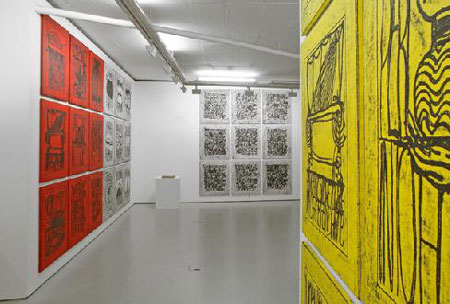
Matt Mullican, Installation View
Cristina Guerra Contemporary Art, 2009 |
|||
|
||||
|
||||
|
MATT MULLICAN Opening 22 October 23 October to 21 November Inside Matt Mullican's Cave "The world is a good term (...) If it's not in my mind, then where is it?" Matt Mullican Strange Prisoners is how Plato defines the men who are in the cave described in Book VII of the Republic. Strange prisoners looking at a strange painting, is often what we feel like when we look at Matt Mullican's work. The setting of this strange painting, the wall of a cave, is the place for the projecting of the images of the world, offering the possibility of entering a virtual world. The cave wall is thus a place where magic happens and the projector-constructor of the images (the artist) is the magician. Back in pre-history the painter who took on the role of the Shaman or witch-doctor of the tribe, in a trance, would put his hands on the painted wall as if on the one hand he attributed authorship (signature) to that image and on the other hand tried to enter it in order to capture within the symbol the animal one wished to hunt in real life. In this way the witch-doctor makes the abstract of the imaginary real, granting it form. The state of trance is not strange to Matt Mullican. He has incorporated it within his modus operand/' since the beginning, through performances in which he subjects himself to the risk of losing consciousness. Or, rather, of abdicating it in order to offer (himself and the spectator) a unique and magic event. In this aspect all art is simultaneously a form of sacrifice and an offering of a gift. The pictures that this artist/shaman creates are archetypes, figures between the general and the particular, which come close to the idea of the object and not the object itself. They are not mere appearances, but are close to an essence, within a conceptual understanding of art. As they are archetypes, they are communicant and can be shared, allowing Matt Mullican to appropriate them and allow the spectator to do the same. This process of appropriation, of choice of the images from the enormous book which is the world, is the way the artist finds to construct a universe very much his own (like Plato with the Republic which becomes the model for an ideal city and society). This world of Matt Mullican's (The Mullican World, which is the title of a poster made by Mullican in the seventies) is made up of an architecture and specific furniture [Untitled (Database), 1994], of maps or charts that owe much to a psycho-geography [Untitled (City Chart: Elements around World Unframed), 1992 and [Untitled (City Chart with Paris Opera House), 1992], of images from the (real or fictional) past [Untitled (Bulletin Board A), 1974-2007], of a cosmology (Cosmology Studies) and also of a writing that accompanies it. It even has an inhabitant, Glen, who although is not here in this exhibition, is always present. It is his alter-ego in a sort of Second Life. When one looks at his works we immediately think of the surrealists, who like Mullican abdicated from a state of consciousness in order to penetrate into a universe that they transposed into fragments and which combined an automatic writing, coming from the subconscious, with images that oscillated between the real and the fictional. Our imaginary works like that, free from the formal constraints that the real attempts to impose on us. So Mullican's true mission seems to be that of subjectivising the world, personifying it and making it real. In a very contemporary strategy of mapping, he makes us realise that the world is not Unitarian and indivisible, but rather made up of fragments that we can re-combine as we wish, giving the greatest importance to details or little touches (Details from an Imaginary Universe or Details from a Fictional Reality - as is the case of the titles of two works from his nineteen seventies series). At the beginning of the XX century the theory of uncertainty in physics, cubism in painting, flanerie in Baudelaire's poetry, and situationist driftings throughout the city (among several examples) show how the fragmented and de-centred subject finally understands that instead of being an a priori fad he is a creating being - creating himself and his surrounding reality. A nomad, a vagabond of the real, who plays with the immense puzzle of infinite combinations. The subject thus becomes an archaeologist who excavates the reality of the images of the world, an archivist who files them according to a personal order, a collector who reinvents them and a curator who exhibits them. Or even, like Dedalus, the architect, who builds the labyrinth and proposes to fly over it. Between the micro and the macro-cosmos. All reading is an individual personification of the text available to us, (perhaps this is why the book is the first virtual world we have). In his cave, Mullican, the strange prisoner like us, builds an architecture of the world and makes a text out of it, appropriating the wonderful shadows that are cast on the wall. Nietzsche states that, unlike what Plato intended, there is no way out of the cave except into another cave, meaning by this that we are always in the world of illusion, as if we had, according to the Orientals, a veil of Maya in front of our eyes. If this were removed we would lose the capacity for fantasy and art would become merely descriptive of the surrounding world. Mullican teaches us, at a moment when art has lost that transcendence that characterised it, that it is possible to rescue its positive bastion in this all-embracing simulacrum illusion in which we find ourselves. As Shakespeare states, "We are such stuff as dreams are made on", and this is the final truth of the world invented by Matt Mullican. We are not prisoners of the cave; we simply do not wish to get out. From Matt Mullican's career one should highlight the exhibition at The Drawing Centre, New York City, the "Matt Mullican Under Hypnosis" performance at theTate Museum, London and his participation at the XXVIII Sao Paulo Biennial and the Kassel Documentas 7, 9 and X. Carla de Utra Mendes Mullican, Matt in AAW, Matt Mullican - Model Architecture, Gemany: Hatje Cantz, 2006, p.19 |
||||
re-title.com
International contemporary art
SIGN UP FOR NEWSLETTERS

 SIGN UP for ARTIST MEMBERSHIP
SIGN UP for GALLERY MEMBERSHIP
SIGN UP for ARTIST MEMBERSHIP
SIGN UP for GALLERY MEMBERSHIP
Click on the map to search the directory