|
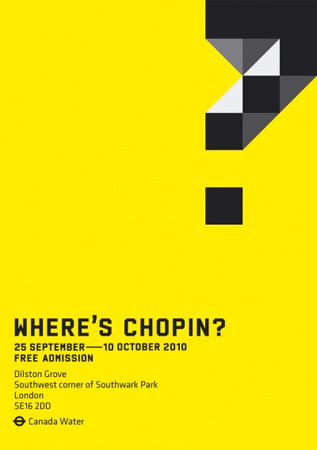
DILSTON GROVE: Where�s Chopin? - 25 Sept 2010 to 10 Oct 2010 Current Exhibition |
||||
|
|
|||
|
||||
|
||||
|
Where�s Chopin? 25 Sep - 10 Oct 2010 Concert-playing installations. Three landmark installations presenting completely new interpretations of Chopin�s music, integrating some of his most popular piano works with high technology to create powerful visual accompaniments, revealing the timeless power and appeal of Chopin�s music well beyond conventional concert-hall recitals. As one of the highlights of a year celebrating Fryderyk Chopin�s music, the Polish Cultural Institute and WRO Art Center present a fresh new take on the most renowned Polish composer, integrating his compositions into three multimedia installations. Organised jointly by the Polish Cultural Institute, the WRO Art Center in Wroc�aw and Stanford University, Where's Chopin? brings together audiovisual artists of three generations - Pawel Janicki, Jaroslaw Kapuscinski and the legendary video-art pioneer J�zef Robakowski � with innovative works that combine Chopin�s music with interactive media installations. The exhibition is curated by Piotr Krajewski. The Where�s Chopin? show will be held simultaneously in Poland and the UK, at the Warsaw Autumn Contemporary Music Festival and at Dilston Grove in Southwark Park in London. The UK opening will feature a performance by Jaroslaw Kapuscinski, the composer of one of the specially commissioned pieces. In the churchlike interior of Dilston Grove, the installations will be experienced sequentially in a 60- minute span. Visitors first enter the interactive environment of Pawel Janicki�s Mapping Chopin. Within the darkened space, white shapes are projected onto the floor by beams of light. As people move across these white shapes, specially designed software combined with a motion-detection system generates variations on digitalized scores of Chopin's pieces, based on the behavior of the audience/participants. Janicki's work utilizes Chopin's Etude in A-flat major (Op. 25 No.1), Valse Brillante in A minor (Op. 34 No. 2), Tarantella in A-flat major (Op. 43) and Nocturne in G minor (Op. 15 No. 3). Various musical parameters of the works � dynamic range, tempo, articulation � are linked with data from the motion-detection system, so that people within the installation space can, through their own activity, �play� the music, generating phrases and longer passages. The data from the motion-detection software are also mapped onto the vertical and horizontal axes of the musical score. This creates a graphic allusion to the physical space as well as to the keyboard projected into it, highlighting the sequencing of the notes in the compositions and the way they're linked to the space and to the movements of the audience/participants. Progressing through the building, visitors next encounter J�zef Robakowski's 2004 work Attention: Light! � a work that startles with its intense use of colour and light in an audiovisual manifestation of synesthesia. Attention: Light! was inspired by a film that the famous American artist and experimenter Paul Sharits made in 1981 in Robakowski's apartment in Lodz under the influence of a potent dose of Chopin's mazurkas. Sharits's tape was lost, but a few years later he sent Robakowski a sketch that served as a production plan when � after Sharits's death � Robakowski made a video version of the lost work in collaboration with Wies�aw Michalak. Robakowski describes the situation that gave rise to the original film, when Sharits, who was then on crutches, came to Poland and was staying at Robakowski's apartment: "Under the influence of a Chopin record that I'd put on full blast, [Sharits] grabbed my camera, hauled himself out on the balcony and started waving the camera around vigorously in time to the blaring mazurkas. That film was never made, because martial law was imposed and the tape was lost somewhere in a state lab where it had been left to be developed. But that performance had made a very powerful impression on us. We were very close at the time. You could say we fell in love because of Chopin and art." The new installation version of this work � Attention: Light! 2.0 is yet another incarnation of Sharits's and Robakowski's idea, created by Pawel Janicki. He has created digital algorithmic sound-generated images that are broken down into pure colors. Each note played by a Disklavier controls the multi-screen video projection, in which specific colours are assigned to particular piano sounds. Using the vast array of moods discovered in Chopin�s 58 Mazurkas, Robakowski creates an absorbing, exhilarating visual experience of some of piano�s finest literature. The installation on which the exhibition based its name is Jaroslaw Kapuscinski�s Where Is Chopin? [Gdzie jest Chopin?], an audiovisual composition for Disklavier & multichannel projection. The starting point is an original composition that Kapuscinski based on Chopin's 24 Preludes (Op. 28). A programmed MIDI-capable piano plays the pieces, and the notes activate a multichannel video projection showing the faces of rapt listeners. The images are the artist's search for traces of Chopin's music on the faces of people listening to it. To carry out this project, Kapuscinski performed a series of concerts in selected cities in countries where Chopin is hugely popular but where he personally never set foot (Tokyo, San Francisco, Wellington, Sydney, Seoul, Beijing, Istanbul, Jerusalem, Helsinki, Buenos Aires, Santiago and Mexico City). During these concerts camera operators and photographers working with Kapuscinski documented the emotional reactions of the listeners to Chopin's Preludes. The three installations were commissioned jointly by the WRO Art Center, the Warsaw Autumn Contemporary Music Festival and Stanford University for the 2010 Chopin Anniversary Year, and were co-funded by the Polish Ministry of Culture and National Heritage and the Polish Cultural Institute in London. For the UK opening of Where's Chopin? and at a private viewing of the exhibition on 24th September (by invitation only), Kapuscinski will perform his original composition based on Chopin's Preludes, controlling the real-time multichannel projection. ARTIST�S BIOGRAPHIES Pawel Janicki (born in 1974) creates interactive audiovisual systems, installations and performances, focussing mainly on microsound and algorithmic compostion. Janicki, who majored in cultural studies at Wroclaw University, works with the WRO Art Center as a curator and head of R&D;, and teaches in the Intermedia Department of the Pozna� Academy of Fine Arts. In 2004 his internet musical performance Ping Melody was awarded the netarts.org grand prize by the Machida City Museum of Graphic Arts in Tokyo, and was nominated for an award at the Viper International Film, Video and New Media Festival in Basel. Janicki is a co-founder and longtime member of the Gameboyzz Orchestra Project, a collective exploring "lo-fi" esthetics, using computer gaming consoles to create audiovisual compositions that have been presented at the WRO Media Art Biennale (Wroclaw), the Transmediale festival (Berlin), Ars Electronica (Linz) and the Centre Georges Pompidou (Paris). Janicki is also one of the artists whose works are featured in WRO's Interactive Playground. He is currently working on an installation entitled Oceanus (under the auspices of the EU Moving Stories project) and an internet-based projection for the fa�ade of one of the European Union Parliament buildings in Brussels. J�zef Robakowski (born in 1939) is an artist, art historian, teacher and one of the foremost figures in contemporary Polish art, renowned as a filmmaker and creator of video works, photographic series, drawings, installations, objects, conceptual projects and art events. Robakowski studied art history and museum studies at the Fine Arts Department of Copernicus University in Toru�, and cinematography at the L�d� Film School. Since 1959 he has regularly participated in major international art events, such as Documenta 6 (Kassel 1977), Film as Film (London 1979), the Sydney Biennale (1982), the WRO Biennale (Wroclaw, regularly since 1989) and Internationale Kurzfilmtage Oberhausen (2005). He has taken part in major exhibitions in Poland and around the world, at MoMA (New York), De Appel (Amsterdam), the Filmmuseum Wien (Vienna) and the Centre Georges Pompidou (Paris). In his experimental film and video work Robakowski has collaborated with many musicians and composers, including Eugeniusz Rudnik, Leszek Knaflewski and Barbara Konopka. Jaroslaw Kapuscinski (born in 1964) is an intermedial composer and pianist who has been composing and performing audiovisual works since the early 1990s. He graduated from the Music Academy in Warsaw and the University of California at San Diego. Kapuscinski's first audiovisual composition, Variations Mondrian, was produced jointly by the Institut National de l'Audiovisuel in Paris and the Polish Radio's Experimental Studio in Warsaw in 1992. Kapuscinskii has participated in major international new-media festivals, including the Festival of Video Art in Locarno, Manifestation Video et Art Electronique in Montr�al, and the WRO Biennale in Wroc�aw as well as in music festivals. His pieces have been presented at MoMA (New York), the ZKM Karlsruhe, the Palais de Tokyo (Paris) the Reina Sof�a Museum (Madrid) and numerous other prestigious art institutions. Kapuscinski has been awarded several prizes including a grant from Witold Lutoslawski and a scholarship to attend the Darmstadt Summer Courses for New Music. He has given lectures at McGill University in Montreal, the Royal Academy of Arts and Music in The Hague and elsewhere, and since 2008 has been an assistant professor in the Stanford University Department of Music, where he is director of Intermedia Performance Lab (IPL). Dilston Grove Southwark Park London SE16 2DD Tel: +44 (0)20 7237 1230 E: [email protected] cafegalleryprojects.org |
||||
re-title.com
International contemporary art
SIGN UP FOR NEWSLETTERS

 SIGN UP for ARTIST MEMBERSHIP
SIGN UP for GALLERY MEMBERSHIP
SIGN UP for ARTIST MEMBERSHIP
SIGN UP for GALLERY MEMBERSHIP
Click on the map to search the directory