|
David Kordansky Gallery: Richard Jackson - The Little Girl's Room Gallery 2: Markus Amm - 10 Sept 2011 to 20 Oct 2011 Current Exhibition |
||||
|
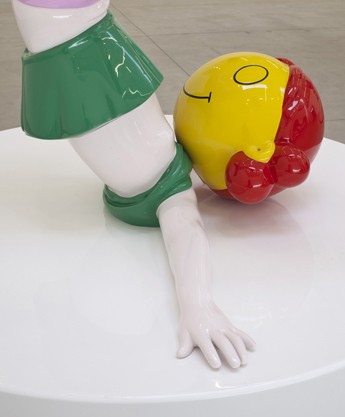
Richard Jackson, Upside Down Girl with Unicorn Head, 2011 (detail)
painted fiberglass 86 x 72 x 72 inches (218.4 x 182.9 x 182.9 cm) |
|||
|
||||
|
||||
|
Richard Jackson The Little Girl's Room September 10 – October 20, 2011 Opening: Saturday, September 10, 6 – 9pm David Kordansky Gallery is very pleased to announce The Little Girl's Room, an exhibition of new work by Richard Jackson. His first solo gallery exhibition in Los Angeles in 20 years, the show is a significant milestone for an artist whose work has continually expanded and redefined the physical and conceptual reach of painting since the 1970s. A painting in the largest possible sense of the word, and the latest in Jackson's series of major room-based works, The Little Girl's Room consists of an immersive environment designed to resemble the room of a child. Viewers will encounter a paint-covered installation that exceeds the constraints of purely visual experience; it is also the record of a performative action that unites careful engineering with unmediated experimentation and risk. The work's centerpiece is a monumentally-scaled sculpture of a unicorn balanced on its horn, embraced by a life-size sculpture of a strangely doll-like little girl, that spins atop a motorized platform. Like many of the objects that Jackson has developed over the course of his career, the piece will be activated at the time of its installation in the gallery space. As it spins, paint will be pumped through the horse's genitals and spray and drip across the other elements of the installation. These include the large-scale canvases that depict fluffy clouds and geometric forms borrowed from Frank Stella, as well as an array of other objects that feel at once familiar and disturbingly out of place in the context of a child's room. The sculptural figures that serve as both sources and supports for paint represent extremes of physicality in which the infantile and the archaic resemble each other. A larger-than-life Jack-in-the-box will be draped over one of the gallery's trusses, and when activated will emit paint downward from the pointy tip of its hat; a hobby horse, its head lodged in a bucket of paint, will rock back and forth, dumping the bucket's contents onto the floor around it; a sculpture of a baby will sit with a collection of baby bottles, filled and overfilled with paint; and, half-hidden in a closet, a comically aroused clown will communicate an aura of unsuccessfully repressed sexuality. Though Jackson's work seems to take aim at the heroic tropes that defined painting by the middle of the last century, it is neither pure critique nor pure homage. Rather, it maximalizes the potential of the individual artist in an age when the physical dimension of art making is often supplanted by an array of proxies. Throughout The Little Girl's Room, paint acts as a vital fluid, one that unites the work's concept with its tangible reality, and that maximizes its pictorial capability by giving rise to three-dimensional objects through which it is pumped and poured. As such, Jackson crosses many of the dominant––and sometimes diverging––modes of modernist and contemporary artistic practice like live wires. By bringing the seemingly competing legacies of Duchamp and the Abstract Expressionists into productive (if uneasy) relation, Jackson imagines and creates ever larger and more embodied situations for painting. In his work, the power of individual human activity is not merely depicted or described in metaphorical terms, but enacted in the flesh. In recent years Richard Jackson has been the subject of solo exhibitions at the Rennie Collection, Vancouver; Kunststiftung Erich Hauser, Rottweil, Germany; Hauser & Wirth, Zürich; and Hamburger Bahnhof – Museum für Gegenwart, Berlin. Recent group exhibitions include The Artist's Museum, Museum of Contemporary Art, Los Angeles; Promenades, Magasin – Centre national d'art contemporain de Grenoble; Bodycheck, 10. Triennale Kleinplastik, Fellbach, Germany; and Los Angeles – Paris, Centre Georges Pompidou, Paris, France. Later this year his work will on view in American Exuberance, Rubell Family Collection, Miami. In 2013 Jackson will be the subject of a major retrospective organized by the Orange County Museum of Art, Newport Beach, California and traveling to other institutions in the United States and abroad. This exhibition is part of Pacific Standard Time: Art in L.A. 1945–1980, a Getty initiative that brings together more than sixty cultural institutions from across Southern California to examine the history of contemporary art in Los Angeles. Markus Amm September 24 – November 12, 2011 Opening: Saturday, September 24, 6 – 9pm David Kordansky Gallery is pleased to announce an exhibition of new work by Markus Amm. This will be the inaugural exhibition at Gallery 2, located at 5896 Smiley Drive in Culver City. The exhibition will include paintings on a variety of supports, including gesso board, canvas, and paper. Markus Amm utilizes the constituent elements of painting as the foundations for works that reassess the legacy of geometric abstraction. He assigns content-based value to what might be mistaken as purely formal practice, and shows how even the most basic, platonic shapes can be mined for connections to a complex contemporary world. In some cases, this means revisiting preconceived ideas about the relationship between image, material and support; in others, the work shows how the conceptual envelopes in which painting is seen readily influence its composition. Amm posits abstraction as a series of intersecting tendencies rather than the result of a linear development. Even the geometry and color choices associated with the white cube, after all, are formal parameters that can be honored or disregarded according to aesthetic preferences and intention. In new medium- and large-scale gesso board works, Amm continues his recent use of monochromatic fields of vibrant color. He uses both additive and subtractive techniques, laying down coats of oil paint and sanding them away. Surprisingly, the forms and marks that hover in the foreground of these fields are often created by removing subsequent layers of paint; the sense of the work as the result of a temporal process is reversed in spatial terms. Amm also plays both with and against rectangularity by giving the color fields soft edges that do not extend to the edge of the canvas, thereby creating the illusion of shadow compositions just beyond what is visible. Particularly in the large gesso board paintings, the work has an immersive quality that is both optical and phenomenological, indicative of the conceptual eye and the physical body as interlocking functions that define our experience of space. This kind of playfulness can be found throughout the works on view, and is itself an inversion of commonplace approaches to the austerity often associated with Amm's brand of abstraction. Painterly issues (like the tension between foreground and background, for instance) take on new metaphorical valences, as they can be read not only within each delimited picture plane, but more widely as a critique of the way in which the picture plane is perceived as an idea. As such, Amm approaches the language of abstraction as an attitude, one whose far-reaching cultural influence appears in a broad array of registers: the aestheticization of the urban environment; the symbolic potential of geometry as recognized in street signs, flags, and logos; and the role of surface textures and materiality as indicators of handmade versus industrial modes of production. The canvas works, in which fields of white gesso are divided by sharp lines made with colored acrylic gesso, introduce a sly narrative element to the exhibition. Amm uses the lines (and brief moments of color) to divide compositions into interlocking forms, provoking readings in which forms fit into, surround, complete, or sit on top of each other. Further, their material makeup has its own push-and-pull immediacy: gesso, usually used as the ground onto which other media are applied, moves to the foreground and is entrusted with the role of creating the picture. Even materials, therefore, seem to take on characterological attributes, emphasizing that there is no such thing as purely abstract painting. In 2010 Markus Amm was the subject of a solo exhibition at the Kunstmuseum Stuttgart, Germany. His work will be or has been featured in numerous group exhibitions, including an upcoming show at Märkisches Museum Witten, Germany (curated by Oliver Zybock); konkret.analytisch.radikal.oder so, Overbeck-Gesellschaft, Lübeck, Germany; A Twilight Art, Harris Lieberman, New York; The Language of Vision, Middlesbrough Institute of Modern Art, Middlesbrough, England; Neuer Konstruktivismus, Bielefelder Kunstverein, Museum Waldhof, Bielefeld, Germany; Stuff: International Contemporary Art from the Collection of Burt Aaron, Museum of Contemporary Art Detroit; Very Abstract and Hyper Figurative, Thomas Dane Gallery, London (curated by Jens Hoffmann); Dereconstruction, Gladstone Gallery, New York (curated by Matthew Higgs); and Formalismus, Kunstverein Hamburg, Germany. David Kordansky Gallery 3143 S. La Cienega Blvd, Unit A Los Angeles, CA. 90016 T 310.558.3030 F 310.558.3060 www.davidkordanskygallery.com [email protected] |
||||
re-title.com
International contemporary art
SIGN UP FOR NEWSLETTERS

 SIGN UP for ARTIST MEMBERSHIP
SIGN UP for GALLERY MEMBERSHIP
SIGN UP for ARTIST MEMBERSHIP
SIGN UP for GALLERY MEMBERSHIP
Click on the map to search the directory