|
David Kordansky Gallery: Elad Lassry | Jonas Wood - 23 Mar 2012 to 26 May 2012 Current Exhibition |
||||
|
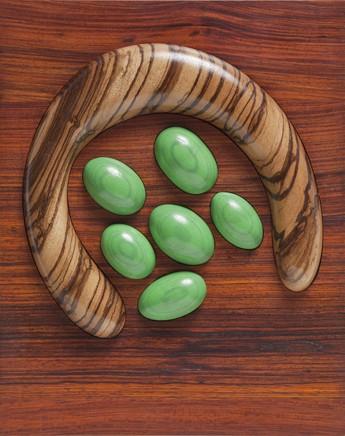
Elad Lassry, Untitled (Rosewood Picture), 2012
rosewood, zebrawood, varnish, paint 14.5 x 11.5 x 2 inches, (36.8 x 29.2 x 5.1 cm) |
|||
|
||||
|
Elad Lassry March 23 –– May 26, 2012 Opening reception: Friday, March 23, 6:00–9:00pm David Kordansky Gallery is very pleased to announce its second exhibition of new work by Elad Lassry. The show will be held at Gallery 2. It will reflect an expansive sense of the picture as an ontological category, one in which a viewer's customary associations with familiar forms are exposed to physical and perceptual paradoxes. Lassry has increasingly looked to diverse media––including drawing, sculpture, and performance––to test current possibilities for engagement with pictures. In each case, the ability to recognize a given subject presents itself as a faculty on the verge of failure, a dissonant constellation of formal characteristics and competing cultural histories. By incorporating objects and immersive situations into his practice, Lassry blurs the boundary between the tangible and cognitive experiences of a picture. As such, his work is indicative of the way in which the virtual defines contemporary culture, not merely on a technological level, but as an embodied mode of perception. Nowhere is this more apparent than in the way Lassry has transformed the gallery space into a tool to activate specific cognitive patterns. A long, thin aperture in an otherwise obstructing wall provides a view into a partially enclosed space. Inside, a second wall has been built to half-height, its upper edge shaped into a series of wave-like forms that support painted wood objects. Seen in conjunction with the row of pictures that hangs behind it, this wall-sculpture suggests that the space of the picture is neither wholly flat nor wholly dimensional, but a fluctuating quantity that collapses and expands depending on movement and context. In Lassry's work, picture and object alternate as framing devices for one another. Framing is revealed as an integral––and sometimes dominant––facet of any composition. For example, a sculpture that resembles a small bed has been constructed from wood reminiscent of the frames that often distinguish the artist's photographs. Adorned with four crosses, it simultaneously tempts and denies a host of readings: the functional and symbolic possibilities of the artwork are communicated precisely when and where they disrupt one another. Similar issues are raised by a group of charcoal drawings on view. Here, Lassry alludes to the photographic precisely by undermining its status as the go-to medium for the making of pictures. In these depictions of ornamental and ephemeral objects, the cultural mediation of the photograph confronts the immediacy of the hand. As a result, it becomes impossible to fix agency to the images, and a supposedly 'trustworthy' medium like drawing is subjected to the doubt usually reserved for techniques like digital manipulation. Analog images are shown to be haunted by pixels. Mediation is explored perhaps most radically in Untitled (Presence 2005), a performance work featuring members of the New York City Ballet that has taken place at an off-site theater before the opening of the exhibition. While dance and questions associated with the notation of choreography have previously served as subjects for the artist's films, this work directly challenges the role of documentation in conceptual practices. Rather than asking one picture to stand in for another, Lassry insists that the performance function by virtue of its absence. He anchors tangible artworks in an elusive experience to which direct access can no longer be granted, and reveals how even physical spaces are permeated by the virtual. Elad Lassry's work was recently featured in ILLUMInations, the International Pavilion at the 54th Venice Biennale, and this year will be the subject of solo exhibitions at Kunstnernes Hus, Oslo, Norway; Rat Hole Gallery, Tokyo, Japan; Fondazione Galleria Civica, Trento, Italy; and The Kitchen, New York. Solo exhibitions have also been held at The Whitney Museum of American Art, New York; Kunsthalle Zurich, Switzerland; the Contemporary Art Museum, St. Louis; and Tramway, Glasgow. Recent group exhibitions include Beyond. International Curator Exhibition of Tallinn Month of Photography, KUMU Art Museum, Tallinn, Estonia; The Anxiety of Photography, Aspen Art Museum; Secret Societies. To Know, To Dare, To Will, To Keep Silence, Schirn Kunsthalle Frankfurt and CAPC de Bordeaux; Time Again, SculptureCenter, New York; Les Recontres d'Arles 2010 / Edition 41, Arles; and New Photography 2010, Museum of Modern Art, New York. Jonas Wood March 31 – May 12, 2012 Opening reception: Saturday, March 31, 6:00–9:00pm David Kordansky Gallery is proud to announce its first exhibition of new work by Jonas Wood. The show will open on March 31, 2012, and run through May 12. An opening reception will be held on Saturday, March 31 from 6:00 to 9:00pm. Making use of sources that are often intimately connected to his own life, Wood nonetheless exemplifies a wide-ranging and expansive view of representational painting and drawing. His practice consists of both analytical and intuitive approaches to composition: domestic and studio interiors, portraits, and imaginary still lifes are rendered according to a keenly felt sense of color and line, and numerous perspectival viewpoints are often combined to form a scene Wood often begins by collaging photographs he has taken, creating composite scenes that defy the limitations of a single eye or camera. Drawings made from these collages become both studies for paintings and standalone works, while paintings often appear again in later paintings that depict the architecture in which they have been hung. This layered methodology allows him to create the foundation for a practice that is pieced together from a wealth of visual information, as well as from a series of discrete moments in time. The work therefore takes shape as a visual analogue to the multiple, unpredictable, and constantly evolving ways in which memory reconstructs the past. Accordingly, Wood frequently portrays his subjects by way of pre-existing representations like baseball cards, posters, and images from television broadcasts. Though contemporary life is at the center of Wood's work, it is useful to locate the historical lineages that contextualize it among competing brands of figuration. Concentration on domestic interiors and everyday life, combined with acute attention toward patterning and color, invariably recall French Post-Impressionist painting and its modernist evolution in the work of Matisse. However, there is also an American brand of modernist painting, one that synthesizes cubism with the cultural landscape specific to this country, that comes to mind when considering Wood's approach to composition. In particular, the artists loosely associated with the Precisionist label can be read as key forbears. Echoes of this tradition, as it is expressed in works by artists like Stuart Davis, Charles Demuth, and Gerald Murphy, can be found in Wood's heightened sense of geometry. On the other hand, Wood also seems to manifest the visual spirit, if not the political didacticism, of paintings and murals made by social realist artists in the period between the two World Wars; it is instructive, for instance, to think about Alice Neel's early affiliations with this movement, as well as her later works, when considering Wood's psychologically-charged portraits. For Wood, the history of art, like the action of memory, is always an ongoing process rooted in daily life, one that tells the viewer as much about the present as it does about the past. His paintings and drawings emphasize the immediate pleasures of light, color, and draftsmanship as they exist on their canvas or paper supports as material facts. In essence, these are figurative works that take form as abstractions, and vice versa. Perhaps surprisingly for an artist who makes extensive use of autobiographical imagery, Wood achieves emotional impact by relying solely on the viewer's eye, and by transforming nostalgia into a network of purely visual relationships. In 2010, Jonas Wood was the subject of a solo project at the Hammer Museum, Los Angeles. His work has also recently been included in Mixed Signals: Artists Consider Masculinity in Sports, Wexner Center for the Arts, Columbus, OH. Interiors, a new catalogue documenting examples of the artist's work from the past five years and featuring an essay by Michael Ned Holte, will be released at the time of the exhibition and will be available for sale at the gallery. Wood lives and works in Los Angeles. |
||||
|
||||
re-title.com
International contemporary art
SIGN UP FOR NEWSLETTERS

 SIGN UP for ARTIST MEMBERSHIP
SIGN UP for GALLERY MEMBERSHIP
SIGN UP for ARTIST MEMBERSHIP
SIGN UP for GALLERY MEMBERSHIP
Click on the map to search the directory