|
David Kordansky Gallery: Thomas Lawson - In the Shadow of the Beast Rashid Johnson - Coup d��tat - 8 Sept 2012 to 10 Nov 2012 Current Exhibition |
||||
|
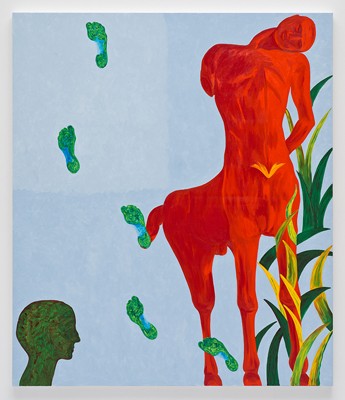
Thomas Lawson, Walking On Water, 2012
oil on canvas, 84 x 72 inches (213.4 x 182.9 cm) |
|||
|
||||
|
Thomas Lawson In the Shadow of the Beast September 8 – October 20, 2012 Opening reception: Saturday, September 8, 6:00–9:00pm David Kordansky Gallery is very pleased to announce In the Shadow of the Beast, an exhibition of new paintings by Thomas Lawson. Consisting of medium- and large- scale canvases, the show presents the latest developments in Lawson's on-going investigation of allegory and the human figure. The exhibition will open on September 8 and run through October 20, 2012. An opening reception will be held on Saturday, September 8 from 6:00 until 9:00pm. For over thirty years, Lawson has explored the ways in which figurative representation allows for––and sometimes disrupts––the transmission of meaning. He has shown how images of the human form in art invariably take on a host of allegorical possibilities: the immediate, phenomenological pose of the viewer's own body before the artwork; the manipulated presence of the human figure in contemporary media outside of the visual arts; and the long, historically-oriented 'literature' of representations that has, over the centuries, become the foundation for understanding how subjects relate to their physical, social, and philosophical environments. The references in Lawson's work are drawn from the entire history of visual culture. In the Shadow of the Beast presents new paintings that borrow tropes and forms from pre-historic cave art, classical statuary, nineteenth century figure studies, forgotten modernist sculpture, and contemporary newspapers. Over intensely colored grounds, Lawson combines, collages, and rearranges these forms, rendering them in an array of different brush marks and viscosities. At times they stand out from the grounds in stark relief, as in a painting entitled Voluptuous Panic, in which a startling image of a werewolf's head has been brushed onto a flat, pink field. On other occasions, figure and ground are blurred, as geometric patterning in the form of discs, drops, lozenges or stripes spreads across them both. In these cases, the entire surface of the work becomes a single, variously articulated plane, as if the reductive endgame of abstraction in painting had given birth to a hybridized, and at times grotesque, new form. As the distinction between the figurative and the abstract reveals itself to be a difference of degrees, the work calls into question any preconceived notions about the evolution of painting from one approach to another. Rather, the tension between these modes is shown as a defining feature of the medium. Lawson balances research and careful composition with an experimentalist's approach to the making of his work, so that the always-uncertain translation from idea to material is allowed to produce surprising results. This can be seen in paintings whose elements interfere with the spatial universe in which other elements reside. In Walking on Water, for instance, ghostly feet traced from the artist's own footprints track across a blue field otherwise occupied by a centaur and a portrait bust; the ground becomes both a pictorial space and a ground for performative action. Here painting, even absent of image, is shown to be an essentially figurative activity––an instructive tool for decoding the degrees to which media are by turns disembodied or aggressively physical. Because they conflate such a wide array of representational approaches and sources, Lawson's paintings reflect the broadest––and appropriately paradoxical––array of psychological responses to a complex world. On view are human figures who morph into animal shapes, or pose in comically contorted positions, making it impossible to determine whether their anguish is pure theatre or a fitting response to external stimuli. When juxtaposed against other figures drawn from historical contexts, these characters enter into an allegorical play that seems to account for all the ambivalences associated with contemporary culture, as well as the ever-persistent drive to represent it. Thomas Lawson has been featured in numerous exhibitions over the last three decades. Surveys devoted to his work have been held at the San Diego Museum of Contemporary Art at La Jolla, the CCA in Glasgow and the Battersea Arts Centre in London. Other solo exhibitions include shows at Participant, Inc., New York; LAXART, Los Angeles; Metro Pictures, New York; and Anthony Reynolds Gallery, London. Lawson was featured in The Pictures Generation: 1974-1984, a major 2009 survey exhibition at the Metropolitan Museum of Art, New York. His work is currently on view, through September 2, in Made in L.A. 2012, the first Los Angeles biennial, Hammer Museum, Los Angeles. In addition to this rich exhibition history, Lawson has authored or edited many essays, anthologies, and periodicals, including, with Susan Morgan, the seminal REALLIFE Magazine. Mining for Gold, an anthology of Lawson's writing, was published by JRP|Ringier in 2005. Lawson is the Dean of the School of Art at the California Institute for the Arts, and editor-in-chief of East of Borneo. Rashid Johnson Coup d’état September 22 – November 10, 2012 Opening reception: Saturday, September 22, 6:00–9:00pm David Kordansky Gallery is very pleased to announce Coup d'état, an exhibition of new work by Rashid Johnson. This is the artist's second solo exhibition at the gallery. It will open on September 22 and run through November 10. An opening reception will be held on Saturday, September 22, from 6:00pm until 9:00pm. Rashid Johnson has become known for his ability to engage both the physical and cultural ramifications of his chosen materials. Beginning with early work in conceptual photography, and an abiding interest in the African American intellectual elite, he has gradually broadened the scope of his practice, creating reliquary-like objects, installations, and wall-based works that increasingly take on established legacies of painting. With Coup d'état, Johnson examines the neuroses of power that accompany established regimes of all kinds. In art, as in governmental structures, the concentration of power allows for stability on the one hand and the potential for overthrow on the other. The ways in which these themes are resonant throughout many interdependent spheres––from the personal to the patently political––find formal parallels in the mutable threshold between painting and sculpture, and in the variety of marks that animate Johnson's work. The exhibition will feature a group of major new works in a variety of materials, in which wood, mirrored tile and wax are used as grounds for a series of mark-making strategies; as well as a series of floor-based works that use rugs as supports for further gestures. Among these are several works that represent new typologies for the artist. For the first time, Johnson has used black mirrored tile as the basis for large-scale, wall-based works that complicate the notions of domesticity, minimalism, and geometry that previous works first set out. If earlier mirrored tile pieces pressed their reflected environments into overt dialogue with the marks (scratching, poured wax and soap) Johnson applied to them, these depict their surroundings as zones of blackness. Any scratched or poured wax marks, therefore, become inscriptions in a black painterly field that is also a reflection. The work becomes a double-articulated instance of optical revolt: black mirror disrupts clear reflection, while the marks disrupt reflection altogether as they establish the work's own independent vocabulary. Another new typology involves the use of wood that has been scorched to an intense, aggressive black. Whereas other wall-based wood works used branding as a mark-making tool, here fire has transformed the entirety of the ground itself, turning it into a field of charcoal-like mutability. Johnson renders the difference between additive and subtractive procedures moot; instead, the ground itself is altered. Here, as in the large-scale, wax-based 'Cosmic Slop' work on view in the exhibition, the mark legislates the transformation of the ground into a network of more- or less-visible gestures. Strict divisions between mark and ground are now impossible to make. Further complicating this relationship, the scorched wood work will include shelves that support found objects. Included among these objects are a record by the Art Ensemble of Chicago (displayed so that its back faces forward), and a copy of Coup d'état: A Practical Handbook, a book by the military strategist Edward Lutt. While the book lends its title to the exhibition, its evocation of a step-by-step revolution also sheds light on Johnson's interest in broaching themes of political identity through the hands-on arrangement of materials. References to political overthrow therefore become metaphorical windows through which to view the upheaval inherent in the studio process; in order to progress, old approaches are jettisoned (sometimes violently) and the chaos of new procedures are allowed to take root. While past exhibitions work were inspired by the ways in which elite African Americans have created more or less covert (and perhaps even fictional) organizations to wield influence, in Coup d'état Johnson shifts his focus to a broader––and more abstract––investigation of power and instability. Suddenly it becomes possible to imagine the wall-based works as trophies in the tenuous palace of a recently victorious African dictator, subject at any moment to deposition. The floor-based works, meanwhile––which use Persian and zebra-skin rugs as grounds for branded marks, and the arrangement of objects––lend the exhibition an aura of menacing luxury. (They also remind the viewer that Johnson has long combined critique and humor as driving modes in his practice.) In effect, they are paintings that have been pushed into relationship with the floor, forced into an accord with sculpture. In this sense they occupy the uneasy ground marked out by Carl Andre and other minimalists who sought to rewire the perceptual experience of objects in space, though they do so by using objects with which the viewer is imminently familiar. For at least the last century, aesthetic advances, especially in painting, are predicated upon rupture. Throughout Coup d'état, Johnson uses the terms of painting as a foil. As a result, philosophical and political endgames, like the futile attempt to define 'blackness', for instance, find a formal analogue in the endgame narrative that has come to define painting. Cultural advances of all kinds involve coups d'état; progress, however ambiguous a term it might be, is always dependent on destruction and erasure. For Johnson, personal advances occupy similar territory, and require a quasi-pathological insistence on pushing forward despite the looming specter of destruction. Rashid Johnson's work is currently the subject of a mid-career survey entitled Rashid Johnson: A Message to Our Folks, organized by the Museum of Contemporary Art, Chicago. In 2012-2013, it will travel to the Miami Art Museum; the High Museum of Art, Atlanta; and the Mildred Lane Kemper Art Museum, St. Louis. Also on view beginning in September, 2012 is a solo exhibition at the South London Gallery, London. Other solo exhibitions include shows at SculptureCenter, Long Island City, NY; Kunstmuseum Kloster Unser Lieben Fauen Magdeburg, Germany; and the Indianapolis Museum of Art. Recent group exhibitions include In the Holocene, MIT List Visual Arts Center, Cambridge, MA; American Exuberance, Rubell Family Collection, Miami; Becoming: Photographs from the Wedge Collection, The Nasher Museum of Art at Duke University, Durham, NC; ILLUMInations, International Pavilion, 54th Venice Biennale; and Secret Societies. To Know, To Dare, To Will, To Keep Silence, Schirn Kunsthalle, Frankfurt and CAPC de Bordeaux. |
||||
|
||||
re-title.com
International contemporary art
SIGN UP FOR NEWSLETTERS

 SIGN UP for ARTIST MEMBERSHIP
SIGN UP for GALLERY MEMBERSHIP
SIGN UP for ARTIST MEMBERSHIP
SIGN UP for GALLERY MEMBERSHIP
Click on the map to search the directory