|
Galerie Eric Dupont: HOWARD HODGKIN, PRINTS - 10 Oct 2015 to 14 Nov 2015 Current Exhibition |
||||
|
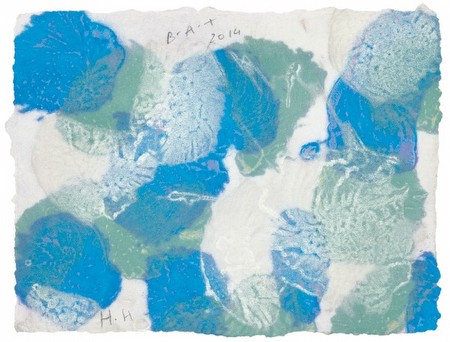
Howard Hodgkin, Wet Day , 2014
20.5 x 27.0 cm Courtesy Howard Hodgkin, Alan Cristea Gallery, Londres et Galerie Eric Dupont, Paris |
|||
|
||||
|
HOWARD HODGKIN, PRINTS GALERIE ERIC DUPONT October 10 – November 14, 2015 I like the sense of life in Hodgkin’s paintings, the wild colour, the different ways of handling paint, and the moody spaces. His painting conjures moods that don’t need definition, subjects that need only be suggested, not finished off. I see his painting as both a depiction and a bouquet offlowers, indecisively drifting now toward the other. I think this uncertainty is Romantic, if it has to be given a name, which it probably doesn’t, but it is larger than what we might think of as a Romantic idea of art. It is the life force of all the arts. Jeff Wall Eric Dupont Gallery, in collaboration with Denise Wendel-Poray, is pleased to welcome Howard Hodgkin, an artist of international renown (British Pavilion at the Venice Biennale in 1984, Turner Prize 1985, retrospectives at the Metropolitan Museum of New York, the Tate Gallery, and in France, at the invitation of artist Jean-Marc Bustamante at the International Festival of Toulouse in 2013...). Following the remarkable exhibition of his paintings at the Gagosian Gallery of Paris in 2014, we would like to offer Parisians another opportunity to discover this great artist as a printmaker with a selection of exceptional works that he produced between 1990 and 2014. Howard Hodgkin has always had a deep attachment to France and to French culture that led him to settle 20 years ago in Normandy where he now lives and works part of the year. British broadcaster and journalist Andrew Marr sees a deep affinity between the artist’s work and the writing of Marcel Proust: "I don’t make the comparison with Proust idly. He’s the writer whose project seems closest to that of Hodgkin’s. Like him, to get his effect, it too k a lifetime’s work and the creation of an entirely new form to contain it. In that case, long curling sentences rather than pattering paint on paint and mysterious, seething swipes of colour... But they have been about the same business. Proust on Hodgkin. Now, there would be an essay worth reading." 1 Today, printmaking has become an important aspect of Howard Hodgkin’s Ïuvre, however, Alan Cristea, who first encouraged him to turn his hand to printmaking, recounts the artist initial reluctance: "Howard Hodgkin doesn’t really like making prints or, at least, he says he doesn’t, and I believe him. It’s understandable really. If he’s making a painting, he can do it whenever he likes – when the inspiration comes – and if it turns out wrong, he can just destroy it and no-one else is any the wiser. The evidence is gone. The trouble with prints is that you have to work with other people and that means working at appointed times and you may just not be in the mood. And they take so long to make -the thinking, the mark-making and then the proofing and the printing and the editioning. It can take years from beginning to end, not to mention the signing and numbering and the endless discussions about framing and presentation. And then of course there are so many of them. They get seen by so many people in so many different places. So many judgments, so much exposure". 2 Like his paintings, the prints transmit a force and vitality characteristic of Hodgkin’s work and are likewise "neither abstract nor, in any conven tional term, representational. " Joined with evocative titles, these works call for an interpretation. Wet Day for instance depicts the feeling of wetness, rain on the face, a certain chilly splashiness; but it’s also a drawing of puddles . 2 This narrative depth hasintrigued many authors, such as Susan Sontag, Bruce Chatwin, James Fenton, Alan Hollinghurst or A.S. Byatt, and brought Julian Barnes to refer to Howard Hodgkin as a writer’s painter whose silent works have paradoxically attracted the attention of those used to telling stories, to describing,imagining, explaining 3. In the meantime, while writers discuss Hodgkin’s work with passion, Andrew Marr recommends: the rest of us can carry on the entirely agreeable business of looking hard and our own resemblance finding, in these other seas and other worlds. 1 1] Andrew MARR, “Howard Hodgkin: a thank you letter”, June 2014. 2] Alan CRISTEA, dans Howard Hodgkin : Acquainted with the Night, catalogue d’exposition, 2012. 3] Julian BARNES, Keeping an Eye Open, Essays on Art, (London: Jonathan Cape), 2015, p. 259. Galerie Eric Dupont 138 rue du Temple 75003 Paris T + 33 1 44 54 04 14 www.eric-dupont.com [email protected] |
||||
|
||||
re-title.com
International contemporary art
SIGN UP FOR NEWSLETTERS

 SIGN UP for ARTIST MEMBERSHIP
SIGN UP for GALLERY MEMBERSHIP
SIGN UP for ARTIST MEMBERSHIP
SIGN UP for GALLERY MEMBERSHIP
Click on the map to search the directory