|
GALERIE CHANTAL CROUSEL: Heimo Zobernig - 31 Oct 2008 to 11 Dec 2008 Current Exhibition |
||||
|
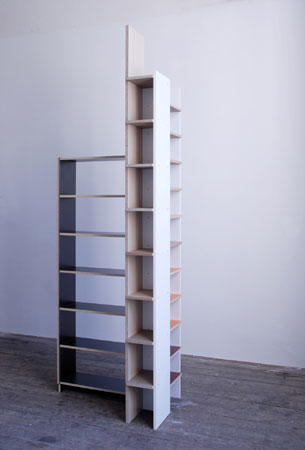
Heimo Zobernig, Untitled, 2008
Wood, chipboard, MDF, 296 x 102 x 62 cm Courtesy of the artist and Galerie Chantal Crousel |
|||
|
||||
|
||||
|
Heimo Zobernig October 31 - December 11, 2008 � The knowledge we gain through art is an experience of the form or style of knowing something rather than a knowledge of something �Susan Sontag For this first exhibition at the Chantal Crousel Gallery, Heimo Zobernig displays a set of pieces mostly stemmed from a series initiated at different times, and which must be put back in the framework of a � works complex �1. These works, more or less recent (between 1986 and 2008), have never been shown in France and are brought together here in a subjective retrospective. Beyond the effect of primacy, it is important at this point to be reminded that this exhibition has been the first one in France for 14 years (the last three taking place at the Villa Arson, the Sylvana Lorenz Gallery and the Fondation des Arts in Paris in 1991; then, at the Unit� d�Habitation Firminy in 1993, and at Nice Fine Art in Nice in 1994)2. Since, it seems there has been a lack of curiosity, if not total oblivion, towards a whole German and Austrian scene, from which Zobernig surely suffered. Yet he was at that time closely related to the community of artists whom gravitated around Cologne, oscillating between institutional critique and � glamour art � (in Josef Strau�s words), trying to reconcile both, within a particularly demanding critical context as well. The current situation seems favourable to a rediscovery of all these artists and therefore we must apprehend in one move their careers (that we missed at that time) and their recent production. Here, Zobernig has decided to render the situation of his studio in Vienna. It is located inside the building dedicated to sculpture at the Kunstakademie, near Prater Park. Through the cover of the catalogue of his last exhibition at the Kunstverein in Braunsweig3, we can gain insight into the atmosphere of the workplace: wide windows onto a leafy patio. The studio is the place of an unremitting research about forms and problems which are incessantly raised by art production. As, from Zobernig�s point of view, art can be nothing but existential and it is the artist who tries to solve the problems: problems of painting (foreground and background, white and blank lines, grain, adhesive tapes, colors, etc); problems of sculpture � such as the sculptures with shelves, which are the result of a sequence of choices � or others. These choices are not logical ones, they are rather a concern of intuition and game. In this way, in the case of the paintings made up with coloured strips, there are neither mathematical rules, as in Sol LeWitt�s work, nor any implementations of colour theories4. � To be automatic is a disaster for the brain �, he says. The main issue of these intuitive variations on each of the different possible structures would be to avoid emptiness. He always works precisely to preserve a strategy of avoidance. For that, he proceeds in the artistic fields of Minimalism, Conceptual Art and Geometric abstraction, with flaws, paradoxes, processes of incompleteness, where often the material and the quality of the making are equivalent to a demonstration, such as the sculptures made of the cardboard tubes of toilet rolls (as the Laocoon presented here), or the sculptures made of painted cardboard. Thus, in the exhibition, the sculpture takes the shape of the organon-box - a box created by Wilhelm Reich to contain, supposedly, an energy present in the atmosphere called �orgon� - even if the work seems to draw its inspiration from the most subversive representative of the Freudian community, it is ironically laid out as a minimalist sculpture. The Love/Hate series refers to Robert Indiana�s painting (LOVE, 1966), used again in a more political way by General Idea (AIDS, 1987), to create a dystopia by mixing the words Love and Hate, and reversing Indiana�s utopic vision. Since the beginning of the nineties, Zobernig has not stopped questioning the artist�s subjectivity and pushing the logics of identity relating to a more and more restricting art system. One of his ways to tackle this issue is to reintroduce his own body in his work. With the strangely asexual puppet bearing his effigy, he brings his own presence in the exhibition, like a � quiet and watchful guard�5. While rejecting the Viennese Actionists� position, he keeps their sense of the scene and the necessity of a bodily experience, adding distanciation and desubjectivation. The canvas made of Swarovski crystals, the ultimate in seduction, takes back to the conception of the modern museum6 and the diamond structure of Mondrian�s paintings. Since 2000, following the research of the latter and the Australian artist Ian Burn, Zobernig has been creating � grid paintings � (built on a grid structure). In the two partially coloured grid paintings presented here, he uses chromatic canvasses � chromakey �7, paints them white and then strips off the adhesive tapes he has applied. Conversely, two other canvasses show a white grid, after the canvass has been covered with an acrylic ultramarine painting similar to the � Blue Box �. While referring metaphorically and formally to modernity8, it is through these new variations on the grid structure that Zobernig pursues his aim: to allow the viewer�s subjectivity free rein by avoiding any interpretation. As a History of Art practitioner, he appropriates in this way some of the materials (form and formal problematics) which he believes essential, to give them a new direction. This research refers to the issue of the conditions of emancipation, initiated from the spectator�s point of view (recalling a recent text by Jacques Ranci�re)9, which takes part in reopening the current debate on the stakes of such positions in contemporary art. Catherine Chevalier. 1 The catalogue of his last retrospective, � Katerlog �, gives its structure in 2003. 2 Concerning these last interventions : � In 2000, he makes the cover for a special issue of Art Press, � Oublier l�exposition�. More recently, in 2004, he participates to group exhibitions : � La Lettre vol�e �, Mus�e des Beaux-Arts in D�le, and � Before the End �, at the Consortium in Dijon. In April 2005, a � damaged � mirror, which surface has been grooved with thin stripes, is presented at the Cit� Internationale des Arts ; it exactly reflects, litterally and metaphorically, different Parisian scenes associated to current exhibitions (John Armleder, Art and Language, John Bock, Liam Gillick, Thomas Hirschhorn, Rirkrit Tiravanija) �. (From Catherine Chevalier, � Heimo Zobering �, Frog n�2, Fall 2005) 3 Heimo Zobernig, Kunstverein Braunschweig, Verlag Walther K�nig, Cologne, 2006. 4 See the book Farbenlehre aus Farbenlehren (� Colour theory made of colour theory �) he made with Ferdinand Schmatz. 5 Heimo Zobernig�s words. 6 See Markus Weh, � The Crystal Soul of the Modern Museum �, in Heimo Zobernig, Kunstverein Braunschweig, op.cit. 7 The � chromakeys �, among which we find a certain ultramarine blue (called � Blue Box �), the Greenbox, the Redscreen, � are of common practice in videos, for their quality of � keying � - that is, the combination of materials from two different video sources, � whereby a certain colour value is filtered out of one film in order to record new material onto the empty spaces �. See Katerlog, MUMOK, Vienne, 2003, p. 343. 8 See David Pestorius, � Due Process, some notes on Heimo Zobernig�s grid paintings and their accidents �, in Heimo Zobernig, Kunstverein Brauschweig, op.cit. 9 Jacques Ranci�re, � The Emancipated Spectator �, in Artforum, March 2007. Heimo Zobernig 31 octobre - 11 d�cembre 2008 � The knowledge we gain through art is an experience of the form or style of knowing something rather than a knowledge of something �Susan Sontag Pour cette premi�re exposition � la Galerie Chantal Crousel, Heimo Zobernig pr�sente un ensemble de pi�ces issues pour la plupart de s�ries initi�es � diff�rentes p�riodes et � resituer dans le cadre d�un � complexe � de travaux1. Ces travaux plus ou moins r�cents (dat�s entre 1986 et 2008) n�ont jamais �t� pr�sent�s en France et sont ici rassembl�s dans une r�trospective subjective. Au-del� des effets de primaut�, il est important � ce point de rappeler que cette exposition est la premi�re en France depuis pr�s de 14 ans (les derni�res �taient celles de la Villa Arson, de la galerie Sylvana Lorenz et de la fondation des arts � Paris, toutes dans la seule ann�e 1991, de l�Unit� d�Habitation Firminy en 1993 et de Nice Fine Art � Nice en 1994) 2. Il semble qu�il y ait eu alors une absence de curiosit�, voire un oubli, vis-�-vis de toute une sc�ne allemande et autrichienne dont a s�rement p�ti Zobernig. Il �tait pourtant � cette m�me �poque proche d�une communaut� d�artistes qui gravitaient autour de Cologne oscillant entre critique institutionnelle et � glamour art � (selon les termes de Josef Strau), cherchant � les concilier, dans un environnement d�une rare exigence critique. La situation actuelle semble propice � une red�couverte de ces m�mes artistes et il faut alors appr�hender en un m�me mouvement leurs parcours qu�on a manqu�s parfois et leurs productions pr�sentes. Zobernig a d�cid� ici de traduire la situation de son studio � Vienne, atelier au coeur du b�timent d�di� � la sculpture � la Kunstakademie pr�s du Prater � la couverture du catalogue de sa derni�re exposition au Kunstverein de Braunsweig3 donne une id�e de son ambiance : grandes fen�tres sur un patio de verdure. Le studio est le lieu de la recherche continue sur les formes et les probl�mes que la production de l�art ne cesse de poser. Car, pour Zobernig, l�art ne peut �tre qu�existentiel et l�artiste, celui qui cherche � r�soudre des probl�mes : les probl�mes de la peinture (arri�re et premier plan, lignes blanches, vides, texture, rubans adh�sifs, couleurs, etc.), les probl�mes de la sculpture - ainsi, les sculptures avec des �tag�res sont le r�sultat de s�quences de choix - ou d�autres. Ces choix ne sont pas des choix logiques mais rel�vent plus de l�intuition et du jeu. Ainsi, avec les peintures compos�es de bandes de couleur, il n�y a pas de r�gles math�matiques comme chez Sol LeWitt ni d�applications de th�ories sur la couleur4. � �tre automatique est un d�sastre pour le cerveau �, dit-il. La question centrale de ces variations intuitives sur les diff�rentes structures possibles serait l��vitement du vide. Heimo Zobernig travaille pr�cis�ment � toujours pr�server une strat�gie de l��vitement. Pour ce faire, il op�re dans les champs de l�art minimal, de l�art conceptuel et de l�abstraction g�om�trique par des failles, des paradoxes, des proc�d�s d�inach�vement o� souvent le mat�riau autant que la qualit� de la r�alisation ont valeur de d�monstration, telles les sculptures en tubes de carton provenant de rouleaux de papier toilette (comme la sculpture en forme de Laocoon pr�sent�e ici) ou les sculptures en carton peint. Ainsi, dans l�exposition, la sculpture reprenant la forme de l�organon-box, boite cr��e par Wilhelm Reich (pour soi-disant contenir une �nergie appel�e � orgone � pr�sente dans l�atmosph�re), alors m�me qu�elle s�inspire du repr�sentant le plus subversif de la communaut� freudienne, est dispos�e ironiquement comme sculpture minimaliste. La s�rie Love/Hate fait r�f�rence � la peinture de Robert Indiana (LOVE, 1966) reprise plus politiquement par General Idea (AIDS, 1987) pour cr�er une dystopie, mixant les mots Love et Hate, en renversant la vis�e utopique de Indiana. Depuis le d�but des ann�es 90, il ne cesse d�interroger la subjectivit� de l�artiste et de bousculer les logiques d�identit� aff�rentes au syst�me de l�art de plus en plus contraignant. L�une des mani�res qu�il a d�aborder cette question est de r�introduire son propre corps dans son travail. Avec le mannequin � son effigie �trangement asexu�, il se rend pr�sent au coeur de l�exposition comme � un garde tranquille et vigilant �5. Tout en rejetant leur posture, il garde des Actionnistes viennois le sens de la sc�ne et la n�cessit� de l�exp�rience corporelle mais y adjoint distanciation et d�subjectivation. Le tableau en cristaux Swarovski, tout en s�duction, renvoie tout � la fois aux conceptions du mus�e moderne6 et � la structure en diamant des premi�res peintures de Mondrian. Depuis 2000, Zobernig poursuit les recherches de ce dernier et de l�artiste australien Ian Burn et r�alise des peintures avec des structures en grille (� grid paintings �). Dans les deux peintures en grille partiellement color�es pr�sent�es ici, il utilise des toiles de couleurs chromatiques, � chromakey �7, sur lesquelles des bandes adh�sives sont �t�es apr�s que la toile a �t� peinte de blanc. � l�inverse, deux autres toiles laissent appara�tre une grille blanche apr�s que la toile a �t� peinte avec une peinture acrylique ultramarine proche du � Blue Box �. Tout en faisant r�f�rence m�taphoriquement et formellement � la modernit�8, c�est par ces nouvelles variations sur la structure en grille que Zobernig poursuit la vis�e de laisser libre cours � la subjectivit� du spectateur en �vitant toute interpr�tation. En praticien de l�histoire de l�art, il s�approprie certains de ces mat�riaux (formes et probl�matiques formelles) qui lui semblent essentiels, pour leur donner une nouvelle orientation. Cette recherche renvoie � la question des conditions de l��mancipation � partir de celle du spectateur (ce qui n�est pas sans rappeler un texte r�cent de Jacques Ranci�re9) qui participe � relancer d�s � pr�sent un d�bat sur l�enjeu de telles positions dans l�art contemporain. Catherine Chevalier |
||||
re-title.com
International contemporary art
SIGN UP FOR NEWSLETTERS

 SIGN UP for ARTIST MEMBERSHIP
SIGN UP for GALLERY MEMBERSHIP
SIGN UP for ARTIST MEMBERSHIP
SIGN UP for GALLERY MEMBERSHIP
Click on the map to search the directory