|
GALERIE CHANTAL CROUSEL: Hassan Khan - Lust | Nature morte vivante - 29 Jan 2011 to 5 Mar 2011 Current Exhibition |
||||
|
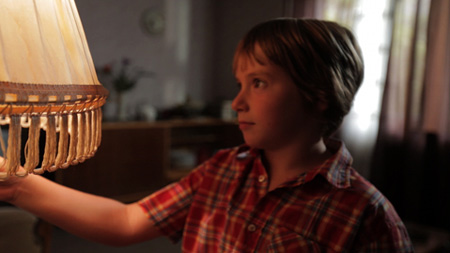
Hassan Khan, Muslimgauze R.I.P., 2010, Full HD video transferred to Blu-Ray, sound
|
|||
|
||||
|
||||
|
Hassan Khan Lust 29 janvier - 5 mars 2011 January 29 - March 5, 2011 Second exhibition space: Nature morte vivante Jennifer Allora & Guillermo Calzadilla, Tony Cragg, Willem de Rooij, Wolfgang Laib, Adriana Lara, Richard Long, Jean-Luc Moul�ne, Gabriel Orozco, Anri Sala, Alain S�chas, Reena Spaulings, Wolfgang Tillmans, Andy Warhol 9 f�vrier - 18 mars 2011 February 9 - March 18, 2011 Hassan Khan Lust 29 janvier - 5 mars 2011 Objects of Collective Consciousness By Brian Kuan Wood Don�t trust the lights. Rather, look into to the darkness for what you need. Hassan Khan�s video installation Jewel (2010, 35 mm film transferred to HD) opens with a cloud of lights flickering to a soundtrack�produced by Khan himself�of hypnotic drones. But one soon discovers that these lights are not stars or a coastal hamlet at night, but a swarm of hideous fang-faced anglerfish� the elegant sparkling being nothing other than the light emitted from the strange growth on their faces: a lure for prey. As a ferocious beat sets in, the image of the anglerfish freezes and shape-shifts, �fossilizing� as a pattern of lights. The camera pulls out, and the fish pattern is shown to be punched into a revolving object�a totemic sort of disco ball surrogate�around which two men, one younger and one older, each perform a strange dance of desperate flailing, drowning, falling, grabbing, and whipping gestures. It is a spare scene of some kind of sinister, yet perfectly viable Arab subculture collectively reveling in a response to total collapse�one in which dancing, limbs flailing in the air, becomes a powerful and resilient performance of futile gestures. Moving with the ambivalence of marionettes commanded by forces that are not theirs, the work draws to a close with the scene slowly receding into darkness in a single continuous tracking shot. What is it that haunts these men and compels them to act, to move? At Galerie Chantal Crousel from 29 January�5 March, Khan presents �Lust�, a multilayered constellation of recent works that can be seen as focal points in his practice over the past three years. While the included works are highly enigmatic in nature and communicate on a number of registers, it is simultaneously important to consider them in light of a sophisticated line of thinking that has taken place over the course of the artist�s 15-year career. Key to this thinking has been a dynamic centered on private consciousness and public address�a way of dealing with the movements of ideological forces and social constructions of value as they pass from the crowd in the street into the psyche and back. In this sense we can then address his oeuvre as a means of confronting the spectral nature of these movements throughout a flowing cultural subconscious of a �public mind.� Key to this is Khan�s particular approach to the way ideological thinking and spectrality function in relation to physical material. In an attempt to revisit the quasi-religious and messianic thinking latent in Marx�s writing on commodity fetishism, Jacques Derrida has used the term �hauntology� to describe a spectral ontology functioning within Marx�s materialist critique of the commodity. As a subtle play on �ontology,� the term allows room for a phantasmatic form of being to precede the material commodity as the ghostly desire for such a commodity to emerge (or be produced) in the first place. Derrida goes on to propose Marx�s very materialist critique to be an exorcism of this already existing auratic, ghostly presence that surrounds an object, expelling the ghosts that would possess a piece of material such as wood to think of itself as not only a chair, but even a diamond, or a Ferrari. But, following from the �hauntological,� for Khan these apparitions are of the utmost importance, as they are themselves another form of material. It is from here that Khan�s work as an artist finds its materiality: as compressions of social desires. If we then suppose that these collective desires, as a form of hidden consensus, also carry ideological content, then the obvious question becomes: What other errant, spectral products are floating around, and how can we perceive them? From this perspective, we have already entered another state of being�one that requires a shift in the understanding of how objects behave, and how they reflect and accommodate collective desires (or a lack thereof ).W ith Banque Bannister (2010), the centerpiece of the exhibition at Chantal Crousel, one finds a brass handrail trying to find its purpose�leaning on something that is missing and leading to something that is not there. Hovering in space, it assumes the shape of ordinary piping or a �stairway to heaven��leaping forward to find stairs to rest itself on. In a twisting of an orthodox Duchampian move, similar to that of Banque Bannister, Khan�s Evidence of Evidence II (2010) is an enormous (3.5 x 3 meter) scan of a discarded flower painting, printed on vinyl, that reverses the premises of a Fountain (1917) or Bottle Rack (1914). Like Duchamp�s readymades, it assumes another character when it enters the exhibition, but, contra Duchamp, it does not gain auratic value or become formally abstracted�in fact, on a formal level, Evidence of Evidence II is barely aware of the exhibition format at all, and it arrives without suspicion or preconceived notions. As its title suggests, the aura does not lie in the context (the exhibition format, with its loaded implications), but came before it, in the flower painting�s domestic origin in the home. As a zoomed-in, scientific extraction of collective meaning latent in a staple bourgeois decorative motif, the artist has described Evidence of Evidence II as �a set of values and socio-economic facts being transformed or translated into aesthetic facts.� This is how Khan positions the objects furnishing the generally-accepted and the already- existing to make them speak about both what they are and what they are about. It is not a Duchampian sleight of hand that recontextualizes the object to introduce potential other readings, but the opposite: a fundamentally subtractive process of obliterating the potential for an already-auratic, already-inflated flower painting to say anything about the person who owns it. Blasting it back down to literal material, it becomes unrecognizable even to itself. Here it is also important to mention the darkness that surrounds these works, for why should it be necessary to obliterate meanings, to subtract possibilities, to reduce agency in such a way�especially when so much of the language used in art contexts is geared towards the production of meaning, the multiplicity of possibilities, the celebration of heterogeneity, and even the potential for art to make positive contributions to the world? With this we can simply look to another common understanding, that �political� content in art is necessarily affirmative for initiating the possibility of political agency. But how can the political be automatically aligned with agency, with �hope,� and potentiality? What about authoritarian regimes, tyranny, the poverty of available options, endemic corruption, botched elections, and all-around collapse� a saturation of a politics that does not include democracy and activism, but point instead to defeat and withdrawal? Are these states of being not equally political, if not radically more so? What is the shape of a political dead-end in which there is no formal expression, no representation� where a political address utterly hollowed of potential might still speak? (And those looking to situate Khan�s work in an Egyptian context may begin by inferring the current political climate and regime in Egypt into the above�it would not be far off.) All of this is not to introduce geopolitics into the argument, but rather to point out the viability of a formal language for political content that stretches past power structures as such and across specific cultural contexts, to encompass also a means of coming into contact with how an next door furnishing an entirely different physics of intercultural contact or touch, beaming himself out of Thatcherite England by, in Khan�s words, �sublimating the dire conditions of the UK�s conservatism at the time into a radical exoticism that spoke, above all, about his own local context.� One may view the works included in �Lust� as a constellation of entry points into a material world in which the ghostly traces of ideological conditioning literally sculpt not only objects, but subjects�a hidden economy in which collective consciousness is both produced and collapsed. In this sense Khan�s works may be seen as articulating a transitional phase between the projection of such a consciousness and its manifestation�a liminal point where ideologies might still reflect the social forces responsible for producing them. And for some reason, it is at this point that these objects begin to tremble�haunted or compelled by strange forces to speak about themselves. And what is its voice? It is that of the flowing cultural unconscious� the nonhuman designer of protocols, the tastemaker par excellence, the master carver, the architect of accidental perfect symmetries and of self-doubt, of imagined solidarities: the hidden consensus. Nature morte vivante Jennifer Allora & Guillermo Calzadilla, Tony Cragg, Willem de Rooij, Wolfgang Laib, Adriana Lara, Richard Long, Jean-Luc Moul�ne, Gabriel Orozco, Anri Sala, Alain S�chas, Reena Spaulings, Wolfgang Tillmans, Andy Warhol 9 f�vrier - 18 mars 2011 February 9 - March 18, 2011 As a representation of natural inanimated objects in a Greek Epicurean manner, recuperated by Christian symbolism (appearance of vanitas), the still life incarnates overall the bourgeois and Realist painting of the 17th century. For a while it was considered the lowest rank, not to mention vulgar, in the hierarchy of academic art, it was rehabilitated in the 19th century and especially in the 20th century by the Cubist avant-garde, but also by the Surrealists. A 1956 painting emblematic of the nuclear mysticism of Dali (and preserved at the Dali Museum of St Petersburgh in Florida) carries the title Still Life - Fast Moving. In this painting, we find levitating several motifs addressed in the present exhibition, in a purely coincidental manner. (cf http://www.allposters.fr/-sp/Nature-morte-vivante-Affiches_i324253_.htm). If the still life remains a synonym of easy painting, commercial, seductive, and ambiguous (cf. the oysters of Reena Spaulings from a photograph of Roe Ethridge), it appears also as the antecedent to the readymade. The arrangements of flowers in a contemporary ikebana, is revisited by Reena Spaulings (the painting of a bouquet prepared to be given as a present.) We come across it more concretely in the sculpture by Willem de Rooij (who does not ignore the Flemish still life tradition and brings together two different tulip species in symbolic antagonism in a bouquet constantly being renewed to prevent withering). On the other hand, Jean-Luc Moul�ne has �denatured� a variety of plants encountered in a French village. By placing a colored background behind each one, he has shot them like portraits in a studio. It seems as if photography is a medium made for the still life. The photographic frame can isolate �compositions� found in nature, where the human eye � and not its hand � has intervened in the composition (Gabriel Orozco or Anri Sala). One can say as much for the abstract realist works by Wolfgang Tillmans. With Andy Warhol, his stylized drawings, initiated from a staged and photographed composition serving as a preliminary step for the artist, are on one hand, works by themselves, and also an intermediary step towards the mechanical reproductions of silkscreen printing. Conversely, other artists recompose real nature with symptomatic materials: Adriana Lara creates a plastic fruit excessively enlarged (an �accessory� for a film). Molded, frozen (not to mention sexualized) in cement, the composite and urban still life of Moul�ne incarnates the image itself of photography. And other artists use live raw materials to make still lives : Reena Spaulings immortalizes the ghostly traces of an art opening diner on tablecloths becoming tondo. Tony Cragg revisits nature and recomposes a tree from manufactured wood, both used and abandoned. Wolfgang Laib collects by hand pollen produced by flowers, which he then develops into active sculptures (Mountains of Pollen) or potential state (Bowls of Pollen). Iridescent, the petrol oil stain mixed with water of Allora & Calzadilla become emblems of its conflicting global reach. Finally, Richard Long proposes a conceptualized still life: on a vertical axis, a column of words evokes a landscape composed from all objects that meets the eye while in a 360� panoramic view. 11F, rue L�on Jouhaux - 75010 Paris Staircase G - 3rd floor |
||||
re-title.com
International contemporary art
SIGN UP FOR NEWSLETTERS

 SIGN UP for ARTIST MEMBERSHIP
SIGN UP for GALLERY MEMBERSHIP
SIGN UP for ARTIST MEMBERSHIP
SIGN UP for GALLERY MEMBERSHIP
Click on the map to search the directory