|
GALERIE MEYER KAINER: ANITA LEISZ BOLTENSTERN.ROOM: NADJA ATHANASSOWA - 18 Sept 2010 to 6 Nov 2010 Current Exhibition |
||||
|
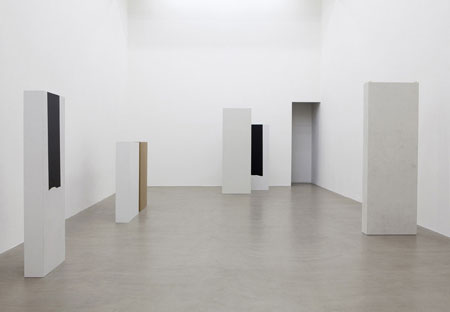
ANITA LEISZ, Installation view, Galerie Meyer Kainer, 2010
|
|||
|
||||
|
||||
|
GALERIE MEYER KAINER: ANITA LEISZ BOLTENSTERN.ROOM: NADJA ATHANASSOWA The Emerging Artist Series by Will Benedict Verena Dengler Ed Ruscha Sara Deraedt Frank Stella Nadja Athanassowa Ronald Bladen OPENINGS: FRI, SEPTEMBER 17, 7 PM DURATION OF THE EXHIBITIONS: 18. 9. - 06. 11. 2010 Anita Leisz Er�ffnung / Opening: 17. 9. 2010, 7pm Ausstellungsdauer / Duration: 18. 9. � 6. 11. 2010 For this exhibition Anita Leisz has continued to build upon a series of works which investigate the construction of basic forms using readily available industrial grade material. For the past several years Leisz has worked towards producing simultaneously reductive and expressive forms which through their extreme simplicity accentuate details that offer the viewer an opportunity to see the works as both general and specific. Two seperate methods of construction are employed in the exhibition one requires a wooden skeleton upon which Leisz affixes fiberboard the other is made of white pressboard. While in the past all seams, joints, or breaks in the material were practical necessities dependant on the construction of the interior skeleton these new series of works exaggerate their construction turning the signs of their stability into cartoons. Simple white pressboard structures are now emblazoned with oversized black tape. The same white pressboard then reverses its role and becomes the interior skeleton upon which a fragile material such as cardboard is given stability. In a concrete sense the works are made up of the minute details created by chance and repetition which give a sidewalk its patina or a sofa the particular contours of its owner. The failure of a metaphorical language to descibe the works of Anita Leisz are helpful in understanding the basic idea that the works are generated by an obsessive atmosphere of precision which find their correspondance in the general confusion and frailty of the human body and in the specific power we give the objects we create and employ for our bodies and the language which our bodies utter to explain the need for those objects. In an allegorical sense the exhibition could seem to be organized into singles, couples and families, some of whom have divorced, remarried and forged bonds based on new found similarities. Or in a seperate example we may have four children who have left home to create their own lives but who are never-the-less related to one another regardless of their distances. But the exhibition is not really a family therapy clinic. (Will Benedict) Nadja Athanassowa The Emerging Artist Series by Will Benedict Er�ffnung / Opening:17. 9. 2010, 7pm Ausstellungsdauer / Duration: 18. 9. � 6. 11. 2010 Der K�nstler und Kurator Will Benedict verbindet die Arbeiten einer j�ngeren K�nstlergeneration am Beispiel dreier K�nstlerinnen Verena Dengler (geb. 1981), Sara Deraedt (geb. 1984) und Nadja Athanassowa (geb. 1982), mit Kunstwerken von Ed Ruscha, Frank Stella oder Ronald Bladen. PRESSETEXT / PRESS RELEASE Nadja Athanassowa's work takes the issue of work itself as its starting point and how our selves are built in relation to those who employ us or act as our beneficiaries. From March 2005 till October 2009 she has collected and exhibited the free journal AK F�R SIE (Arbeiter Kammer) a magazine dedicated to employment issues. Rather than take an ideological position Athanassowa attempts to present the material fact of the journal's reality by demanding that it be known that she is willing to store what is normally discarded after use. For the past couple of years Athanassowa has transformed her apartment into her work by methodically collecting and throwing her things away. At one point she found her house completely empty and instead of refilling it built up a second level to create even more floor space because she found her 3 meter ceilings to be wasteful. When I visited Athanassowa last, her walls where covered in rugs upon which she had attached advertisements for credit card offers and newspaper clippings which she had carefully folded into three dimensional forms. In the middle of the kitchen floor she was keeping the coal ash from her furnace in clear plastic bags. In an exhibition at WUK Kunsthalle she used these bags simultaneously as pedestals for her paper forms; and as what they were, bags of ash. For this exhibition Athanassowa removed and sold her furnace and used the material which functioned as the base as the key element. The furnace which is not in the exhibition was sold through Willhaben.at its value assured by its functionality unlike the base or pedestal, made of fire clay, which lost its function with the removal of the furnace. By exhibiting these left over pieces of fire clay and painting some of them in the style of an inverse frottage Athanassowa has reinscribed a value onto these chunks of debris which stress their conflicted status as both nothing and something. The other elements in the exhibition have taken a similar route towards their commodification. The pink painting was in its previous incarnation an advertisement for Yves Saint Laurent's Opium which had been transformed into a pinboard by the employees of a cosmetic store for their shop window. Twice removed from its original function the painting has travelled the spectrum of aesthetic use from advertisement to functional background display and finally to the suspicious realm of conceptual painting. Athanassowa's work struggles to address the forms that immateriality must take to be read and to always reiterate the labor involved in making this legible. (Will Benedict) |
||||
re-title.com
International contemporary art
SIGN UP FOR NEWSLETTERS

 SIGN UP for ARTIST MEMBERSHIP
SIGN UP for GALLERY MEMBERSHIP
SIGN UP for ARTIST MEMBERSHIP
SIGN UP for GALLERY MEMBERSHIP
Click on the map to search the directory