|
GALLERIA CONTINUA Le Moulin: Ilya & Emilia Kabakov | Kimsooja | Jorge Macchi | Manuela Sedmach - 27 June 2009 to 4 Oct 2009 Current Exhibition |
||||
|
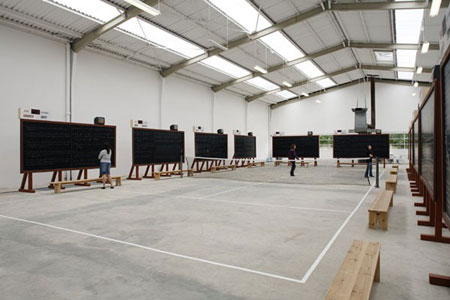
Ilya & Emilia Kabakov - The Tennis Game
(Conversation between Ilya Kabakov - Boris Groys) 1999-2001, installation mixed media, 1200 x 2000 cm, exhibition view |
|||
|
||||
|
||||
|
Opening night Saturday 27th June at Le Moulin, 6pm to midnight: o At 6pm: exhibition visit and cocktail o From 9pm to midnight: rustic banquet and Dj set beside the river Ilya & Emilia Kabakov, The Tennis Game 27th June � 4th October 2009 Ilya Kabakov (born in Dniepropetrovsk in 1933, Ukraine), worked in the Soviet Union as a children�s book illustrator until 1988. This context did not allow him to work as a �free� artist. He left the Soviet Union, first of all staying in Germany and then moved to New York. Emilia Kabakov (born in Dniepropetrovsk in 1945) studied music then experienced being a curator and gallery owner in New York from 1975. She has worked with Ilya Kabakov since 1989. They both live and work on Long Island (United States). As Kabakov himself defines, their works of art are part of a�Total Installation�, which signifies putting art and life in contact. His works are as much progressive, as they are romantic, and invite the spectator to concentrate on their own life, on the possibilities, the problems and the solutions with regard to their personal reality. The main work of art presented at Galleria Continua / Le Moulin is Tennis Game, A conversation between Ilya Kabakov and Boris Groys, which re-stages the medieval custom of a philosophical argument, a type of intellectual tournament between two rivals. With a discussion of this kind, a preliminary subject was established and discussed by the two partners. The two rivals belonged to sides with different traditions and the joust was rich with abrupt movements. Here, a tennis court is surrounded by fourteen black paintings unwinding the thread of a conversation between the artist and Boris Groys: the sports game gives way to the dialectic and the sports ground becomes the scene of a re-transcribed verbal joust. The match was played by Ilya Kabakov and Boris Groys. The spectators can watch past action on television screens. True, the players don�t have the same level as Boris Becker or Marat Safin, but the principal after all, is to love the game. At the same time, the spectators can contemplate the result of another game, written on the black painting. The dialogues between the philosopher Boris Groys and the artist Ilya Kabakov are presented like five rounds of a tennis match in which a question is served and then followed by a return shot. Ilya & Emilia Kabakov�s work has been exhibited in many museums like the Museum of Modern Art (New York), the Centre Pompido (Paris), the Hirshhorn Museum (Washington DC), the Stedelijk Museum (Amsterdam), at the Documenta IX, at the Whitney Biennial 1997, at the State Hermitage Museum (St. Petersburg) and in several Venice Biennials. In 1993 for example, they represented Russia at the 45th Venice Biennial with their installation The Red Pavilion. In 2008, a large retrospective: Alternative History of Art and Other Projects � and first exhibition in Russia since leaving at the end of the 1980�s � took place in four exhibition spaces in Moscow (State Pushkin Museum of Fine Arts, Center for Contemporary Culture Garage, Moscow, Contemporary Art Center, Winzavod, M&J; Guelman Gallery). The Kabakov�s works of art feature in many public collections across Europe. They have also won a large number of honorary prizes, like the Oscar Kokoschka Preis (Vienna) in 2002, and they were made Chevaliers des Arts et des Lettres in Paris, in 1995. Kimsooja, Mumbai-A Laundry Field June 27 � October 4 2009 The artist Kimsooja (Born 1957, Taegu, Korea) acts as a visual and spiritual mediator through a metaphor for life which viewers are invited to contemplate. Since the early �80s, Kimsooja began to include colourful used and popular fabrics in her work. Her fascination with textiles specifically began in 1983. It was a very precise moment in her life, when she was sewing a Korean bedspread with her mother. At that time, she was questioning the concept of �painting�s surface dimension�. When she first placed a needle into the structure of a fabric, she felt thrilled and joyful, as if a ray of immeasurable energy penetrated through her fingers and into her whole body, reaching to the needlepoint where it met the surface of the fabric. Since this very particular experience, Yin and Yang have become life's essential components for Kimsooja, and have evolved on a number of levels in her art. The work �Mumbai: A Laundry Field�, showing at Galleria Continua, Beijing, in a 4 channel video format, evolved from the series "A Needle Woman" (1999-2001 and 2005). The series was filmed in cities and other locations around the world. The artist, in a featureless outfit, has her back to the camera, almost like a silhouette. The central figure is an unknown and common presence, an "everywoman�, constantly portrayed as a fixed point in the flow of the passing crowds, or lying still while clouds pass overhead. In this video series, Kimsooja�s body is always an anonymous presence moving into a deep phase of meditation, immersing in contemplative scenarios, breaking through the world�s surface and deep into its soul, "like a needle in a haystack". The eye of the camera corresponds to that of the artist, standing apart, watching from a detached perspective. It is as if in a pure act of concentration the world vision would appear clearer and undisturbed through the narrow needle�s �eye�. Jorge Macchi, Diario Intimo June 27 � October 4 2009 The artist Jorge Macchi was born in 1963 in Buenos Aires, where he lives and works. He plays an important role amongst the generation of Argentinian artists who emerged in the 1990�s. In 1993, he moved to Paris, the start of a five year period during which he travelled all over Europe, participating in many residencies in Rotterdam, Amsterdam and London� In 1998, Jorge Macchi returned to Buenos Aires. In 2005 he displayed his work at the Venice Biennial, representing Argentina. His work was exhibited notably at the Havana, Sao Paulo and Istanbul Biennials, at Le Credac in Ivry-sur-Seine, at 10Neuf, the Regional Contemporary Art Centre in Montb�liard, at MUHKA in Anvers, at the Walker Art Center in Minneapolis, the New York Sculpture Center, the MUCA in Rome, etc. The exhibition at Galleria Continua / Le Moulin has installed an eclectic sample of the artist�s work: installations, sculptures, videos, drawings, etc. displaying his great creativity. The contradiction between movement and stability, the ephemeral and the permanent, and destiny are the artist�s favourite themes. Jorge Macchi�s work stands up to any exegesis. Rather than a linear progression, his works appear as dense and intricate semantic networks. The information is knowledge which comes from all sides and ends nowhere. Jorge Macchi frequently uses newspapers, paradigms of information archives based on fact. Beyond simple information, writing, poetry and music play an important role in his work, visible in the installation The Singers� Room (2006), made in collaboration with the Argentinian musician/composor Edgardo Rudnisky. This work, exhibited for the first time in 2006 at the University of Essex (Great Britain) is the conclusion of Jorge Macchi�s residency at AHRC (Research Centre for Studies of Surrealism and its Legacies). The installation is based on light and sound. It is composed of four large glass panels with the material chosen for its intrinsic qualities: transparency, extreme fragility and reflective ability on contact with light. As soon as a letter appears, a sound follows, reverberating over the whole room like the chant of mermaids. The text which emerges is the work of the Uruguayan poet Idea Vilari�o. What mainly interested Jorge Macchi and Edgardo Rudnisky is the pyramidal structure of the poem, and its �phonetic� representation around the sentiment of loss evoked. Manuela Sedmach, Destinazione Provvisoria 27th June � 4th October 2009 The exhibition at Galleria Continua / Le Moulin will display about twenty old and new canvases, like for example, Assolutamente niente (1999) and Tornare a casa (2009). Manuela Sedmach, born in 1953 in Trieste (Italy) where she lives, has for thirty years expressed the complexity of her research through a traditional medium: painting. She develops an intense experience, concentrated on her work, with an almost religious attitude. Following a ritual, the artist begins a canvas with her favourite subject that she makes abstract. She uses only three colours: black, white and brown. At the beginning, Manuela Sedmach begins with a black canvas, on to which she introduces the two other colours, shaped and alternated until the desired effect is achieved. The artwork is defined during the work which can last two or three months. The final result stems from a superposition of layers of colour (up to fifty) which are used to produce the extraordinary game of transparency and voiles. The successive additions progressively change the representation and produce cycles of the same images with a similar title and pattern. The difference in quantity of the three base colours gives diverse chromatic results, like many variations from a single piece of music. The first series from the 1980�s, a dense and impetuous execution, progressively gave place to a more subtle and fluid style. The figures and objects have disappeared little by little; the subject becoming voluntarily non-narrative. The elements (water, air, fire, earth) are henceforth the only protagonists of the works of art. With skill, Manuela Sedmach passes these �normal� even ordinary fundamental principles, to an unusual and extraordinary dimension. Today Manuela Sedmach�s themes are undefined places, endless horizons and diaphanous clouds, the distended time of misty marine atmospheres, frozen deserts, the cosmos, stars and white rain. The artist seeks to show the essential in her paintings. Shapes, transparencies and glaze leave room for imagination. Reality is expanding here. The canvas space is contemplated, but not only: this one also speaks of another space, this one outside the canvas, outside time, this one of the depth of the soul. The endless repetition of almost identical visions allows Manuela Sedmach to create a sort of hypnosis. The observer must �lose themselves� in the universe of the artist. Manuela Sedmach�s work has been exhibited in different galleries and museums in Italy. She has taken part in individual and group exhibitions in Belgium, Austria, Germany and Hungary. Her paintings are part of large private collections in Europe, the States and Japan, as well as at the SMAK Museum in Ghent. |
||||
re-title.com
International contemporary art
SIGN UP FOR NEWSLETTERS

 SIGN UP for ARTIST MEMBERSHIP
SIGN UP for GALLERY MEMBERSHIP
SIGN UP for ARTIST MEMBERSHIP
SIGN UP for GALLERY MEMBERSHIP
Click on the map to search the directory