|
GALLERIA CONTINUA Le Moulin: 1 venue, 4 exhibitions: 26th June � 3rd October 2010 - 26 June 2009 to 3 Oct 2010 Current Exhibition |
||||
|
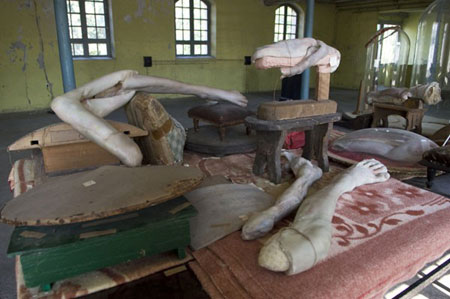
Berlinde De Bruyckere - Infinitum
2009, wax, epoxy, metal, blankets, wood, iron, rope, glass bells, 135 x 76 x 265 cm |
|||
|
||||
|
||||
|
1 venue, 4 exhibitions: 26th June � 3rd October 2010 3 solo exhibitions: Berlinde De Bruyckere, Urs L�thi, Serse 1 group exhibition: Idoles (Idols) with Kendell Geers, Anish Kapoor, Liu Jianhua, Moataz Nasr, Luca Pancrazzi, Michelangelo Pistoletto, Arcangelo Sassolino, Pascale Marthine Tayou LE MOULIN Galleria Continua, proud of the San Gimignano and Beijing experiences, launched a new project, The Moulin de Boissy, a peculiar site in the Parisian region dedicated to contemporary art creation. Le Moulin hosts large scale exhibitions and projects by major artists from the five continents several times a year, following the rhythm of the seasons. Renovated, the site, a former factory of 10,000-m� embraces a new artistic life with already 15,000 visitors during the first two years of activity. The local population, Parisians, the international art scene, and the region bring passionate support and help to spread this new wave of culture throughout the area. The site, as well as having commercial preoccupations, also turns itself towards the public and its desires. For its 10th exhibition�s opening, Le Moulin, after 3 years of existence, will host 3 solo shows: Berlinde De Bruyckere, Urs L�thi and Serse, each having very different approaches and reasoning. In parallel, Le Moulin proposes a group exhibition, entitled Idoles (Idols). Once again, Galleria Continua demonstrates the extent to which various forms of art, Berlinde De Bruyckere�s sculpted figures, Urs L�thi�s installations and Serse�s drawings, can be adjacent to a group show with strong themes, all integrating into one same, and atypical space, Le Moulin. Berlinde De Bruyckere The sculptor Berlinde De Bruyckere is considered to be one of the major female Belgian artists today. She was born in Gent in 1964 where she lives and works. Her solitary figures are formed from an assembly of heterogeneous, plant and organic materials (wax, wood, hair...). Berlinde De Bruyckere evokes death and violence. Her bodies with cyanotic skin, often without a head, and sometimes without gender, and her hung or slumped animals, infringe on imagination linked with the theme of brutality. She re-elaborates anatomical images and shapes to spark duality between terror and pity, love and suffering, peril and protection, confronting the state of abandon of the body. She thus appropriates certain structural codes peculiar to the representation of the suffering body in medieval or Renaissance painting. The concept of duality is at last all the more valued by the choice of her subjects: animals and plants bear the contrasts of the superior and inferior world describing the distance between the earth as well as the spiritual, like a gap which seems equally to govern the universe of man. Berlinde De Bruyckere�s work has been exhibited at La Maison Rouge in Paris, at MUKHA in Anvers, the Kunsthalle in Dusseldorf, the Fondazione Sandretto Re Rebaudengo in Torino and the Lyon Biennial of Contemporary Art. Urs L�thi : Art is the better life Urs L�thi was born in 1947 in Lucerne (Switzerland), he lives and works in Munich. Since the beginning of his career, Urs L�thi has used different media: photography, painting, and installations. Since 1968, he has developed a new photographic work based on himself, his body, which becomes the support and the subject of his art. In these true staging self-portraits, the artist disguises himself or dresses up, playing on sexual ambivalence. Most frequently he represents himself in polyptychs and combines himself with exterior objects or figures (female characters, landscape, empty interiors�), enrolling it in the social context of his period. Urs L�thi thus sets off on a search for his identity, whilst bringing to light links between art and life, he who is a supporter of the expression �art is the better life.� He takes the spectator through his experience and his works towards what has a hold on him: memory, personal account, research, exploration, sadness and distance. Urs L�thi has acquired a significant notoriety globally thanks to numerous solo exhibitions in museums and galleries, in Switzerland and abroad. He received the Prize of Honor from the canton of Zurich for his work in 1996. In 2009, the town of Kassel awarded him the Arnold-Bode-Preis Prize. Serse : Disegni in Scala Serse Roma (born in San Polo De Piave in 1952, Italy) lives and works in Trieste. He has pursued his artistic research for more than twenty years and is considered one of the key figures in the panorama of contemporary Italian drawing. The artist produces his works by using graphite powder and rubber on paper. His works represent the plant and architectural landscape as only a photograph can and is characterized by the sophisticated use of black and white. According to the artist, these two tones are a way of understanding the physical essence of reality and matter. Through his play on shadows and light, Serse manages to create an almost magical landscape, where time is suspended: storms, which disrupt the sea, remain frozen in his photogram; the reflections carved in real time have hardly finished blending. Serse Roma�s work has been displayed in many museums like the Museum of Beaux Arts and the SMAK in Gand, at the Royal Palace in Milan, at the Luigi Pecci Centre for Contemporary Art, etc. and in 2005 participated in the third Valence Biennial in Spain. Idoles (Idols) KENDELL GEERS, ANISH KAPOOR, LIU JIANHUA, MOATAZ NASR, LUCA PANCRAZZI, ICHELANGELO PISTOLETTO, ARCANGELO SASSOLINO, PASCALE MARTHINE TAYOU Idoles (Idols) is the third group exhibition organized by Galleria Continua / Le Moulin. It gathers 8 renowned artists who exhibit their own idols or who show the spectator the place that the old and contemporary idols occupy in today�s society. Initially signifying a representation of divinity as a cult object, the idol henceforth assigns in a much wider way in informal language, a personality taken as a model by a society, a generation, or an icon, whether artistic, religious, mythological or even political. The artists represented in Idoles (Idols) reinterpret in their own way this plurality of accepted meanings. |
||||
re-title.com
International contemporary art
SIGN UP FOR NEWSLETTERS

 SIGN UP for ARTIST MEMBERSHIP
SIGN UP for GALLERY MEMBERSHIP
SIGN UP for ARTIST MEMBERSHIP
SIGN UP for GALLERY MEMBERSHIP
Click on the map to search the directory