|
GALLERIA CONTINUA San Gimignano: MOATAZ NASR | GIOVANNI OZZOLA | LUCA PANCRAZZI - 12 Feb 2011 to 1 May 2011 Current Exhibition |
||||
|
|
|||
|
||||
|
||||
|
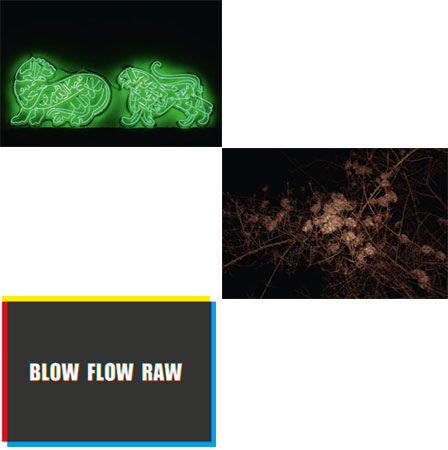
Opening: Saturday 12 February, 2011, via del Castello 11, 5pm-12 midnight Until First of May 2011, Tuesday-Saturday, 2-7pm MOATAZ NASR The Other Side of the Mirror Galleria Continua is pleased to present The Other Side of the Mirror, a new solo show by the Egyptian artist Moataz Nasr. Regarded as one of the leading exponents of contemporary pan-Arab art, Moataz Nasr has conceived this exhibition as a philosophical and spiritual journey, inviting us to meditate on the meaning of things and on co-existence. A choral song, a paean to compassion, as the key to knowledge, as the light which illuminates the way, and to love, as the abolition of frontiers and prejudices � elements which the artist renders in formal terms by re-elaborating common icons of the Islamic world to the point of transforming them into new global aesthetic signifiers, symbolic abstractions open to a multiplicity of readings. The exhibition is spread over the stalls area, the circles and the stage of the former cinema and theatre, metaphorically tracing a path directed towards spiritual elevation. The Other Side of the Mirror is a video installation whose name has also been used as the exhibition title. The Other Side of the Mirror is the world the artist invites us to explore. A space we believe to be inaccessible only because we have not gone to the trouble of understanding its mechanism. It is the matrix of the human being, it is the desire to recognize oneself, it is that possibility which utopias and dreams keep alive; but it is also a dimension of the mind which, if once innate in the child, is, for the adult, something that can be retrieved only after a journey of discovery in one�s consciousness. The thought of the mystic Sufi philosopher and poet Ibn Arabi (1165-1240), a point of contact between Arab and Catholic culture - Doctor Maximus for Europeans, the Great Sheikh for Muslims - inspires many of the works in the show. In EL Thaherwa El baten (The Manifest and the Un-manifest), the artist uses the Arab form of the word Elhob (�love�) twelve times to create two circles, the first visible, the second in shadow on the other one, between the white of the mind and the black of the body. Counterposing the circles are the animals, the five lions of Islamic propaganda realized with over 35,000 wooden matches (Oxymoron, 2011), symbols of strength, ferocity, force and power, but also a representation of the Arab nations in the history of the world and of the energy of every single individual. Love, as a universal symbol, also appears and acquires form in other works making up the exhibition. We find it in the tapestries produced by the artist as symbols of compassion and beauty; it stands out on the top of the two towers evoking the architecture of the five great religions; it is traced out in the Arabic calligraphy of the alabaster and crystal sculptures suspended over the stage. Commenting on the show, the critic Simon Njami writes: The base of the installation is inspired by a memory through which we rediscover the calligraphy, the myths, the magic signs and the aesthetic representations produced in the Arab world by the various problematic issues facing human beings. In the heart of this mechanism, two elements form the cornerstone of the proposition. A duplicated octagonal construction (the number eight is magical) that can represent a profane temple in which, as in a throbbing heart, we are invited to adapt the rhythm of our pulsations to the rhythm of the environment, a transformation which, alone, will enable us to accede to knowledge and ecumenism. And on the scene, as a wall of words, is the sentence of Ibn Arabi. In the large green neon dominating the stalls area, the artist forcefully proclaims the identification of his heart, now capable of assuming any form, with Ibn Arabi�s thought. His inner being can be: a pasture for gazelles and a convent for Christian monks, and a temple for idols and the pilgrim�s Kaa�ba, and the tables of the Torah and the book of the Quran. I follow the religion of Love... that is my religion and my faith. The space in which we are progressively transported, continues Simon Njami in his analysis, is cabalistic� As in a treasure hunt, we walk around in this codified universe, and what does it matter if we are unable to completely unveil the constellation of signs and emblems comprising the exhibition path� the key to this journey is not reason but feeling. The consciousness of a space that goes beyond us and is concerned to measure us up, until all the old ideas that have thus far represented our raison d��tre have been cast into doubt and transformed. GIOVANNI OZZOLA Settecento The new solo exhibition conceived by Giovanni Ozzola for the Galleria Continua is entitled Settecento. With this title the artist gives us a suggestion remarking the idea of a world concived as will, as a way to achieve consciousness: self-awareness of who we are, of our history, of our perception. Ozzola�s works come into being in the moment in which reality corresponds perfectly with the mental image and thought. The fleeting moment in which the artist realizes that memory once again becomes present, when the inner world finds a full correspondence with what is external. It is in that precise moment that consciousness becomes knowledge and personal vision representation. I believe that we arrive at the �moment�, at that type of perception, comments Ozzola, only by having a thought, an attuned sensibility, creating and putting oneself in the situation, being receptive and willing� sometimes, situations manifest themselves and play a single note, like big tuning forks. A note that is no longer an exclusive part of an individual history, but which becomes representative of a shared path: this, for me, is art. As an artist, I consider myself a �way� of seeing the world, of participating in this flowing time, offering my vision according to a perspective which I hope may be universal. Ozzola�s work is punctuated and traversed by light. The light that accompanies the passing of our days. In his photographs, as in the videos, light acquires substance and manifests itself as an event; as a representation of the grandeur of simple events; as passing time. In the video installation created by Ozzola for this exhibition, light unites everything and, as matter, represents the passage and the manifestation. The framing is narrowed onto a distant horizon. The artist�s gaze is directed towards a view that only appears in the moment in which the flashes of lightning split the sky, suddenly showing the forms and volumes of the clouds. The installation is also made up of another element � a block of rough-hewn marble. It too is matter shaped by light, that of the projector. The elements interlock once again. Ozzola introduces into the installation a real physical element, stone, opening up a series of reflections on the medium and on the language of art. The stone immediately brings to mind the early cave carvings in which primordial habits and customs are recounted in the etched rock. Here, stresses Ozzola, is where myth in an iconic sense first began, and where an early behavioural code expressing securities and fears started to emerge. This line of thought is developed by Elena Forin, who, in an exchange of letters with the artist, writes: �Marble is also a symbolic element because its form evokes that of the mountain from which it was extracted. What�s more, marble is a pure pictorial instrument, not only because it has been the support of so much sculpture (and thus carries with it the trace of history), but also because the video projected onto it further increases its potential in this respect. Marble, in fact, reflects and intensifies the pure value of luminosity and colour, which end up having the same body as many other of your works in which unusually tangible and tactile qualities are found.� Settecento also features a new body of works that stem from a photographic nature. Here too different elements combine and re-form in an image that acquires new body on the natural support from which it is composed. An observation made by Pier Luigi Tazzi helps to visualize this occurrence in concrete terms: �Each image emerges from a background. The background is not image, but rather the substance giving rise to the image.� For this reason, in these new works all the materials that make up the work contribute to the constitution of the image; the background and the emulsion touch, creating a vision. As regards the concept of transformation, of the change of form and substance that generates the birth of the work, Ozzola continues: The background is the humoral fluid � the amniotic liquid of the image. The image is the vision, the realization. LUCA PANCRAZZI BLOW - FLOW � RAW Blow � Flow � Raw is the title of the new solo show that Luca Pancrazzi has conceived for the exhibition spaces of the Galleria Continua. Pancrazzi has always focused on the intimate universe of painting and its interaction with the viewer, and in this show he presents his most recent output relating to this line of inquiry. On display are a series of new works, ranging from the immateriality and transparency of the monochrome paintings to the rhythmic sign of the drawings on paper, and through to the installations, with which he sets up a direct dialogue between space and material. �For a while now I�ve been cultivating the habit of giving a form also to the most abstract of thoughts. Those which are nothing more than an initial formless idea, to which I at least attribute a colour. It is a spontaneous and perhaps naturally cultivated movement, but this generates dozens of colours, forms and signs that flow around in my thoughts at the same time. From the less defined forms to the full-scale projects, this vortex of emanated pieces moves, uncombed, around my bald head. The best ones, perhaps the weightiest, land somewhere close by, on the first surface they happen across. Often onto paper. A mass in a disorder of appearance moves around in a disoriented fashion in that phase of chaotic liberty until it is grasped by the expository contingency when it then has to be represented. This direct level of flow, in which the idea prevails over the realization, the cultivation of a certain independence over the opportunistic structure, and a certain rawness with respect to the finished package, multiplies the possibilities rather than the necessities. I am allowing to blow around, �inside� and �outside�, all the thoughts in the form of colour or of sign that position themselves, from one moment to the next and with new and previously unseen hierarchies, pretty much everywhere, even if they privilege sheets of paper and books full of blank or already marked pages. These communities of pages are suited to hosting centrifugal and centripetal thoughts, pieces of paper of all types, shapes and sizes, scraps and off-cuts of other thinking activities. Sheets of paper gathered and stapled together, sitting on tables, in order or in disorder, stuck to the wall, held in place in corners by masking tape or stuck with their backs to the wall so as to kick at the slightest movement of the air, sheets of paper that have ended up on the floor which look at me from below, sheets held down by improvised paper weights or bound together in books. And again, open books and stacked-up books, resting or supporting�. The book as an assemblage of sheets of paper to draw on or gather together and reread in a chronological or casual sequence � this, indirectly, is the subject of the exhibition. The book understood as a city that houses communities of signs and thoughts, a utopic city of drawings that reside as anarchic and self-sufficient citizens. At once a booklet and a passport to freedom for the very signs that are so fond of blowing in minds and in rooms. The drawing frees itself of the draughtsman, and entrusts itself to the journey as the definitive possibility of existence, and organizes itself in books in order to travel better. Books understood as vehicles, space craft of drawing with heterogeneous crews. Blow is a movement of the air generated by a draught, a gust of wind, which sends lightthings like sheets of paper flying, and creates domestic whirlwinds and tornadoes that reposition everything in a new way. Flow is a liquid flux, which is generated when thoughts flow, it is the uninterruptable flow of the mind which requires the skill of the hand in representing those thoughts. Raw is the raw flavour of that movement of thought that generates off-cuts of pure signs destined to be primary material, ancient and necessary. These three onomatopoeic terms of global import are the archetype of the organic action that generates the metaphysics of our lives, from the lightest things to the heaviest and most present ones. This show will be decided in the moment in which all the fluttering pieces of paper come to rest, momentarily, in the available spaces.� Luca Pancrazzi |
||||
re-title.com
International contemporary art
SIGN UP FOR NEWSLETTERS

 SIGN UP for ARTIST MEMBERSHIP
SIGN UP for GALLERY MEMBERSHIP
SIGN UP for ARTIST MEMBERSHIP
SIGN UP for GALLERY MEMBERSHIP
Click on the map to search the directory