|
GALLERIA CONTINUA San Gimignano: MONA HATOUM | JORGE MACCHI | MARGHERITA MORGANTIN - 15 Sept 2009 to 7 Nov 2009 Current Exhibition |
||||
|
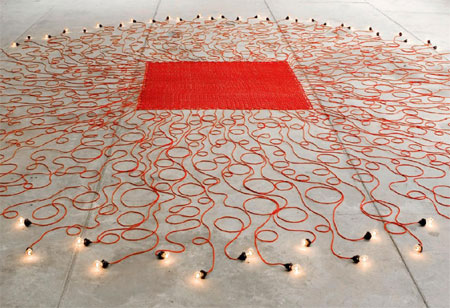
MONA HATOUM Undercurrent (red), 2008 (detail)
Image � the artist. Courtesy GALLERIACONTINUA |
|||
|
||||
|
||||
|
GALLERIACONTINUA / San Gimignano opening Sunday 13 September 2009, 11am - 3pm MONA HATOUM - Undercurrent (red) JORGE MACCHI - Rendez-vous MARGHERITA MORGANTIN - Air drawing MONA HATOUM Undercurrent (red) Opening: Sunday 13 September 2009 Via del Castello 11, 11am�7pm Until 7 November, Tuesday-Saturday, 2-7pm Following her solo exhibition in 2006, Galleria Continua is pleased to present Undercurrent (red), a show of new and recent works by Mona Hatoum. Over the course of a career spanning over twenty five years, Hatoum has become a prominent artist in the contemporary art world. Cultural and geographic displacement, the threat of war and the sense of existential precariousness and disorientation are central topics in her work. In this exhibition Hatoum revisits some of the themes that have become emblematic of her practice in the last decade, namely work that often draws on the everyday using recognizable objects that have been transformed into unfamiliar and disquieting sculptures. Paravent (2008) is based on a fold-out cheese grater scaled up to the size of a room divider, giving it surreal and architectural dimensions. Similarly, Dormiente (2008) is based on a grater with curved ends enlarged to the size of a bed that promises discomfort and pain. �Hatoum tackles the domestic setting and the concept of home, bringing something foreign into it. She is perhaps most well known for her striking sculptures which reproduce innocuous kitchen utensils � graters, colanders, egg-slicers and vegetable choppers, for example � on a gigantic scale, turning them into threatening and monstrous objects if not instruments of torture. Most critics seem to interpret them as objects which point to the inherent cruelty in daily routine or in the imposition of domestic life. I, however, prefer to see them as belonging to a �surreal� journey that begins with Duchamp�s ready mades and which brings perturbation into the field of phenomenality.� (Chiara Bertola, Interior Landscape, Charta, 2009). Hatoum�s works are never rigid or crystallized. They seem to be open to transformation as, for example, in Bukhara (maroon), a traditional oriental carpet that looks as if it is in a state of disintegration as large patches of the weave appear to have been moth-eaten or somehow worn-out. On second glance one can see that the apparently random patches come together to form a recessed world map. The same potential for change can be seen in Undercurrent (red) 2008, the largest piece in the exhibition. It occupies the entire stalls area of the gallery and lends its title to this show. Out of the central square of loosely woven red, cloth-covered electric cable, a long fringe snakes across the floor, each strand ending in a 15-watt light bulb that quietly brightens and dims at a slow �breathing� pace, hinting at a malevolent presence underfoot. Notions of threat are similarly referred to in a recent sculpture entitled Nature morte aux grenades, 2006-2007. A collection of colourful crystal blown into the shape of hand grenades are displayed on a steel and rubber trolley, setting up a contradiction between the seductiveness of the material and a subtext of danger. Mona Hatoum was born into a Palestinian family in Beirut in 1952. While on a short visit to London in 1975, the outbreak of the civil war in Lebanon prevented her returning so she remained in London ever since. She now divides her time between London and Berlin. By the mid-80s Hatoum had already established herself on the art scene with performances and video works in which the body was the expression of a divided reality, oppression and cultural and social control. By the early 90s Hatoum�s work became more focused on large-scale installations and sculptures. The artist has held solo exhibitions in numerous museums in Europe, the United States, Canada and Australia. Her exhibition The Entire World as a Foreign Land was the inaugural show for the launch of Tate Britain in 2000. In 2004, the most extensive survey of her work was organised by Hamburger Kunsthalle, and travelled to the Kunstmuseum Bonn, Magasin 3 Stockholm Konsthall and the Sydney Museum of Contemporary Art (2005). She has also participated in several important international exhibitions, namely the 46th Venice Biennale and the 4th Istanbul Biennial in 1995; Documenta XI in 2002; the 51st Venice Biennale in 2005, the 15th Biennale of Sydney in 2006; the 3rd Auckland Triennial and the 8th Sharjah Biennale in 2007 and in 2008, the XIII Biennale Donna at Palazzo Massari PAC in Ferrara was devoted to a solo exhibition by the artist. Recent exhibitions include Measures of Entanglement, UCCA, Beijing (2009) and Interior Landscape, which is currently showing at the Fondazione Querini Stampalia in Venice and runs till the 20th of September 2009. JORGE MACCHI Rendez-vous Opening: Sunday 13 September 2009 Via del Castello 11, 11am�7pm Until 7 November, Tuesday-Saturday, 2-7pm Galleria Continua is pleased to present Rendez vous, the latest solo show by Jorge Macchi, one of the leading artists on the Latin American art scene. The exhibition is organized around a previously unshown group of works � sculptures, videos, photographs and drawings, produced specifically for this exhibition. Macchi�s work resists any form of exegesis. Rather than following a linear progression, his works appear as dense and intricate semantic networks. Information is knowledge that comes from everywhere and ends nowhere. The artist often draws on newspapers, paradigms of information archives based on facts. Over and above the simple information content, the writings and poetry play an important role in his work, as does music, which in this exhibition once again appears, in the video piece 12 short songs, to be a complete formal language. Macchi�s works are also conceived from anecdote, chance and everyday life. Signs are silently broken down and then pieced together again according to a process of �de-familiarization�. In the artist�s view, the simpler and cleaner the object, the more it is capable of containing references and the more its relationship with us will be personal and sentimental. This �oblique strategy� and a sharp sense of black humour are characteristic of his work. In his works Macchi likes to suggest the existence of a world parallel to our own, hidden beneath a surface of banality � reality is elusive. The artist is interested in recreating a parallel reality, and his work is an elegy to the absence of a single vision of the world. The encounter between objects and materials in his work stimulates new readings of everyday life. Rendez vous, which is also the title of the show, is emblematic in this sense: an old wooden wardrobe is positioned precariously on a mirror at the end of the first flight of steps in the gallery. The wardrobe mirror and the gallery mirror meet, producing unexpected reflections. Macchi clearly shows an interest for margins, endings and fragments, what has fallen behind us. In his universe, everything is in transit, precarious. Nothing is ever permanent. His pieces reflect absences which order the scenes as strongly as each presence. He is an artist of loss and nostalgia. Signs of a collective memory increased by connotations were used by the artist to develop Cavern, his personal vision of the contemporary world. The souvenirs are fragmented, on the same level as reality and images. For him, the atmosphere acquires something metaphysical, a mysterious tranquillity, seriousness or calmness. The emotional truth seems as solid as a scientific truth, and his images are many stories which haunt him. Without a doubt, his work is fiction that ponders over communication and the hereafter of language, the inexpressible proportion. Jorge Macchi was born in 1963 in Buenos Aires, where he lives and works. He is one of the most prominent members of the generation of Argentine artists that emerged in the 90s. In 1993 he moved to Paris, the start of a five-year period during which he travelled all over Europe, participating in residencies, amongst other places, in Rotterdam, Amsterdam and London. In 1998, Macchi returned to Buenos Aires. In 2005 he represented Argentina at the Venice Biennale. His work has also been shown at the biennials of Havana, Sao Paolo and Istanbul, at Le Creac in Ivry-sur-Seine, at 10Neuf, the Regional Contemporary Art Centre in Montb�liard, at the MUHKA in Antwerp, the Walker Art Center in Minneapolis, the New York Sculpture Center and the MUCA in Rome. MARGHERITA MORGANTIN Air drawing Opening: Sunday 13 September 2009 Via Arco dei Becci 1, 11am�7pm Until 7 November, Tuesday-Saturday, 2-7pm Galleria Continua is pleased to present a new solo show by Margherita Morgantin, one of the most interesting representatives of the Italian art scene in recent years. The Venetian�s artist practice starts with the observation and description of concrete things or situations, before moving on to explore an interior condition. Her poetics is expressed through photographs, drawings and video works, which are also often realized by means of a succession of photographic sequences, fade outs and superimpositions. Her works are punctuated by pauses and silences, placing the viewer in a position to piece together the missing pieces and also to activate an imaginative capacity that offers new possibilities and perspectives. Untitled (2009), the large-scale installation shown by Morgantin in this solo exhibition, seems to refer to a state of shipwreck and failure but also, invariably, to the possibility of re-emerging again. �Once again I dwell on security, control, self-control, colour, geometry and god, and the thoughts that I cannot rationally grasp are still the majority. The tension created by this is one of the fundamental materials of my practice,� comments Morgantin. And she continues: �Then there are the orange lifejackets, which, with their specific shape, simultaneously reference the form of a body and its absence. They deny the pure geometry of the cube.� In a recently published essay, art critic Emanuela De Cecco affirms: �This work is the result of an encounter/clash which starts from the assumption of a strong model through the use of a sign pertaining to another, equally strongly connotated universe. Moreover, one can glimpse the space for thinking once again in terms of a possible further articulation of the relation between subjection and the coming into being of the subject, a step, also in relation to the thinking of Butler, necessary for being able to carry on expressing oneself. The lifejackets, lots of them, refer to survival, to an earthly salvation understood not as an individual fact but as something regarding a collectivity. It might be the metaphor of an existential condition that potentially concerns us all, but, bearing in mind the clues that are actually presented, a directly political reference would be reductive. Margherita Morgantin, as I said at the beginning, does not orient interpretation, closing down on a single reading. Rather, there are reasons for thinking that this work participates in an acknowledged legacy so as to reinvent it from within. This is where the choice is political, and it is in this sense that a political reading focusing on the lifejacket as object would be reductive.� Nature and meteorological phenomena are often dwelt upon by Morgantin in her work. The landscapes evoked by the artist are not just recordings of what the eye sees. Instead, they express a synchronic relationship between personal experiences and technical functions, as in the video Air Drawing (2009) featured in this exhibition. It comprises a series of sequences taken from thermographic surveys which make the effects of wind on land visible. Wind movements produce drawings on the landscape: hot currents are white, cold currents are black. Turbulence and vortexes lend themselves to being read as emotional traces, evidencing the artist�s ability to bring together mind and heart, artistic vision and scientific influence. Wind is also the protagonist of the previously unshown installation set up by Morgantin in the garden of the gallery. Margherita Morgantin was born in Venice in 1971. She graduated in Architecture from the Department of Technical Physics at the University Institute of Architecture in Venice. She lives and works in Milan, Venice and Palermo. Major solo shows include: Palermo_zen (white rainbow), curated by H. Marsala, ZEN 2 neighbourhood, Palermo (2009); Download-now #4, Fondazione Olivetti, Rome, curated by F. Comisso (2005); Codice Sorgente, Galleria Continua, San Gimignano (2004); Baggage identification tag, curated by D. Bigi, Casa Musumeci Greco, Rome (2004); Spazio Aperto, Galleria d�Arte Moderna, Bologna, with Davide Tranciana, curated by C. Bertola (2003); Arte all'Arte 7, project for the Teatro dei Leggieri of San Gimignano, Palazzo delle Papesse, Siena (2002). She has also contributed to many group shows in Italy and abroad, including Piove dentro a l�alta fantasia, Museo Marino Marini, Florence (2007); D�ombra, curated by L. Vergine, Compton Verney Art Museum, Warwickshire (UK) and MAN, Nuoro (2007); Videoreport Italia 2004-05, Galleria Comunale d�Arte Contemporanea di Monfalcone (2006); Biennale Donna, curated by E. De Cecco, Galleria d�Arte Moderna e Contemporanea di Ferrara, Ferrara (2006); Il potere delle donne/The Power of Women, Galleria Civica di arte contemporanea, Trento (2006); Con altri occhi, curated by K. Anguelova and R. Pinto, Palazzo della Ragione, Milan (2005); Aperto per lavori in corso, curated by F. Pasini, PAC, Milan (2005); Alineamenti, curated by L. Aiello, S. Risaliti, Trinitateskirche, K�ln (2005); Sweet taboo, curated by R. Pinto, Kompleksi-Goldi, Tirana, Albania Tirana Biennale 3 episode II (2005); Empowerment, curated by M. Scotini, Museo d�Arte Contemporanea di Villa Croce, Villa Mombrini, Genoa (2004). GALLERIACONTINUA / San Gimignano Via del Castello 11 - 53037 San Gimignano Italia Tel. +39 0577 943134 Fax +39 0577 940484 mar-sab ore 14-19 | Tue-Sat h. 2-7 pm | [email protected] | www.galleriacontinua.com |
||||
re-title.com
International contemporary art
SIGN UP FOR NEWSLETTERS

 SIGN UP for ARTIST MEMBERSHIP
SIGN UP for GALLERY MEMBERSHIP
SIGN UP for ARTIST MEMBERSHIP
SIGN UP for GALLERY MEMBERSHIP
Click on the map to search the directory