|
Galeria Fortes Vila�a: Alejadra Icaza - 25 June 2009 to 27 July 2009 Current Exhibition |
||||
|
Alejadra Icaza
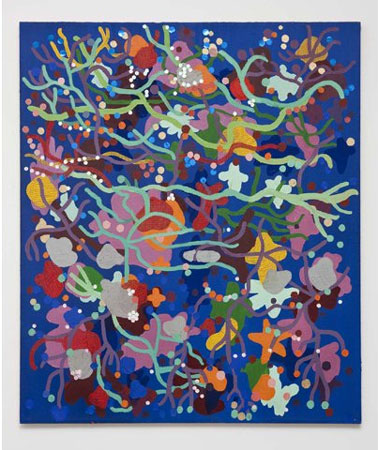
Las Medusas de Matisse, 2009 Mixed media on canvas, 195 x 165 cm |
|||
|
||||
|
||||
|
English below Galeria Fortes Vila�a Alejadra Icaza 25.07.09 - 29.08.09 A Galeria Fortes Vila�a tem o prazer de apresentar a terceira exposi��o individual de Alejandra Icaza no Brasil. Cinco pinturas inspiradas nas formas e cores dos fundos dos mares comp�em a exposi��o da artista espanhola, juntamente com colagens in�ditas. Nos presentes trabalhos, Icaza utiliza uma paleta de cores vibrantes. Em Las Medusas de Matisse, a artista adota um colorido brutal, em que amarelos c�tricos, laranjas e vermelhos vivos se destacam sobre o fundo azul intenso. Como aponta o t�tulo, a artista faz uma refer�ncia � Henri Matisse. Defensor da cor como o �fator principal da pintura�, Matisse - em sua fase mais fauve - buscava uma �arte do equil�brio, destitu�da de temas perturbadores ou deprimentes�, assim como Icaza.O impacto das pinturas tamb�m se d� pelas formas, por vezes espont�neas, gestuais e voluptuosas; por outras, feitas a partir de um tra�ado preciso, de linhas finas e delicadas. Nas telas Tomates del Mar e Japanese Flowers, Icaza desenha com uma ponta seca sobre as grossas superf�cies de tinta e cera. As linhas se afundam na tela, criando uma textura que faz com as pinturas se pare�am com matrizes de gravura. Flores, folhas e estrelas do mar s�o desenhadas repetitivamente, criando padronagens que ocupam toda a superf�cie das telas. Desta vez, Alejandra Icaza traz mais elementos � pintura. Na obra Vegetalia, al�m de desenhar, a artista cola na tela mi�angas brilhantes, pontuando a composi��o e propondo uma discuss�o acerca dos limites entre a pintura, o desenho e a colagem. Em todas as obras, a artista prop�e um �ritmo visual�, sugerindo movimento e vibra��o. Sua pintura se distancia de qualquer narrativa linear e semelhan�a com o real. Alejandra Icaza nasceu em Bilbao, em 1966. Atualmente vive e trabalha em Madri. Entre as exposi��es que realizou recentemente, destacam-se as mostras individuais na Galeria Edward Tyler Nahem, New York, USA, em 2007 e no Centro de Arte de Salamanca, na Espanha, em 2004. [English] Galeria Fortes Vila�a is pleased to present Alejandra Icaza�s third solo show in Brazil. The Spanish artist�s exhibition consists of paintings inspired by undersea forms and colors, together with never-before-shown collages.In the present works, Icaza uses a palette of vibrant colors. In Las Medusas de Matisse, the artist adopts a brutal coloring, in which citric yellows are highlighted along with vivid oranges and reds against an intense blue background. As the title indicates, this painting refers to Henri Matisse, who held that color was the �main factor in painting,� and who, in his fauve phase, sought for a �balanced art, without perturbing or depressing themes,� just as Icaza does.These paintings are also striking for their shapes, which are at times spontaneous, gestural, and voluptuous, while at others they arise from a basis of precise, thin and delicate lines. In the paintings Tomates del Mar and Japanese Flowers, Icaza draws with a drypoint needle over the thick surfaces of paint and wax. The deep-cut lines compose a texture that makes the canvases resemble engraved printing plates. Flowers, leaves and starfish are drawn repetitively, creating patterns that cover the entire surface. This time, Alejandra Icaza brings more elements to her painting. In the work Vegetalia, besides resorting to drawing, the artist glues bright beads to the canvas, punctuating the composition and proposing a discussion about the limits between painting, drawing and collage. In all of her artworks the artist proposes a �visual rhythm,� suggesting movement and vibration. Her painting lacks any linear narrative or resemblance with reality. Alejandra Icaza was born in Bilbao, in 1966. She currently lives and works in Madrid. Her recent exhibitions most notably include solo shows at Edward Tyler Nahem Gallery, in New York, USA, in 2007, and at the Centro de Arte de Salamanca, in Spain, in 2004. |
||||
re-title.com
International contemporary art
SIGN UP FOR NEWSLETTERS

 SIGN UP for ARTIST MEMBERSHIP
SIGN UP for GALLERY MEMBERSHIP
SIGN UP for ARTIST MEMBERSHIP
SIGN UP for GALLERY MEMBERSHIP
Click on the map to search the directory