|
Galerie Eva Presenhuber: AMY GRANAT | MONIKA BAER : IN KETTEN - 18 Apr 2009 to 23 May 2009 Current Exhibition |
||||
|
Amy Granat
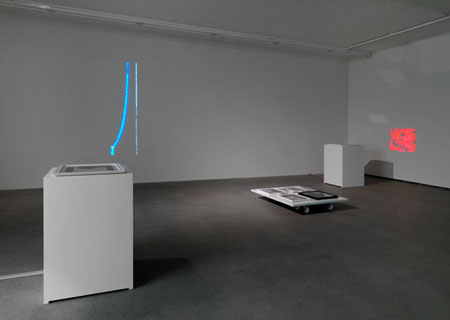
Installation View Galerie Eva Presenhuber, Zurich, 2009 |
|||
|
||||
|
||||
|
AMY GRANAT | APRIL 18 2009 - MAY 23 2009 Galerie Eva Presenhuber is pleased to present a solo exhibition by New York-based artist Amy Granat (*1976), featuring new works. Since completing her art studies at Bard College, in New York, Amy Granat has participated in exhibitions at venues such as the P.S.1 Contemporary Art Center in Long Island City, the Swiss Institute in New York, or the Milwaukee Art Museum, and the Palais de Tokyo in Paris, among other. The majority of Amy Granat�s work consists of films and photography. Often creating abstract films without a camera, she uses the materials in untraditional ways. The destructive use of color or acid, the scratching and puncturing of the film strip: these manual modifications mani-fest themselves in a variety of reflections and distortions that, through the process of projection, generate pictorial shapes. The artist�s oeuvre also includes films that are characterized by a stronger narrative thread. At the 2008 Whitney Biennial, for instance, she showed the film T.S.O.Y.W. (�The Sorrows of Young Werther�), a 200-minute double projection made in collaboration with the artist Drew Heitzler, in which a young protagonist travels across the vast American landscape on a motor-cycle, passing major earthwork sites along the way (Spiral Jetty, the Lightning Fields, the Sun Tunnels). In a major new work on view in this exhibition, Amy Granat continues her interest in land art and nature as psychic space with �Landscape Film�, filmed at Cahokia Mounds, the site of a Native American city built between 700 and 1400 AD in what is now the state of Illinois. The ancient and sacred mounds, juxtaposed with modern day architecture, roads, flagpoles and walking paths, create a stirring portrait of man-made ladscapes. Granat then took the film strip, shot in black-and-white, and hand painted the sections of it in monochrome washes of color, resulting in a film that combines film as recorded image with a charged emotional space. While the camera frames, divides, crops, flattens, the color washes create fluid boundless movement. Alongside the film is a new sound piece, conceived in parallel with � but separate from � the film itself. On show at Galerie Eva Presenhuber will be a new series of photographs, placed ont table-tops, where different objects become abstract and evoke the interplay of light and shadow. A tension between the original and the reproduction, an oject and its physical trace, leads to the dream-like reality typical of Granat�s work. Her choice of photograms, and her hand-made process in the dark-room, allows each image to be unique, undermining the tradition of photo-graphic reproduction. Experiments with photographs began as early as the mid-19th century, but it was not until the 1920s that the technique gained wide popularity, with artists such as Man Ray or Lazlo Moholy-Nagy. However, Granat�s reference reach beyond that to include the abstractions of Frank Stella, and �F.F.F�, her new series of paired photograms, refer to Stella�s 1969 painting �Flin Flon III�. Central to Granat�s work is how she experiments with and defamiliarizes her media. Her films have a pictorial feel, while her photographic works are reminiscent of sculptures: scratched lines make up her projected images, and pieces of film strips appear on her photograms and collages, the exhibition at Galerie Eva Presenhuber also includes two projections of �Black and Blue�, a new abstract cameraless film, as well as a backlit digital print on transparent paper. In addition to a number of private collections, the artist is also represented in several public col-lections, such as the Museum of Modern Art and the Whitney Museum of American Art in New York, or the Fonds National d�Art Contemporain in France MONIKA BAER | IN KETTEN | APRIL 18 2009 - MAY 23 2009 Monika Baer�s latest exhibition, titled �In Ketten� (�In Chains�), combines paintings from different series into a circuit along which her various motifs and pictorial strategies can be experienced in a broader context. The show features images of roads and paper money, spider webs, walls and holes, breasts and seams: Not only do the motifs vary, but the artist also makes use of a wide range of materials, techniques, and ways of painting. Rather than reflecting a change of style or a succession of different �periods�, the diversity of these elements is to be understood as a fundamental principle of Baer�s artistic approach. While still in the making, the paintings already refer to one another, evolving through mutual attraction and rejection. Thus, the title �in Ketten� may be interpreted both as a chain of heterogeneous themes and visual constituents and the feeling of being captivated by, or caught in, every single painting - a feeling that, although eventually offering the opportunity to move on, initially presents an obstacle that needs to be overcome in artistic terms. The psychological and emotional space that opens up both within each piece of work and between the paintings cannot be separated from material aspects related to motif and technique. In this light, a road might just as readily be seen as the path of life as it could be considered an element of self-reflection that shows the path from one painting to the next. Most of the time, though, the depicted roads can only be recognized as the markings of a centerline whose individual strips could be the paintings themselves moving within the pictorial space. In some pieces, these paths are dynamic and free, while they are relocated and blocked in others. Since her early years at the D�sseldorf Art Academy, Baer has avoided following specific traditions of painting. She seems, however, to have been influenced by the minimalist, conceptual, and performative approaches that formed the essential points of reference at the Academy at the time. The performative factor has found expression in one pole of her artistic approach that one might define as �stage-like�. In these works � from the series of the �huts� and the so called �Mozart paintings� to the �hunter�- and �vampire� series �, props, sceneries, and masks appear as key starting points for entering into an unusual exploration of painting as a discipline of art that stages its possibilities. The other pole of Baer�s work could be viewed, against a minimalist-conceptual background, as the very �object� of painting, revealing itself, since her cut pictures of the late nineties if not earlier, in the seams of her breast paintings and, especially in her recent web paintings, in the form of visible framework, carrier surface, and, sometimes, even mounting. Object and stage may well represent opposite poles, but there is an increasing interplay happening between them, which thematizes the object-like side of the stage and the stage-like side of the object. The individual themes develop in the area of tension in between. They may appear both literal and linked, trivial and thought-through at the same time. Some paintings seem almost emptied and meaningless, while others leave the impression of being loaded with collectively experienced, emotional, and psycho-sexual moments of meaning. On the one hand, the object may turn into a motif, as can be seen in the jeans-like seams of Bear�s breast paintings; on the other hand, the motifs, such as the breasts, become objects � not only in a sexual sense (both as passive objects to be looked at or desired and as active �subjects� that drip and squirt), but also in a literal sense, since they end up serving as a carrier surface for the paintings. Along these lines, her seemingly realistic bills, which seem almost within reach, can also be read as abstract surfaces that vanish into the pictorial space. The webs, in turn, are based on actual spider webs; here, the motif becomes virtually identical with the object of the painting, while the monochrome coloration ranging from pink to peach alludes to other levels of reference altogether. It is in this kind of exchange, the process of veiling and unveiling, that Monika Baer�s artistic agenda becomes evident. Her paintings accentuate the ambivalence between perception and recognition, between the technique and production of a piece of work, and generally between the content, expression, and medial conditionality of painting in ways that make them appear paradoxical. |
||||
re-title.com
International contemporary art
SIGN UP FOR NEWSLETTERS

 SIGN UP for ARTIST MEMBERSHIP
SIGN UP for GALLERY MEMBERSHIP
SIGN UP for ARTIST MEMBERSHIP
SIGN UP for GALLERY MEMBERSHIP
Click on the map to search the directory