|
Galerie Eva Presenhuber: Valentin Carron | Peter Fischli & David Weiss - 6 June 2009 to 31 July 2009 Current Exhibition |
||||
|
|
|||
|
||||
|
||||
|
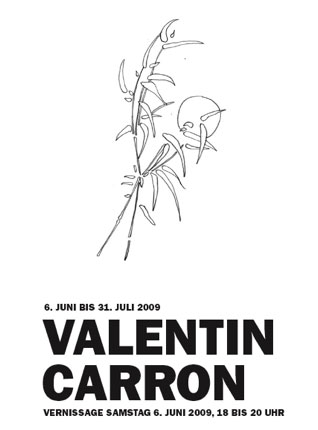
Valentin Carron June 6 to July 31, 2009 Opening: Saturday, 6 June, 11am � 5 pm Galerie Eva Presenhuber is pleased to present a new exhibition by the Swiss artist Valentin Carron. �For his second solo show at Galerie Eva Presenhuber, Valentin Carron (1977, Fully) takes as his model the kind of museum display found in European historical institutions. This is a �period room,� where objects belonging to different art historical categories, such as �fine� or �decorative arts� are placed alongside each other, recreating for the viewer a general feel of the aesthetic of a given epoch. Of course such a canonical display of good taste is always already a show of power, whether that of an old-world bourgeois order (one thinks of the countless public historical museums scattered throughout Europe,) or, in it�s new world embodiment, of raw, private capital (such as the Frick collection in New York). The works exhibited here either duplicate or inspire themselves from existing artifacts, decorative patterns and public sculptures found in the artist�s immediate surrounding in the Valais. It is a peri-urban region, home to a rural aesthetic supposed to represent, since the late 19th century, the �essential� values of the country, and which exists side by side with a generic version of modernism devoid of progressive ideology. The result yields a grim, unflinching scale model of a (pan-European) culture incapable of truly renewing itself. Contrary to the beliefs of many artists of Carron�s generation working with nostalgic, avant-garde motifs, this culture � our own � lies just around the corner.� Text by Fabrice Strout For further information, please contact Thomas Jarek at Galerie Eva Presenhuber. In parallel with this exhibition, Galerie Eva Presenhuber will present a solo show by Peter Fischli/David Weiss. Opening hours: Tuesday � Friday 12 noon - 6 pm Saturday 11 am - 5 pm Upcoming exhibitions at the gallery: Douglas Gordon ,August 29 � October 17 Opening: Friday, August 28, 6 - 8 pm Gerwald Rockenschaub, August 29 � October 24 Opening: Friday, August 28, 6 - 8 pm Peter Fischli David Weiss June 6 to July 31, 2009 Opening: Saturday, June 6, 11 am - 5 pm A Brief Biology of the Film Animal, with Particular Regard to Rat and Bear The only difference between film and real life, according to the American philosopher Stanley Cavell, is that what the film shows does not exist. However, since existence is not an attribute, as Kant has demonstrated in his ontological argument for the existence God in the Critique of Pure Reason,1 this difference carries little weight. The same applies to a film animal: there it is, before our eyes, moving, eating, procreating, etc., for as long as the footage can be projected (or for as long as the DVD can be played). At the same time, it does not really exist � at least not in the sense that you would have to feed, groom or fence it in. But since existence is not an attribute and the film animal appears very much alive in every other respect, we should not be sidetracked by the mere fact of its non-existence. Instead, the world of film animals should be considered as a world that has its own order, its own categories, classifications and subspecies and, with that, its own taxonomy and system. Biology, as Wolfgang Lef�vre points out, is a historical discipline and those who study the history of the film animal have no reason not to conduct themselves just as a biologist would on examining a particular example. The first step would be to determine the taxonomic classification, because, as Stephen Jay Gould says on the subject of taxonomy, it is �the most underrated of our disciplines� and �its changes through time [are] the best guide to the history of human perceptions.�2 Generally speaking, the world of film animals is, in many respects, congruent with the realm of real, or non-film animals. But it has a far greater diversity of species. The current number of extant species, depending on author, is estimated anywhere between 2 and 100 million. The number of film animal species is unlimited. The world of film animals comprises reconstructions of extinct species such as dinosaurs as well as simulated species that might one day exist. Consider the giant octopus that has come ashore to dwell in the rainforest, featured in the series The Future is Wild, which shows how the animal world might look 200 million years from now. It also includes animals that look like a perfectly real species, but act like a completely different animal, much the way the Disney jungle comedy shows a realistic-looking elephant behaving like a trained dog. Finally, the world of film animals includes all the animals ever recorded on film in their natural habitat or in a laboratory situation, in other words species that still existed at least when the film was shot. We could also speak of reconstructed animals 1 Anselm of Canterbury (1033-1109) opens his Proslogium with the proposition that God is �that than which nothing greater can be conceived� and that this greatest being that exists in our understanding must therefore necessarily exist in reality. Kant calls this the ontological argument for the existence of God and refutes it by stating that the possibility of thinking a supreme being by no means implies its real existence. In this respect, existence is not an attribute. The possibility of thinking God proves neither his existence nor his non-existence. Similarly, the ontologically precarious status of the film animal � the fact that it appears to be present and yet is not � is no proof of its non-existence. See Sidney Norton Deane, ed. and transl., St. Anselm, Proslogium (Chicago, 1926), 7-8. 2 SJ Gould and Rosamond Wolff Purcell, Illuminations � A Bestiary (New York: Norton, 1986) 13-14. (dinosaurs), projected animals (rainforest-dwelling octopuses and elephants with canine behavioural traits) and archived animals (all those that existed as a real species at the time of filming). But what kind of film animals are Rat and Bear? �Rat and Bear are not animals; they are people in animal costumes,� says Peter Fischli.3 And he should know because at the time the film was shot, he was inside the Bear costume. It sounds plausible because Rat and Bear can speak and use tools. Since Jane Goodall�s groundbreaking early 1960s study of the use of tools by chimpanzees, we know that the description of man as homo faber no longer fits the bill: the ability to use tools is not the sole distinction between humans and animals.4 As for the ability to speak, it is so common among film animals � even those that are obviously not humans dressed in animal costumes, for instance animated mice � that language can also be dismissed as a means of defining Rat and Bear as non-animals. Actually, it is probably inadvisable to accept the animal actors� own characterisation unconditionally, just as we tend not to take at face value the statements made by artists wishing to explain their work. After all, where would that leave the critics?5 In this case, taking the statement at face value would mean reducing the film animal to its pro-filmic reality (actors in costumes in front of the camera) and negating its filmic reality (Rat and Bear in the city, Rat and Bear in the mountains). In other words: what Fischli and Weiss do in costume while being filmed represents a different reality from what Rat and Bear do on the screen when they make their way through the city and the mountains. One option with regard to the taxonomic classification of Rat and Bear can be discounted right from the start. Rat and Bear are not fable animals in film. Fable animals are human figures with animal masks that give them the license to say things with impunity that the author could not say himself without breaching social convention or getting into trouble with the powers that be. Rat and Bear are very much on a human scale: Rat is too big and Bear rather too small, but both are about the same size as an adult human. More importantly, they break a visual taboo.They inhabit landscapes that were the preserve of others at the time the film was made: Los Angeles belonged to Hollywood and the Swiss Alps to sentimental local-interest films and the tourist industry. In the 1980s, every self-respecting politically correct Swiss artist eschewed these landscapes with a shudder of profound abhorrence. Anyone wanting to operate in these areas had to be very smart in such a political climate. Fredi Murer reclaimed the Alps in his 1985 opus magnum H�henfeuer, in which he transposed the style of Japanese director Ozu Jasujiro and his cameraman Yuharu Atsuta to his native Swiss mountains. Murer�s solution was to avoid showing any mountain peaks, to favour long takes and to keep the camera more or less at knee level. That way, the Alps really don�t look anything like a setting for patriotic, sentimental cinema. Hardly anyone might notice, but it works. Rat and Bear, on the other hand, are clearly visible at all times. Whatever they do, they do in full view of all. And what they do can best be described in biological terms: Rat and Bear is their biogeographical designation. The form, appearance and behaviour of conventional animal species are determined over thousands of evolutionary generations by environmental factors in combination with mutation and selection. Rat and Bear, by contrast, turn the process of evolution upside down; their appearance and behaviour redefine the environment. Not only do they occur in both the city and the countryside. City and country are no longer the same when they appear there. Or, to put it in the words of art and film criticism: their very presence breaks through the thick crust of time-honoured associations deposited on the urban and rural landscapes. We see them and at the same time we cannot believe our eyes. They refresh the gaze, just as the Russian 3 Personally communicated to the author by Peter Fischli, 26 February 2009. 4 Jane Goodall, �Tool-Using and Aimed Throwing in a Community of Free-Living Chimpanzees�, in Nature 20, 1264 � 1266, 28 March 1964. 5 Since the Romantic era, there has been an ineffable aspect to the work of art, a silent aspect that requires interpretation and finds expression only in the critical reception of the work, which thus completes it. We shall continue in this vein, even though the question that the work poses here is one of biology and taxonomy. Critical reception, in this context, also means identification and can therefore also be used as a description for the fundamental task of the biologist. Formalists of the 1920s did when they defined this as the strategic aim of art and its tactical form-finding process. So when Rat and Bear bring taboo images back into the realm of accepted beauty, this is very much the filmic equivalent of an otherwise taboo utterance made by a fable character behind the protective mask of an animal. In this respect, they do seem to be related to fable animals. However, the Rat and Bear films do not comply with the second, crucial criterion that defines fable characters. Fables are meant to be edifying and to teach us moral lessons about human weaknesses, criteria shared with many films from Switzerland, the land of, Rousseau and Pestalozzi. Irrespective of all art philosophical talk about the autonomy of art in the modern era, films from Switzerland generally aim to have some educational side-effect. It is no coincidence that a famous scene in Alain Tanner�s Jonas qui aura 25 ans dans l�an deux mille is set in a school classroom. The Least Resistance and The Right Way, by contrast, do not pass the educational test. City and countryside, the corrupt and corrupting metropolis and the wholesome, unspoilt Alpine meadows are the two landscapes that shaped the thinking of Rousseau, whose distaste for corrupt Parisian society led him to the strange conclusion that man was inherently good and that a life lived in the bosom of nature was the best kind of life. [...] |
||||
re-title.com
International contemporary art
SIGN UP FOR NEWSLETTERS

 SIGN UP for ARTIST MEMBERSHIP
SIGN UP for GALLERY MEMBERSHIP
SIGN UP for ARTIST MEMBERSHIP
SIGN UP for GALLERY MEMBERSHIP
Click on the map to search the directory