|
Galerie Peter Kilchmann: Adrian Paci - The Encounter Maja Bajevic - Layers - 10 Nov 2011 to 23 Dec 2011 Current Exhibition |
||||
|
Adrian Paci
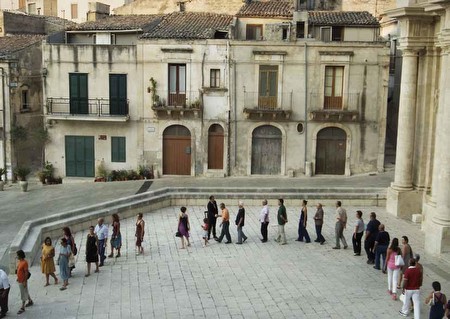
The Encounter, 2011 (video projection and c-print) |
|||
|
||||
|
||||
|
Adrian Paci The Encounter Nov. 10 — Dec. 23, 2011 Maja Bajevic Layers Nov. 10 — Dec. 23, 2011 ADRIAN PACI The Encounter Galerie Peter Kilchmann is pleased to present the fourth solo exhibition of the artist Adrian Paci. Adrian Paci was born in Shkoder, Albania, in 1969, and he immigrated to Italy in 1997. Since then he has been living and working in Milan. Apart from the new video work The Encounter Adrian Paci will be showing a freestanding mosaic piece, new paintings, works on paper and photographs. The video work The Encounter (2011) shows a man as taking a seat in the middle of a public square. Gradually, several hundred protagonists enter the square and consecutively approach the man, who stands up to shake their hands. The simple and habitual gesture of the handshake is repeated so often that it transforms itself into a meaningful ritual. While the reason for the ceremonious meeting remains unknown, the encounter between the participants becomes charged with tension. A moment of connection occurs, not only between the participants, but also between the persons and the square, which is transformed into a stage. The video work was produced in the town of Scicli on Sicily. With the 12-part series Passages from 2010 (acrylic on wood) the artist also questions traditional rituals. Here, the gesture of the handshake as the visualization of fleeting everyday encounters is again a central theme. Persons come and go, greet each other and say goodbye, and at times touch the shoulder of the person opposite. In contradiction to the video piece the twelve small-format works are a collection of single moments and thus framed by the choice of the moment, the angle, the color and the painting technique. The confrontation between painting and video questions the supposedly objective camera eye. The works are true “snap-shots”, capturing the fleeting encounter between two people, who have a reaction towards each other and then depart again, without knowing where the other is going, or what will happen in their own future. What can we decipher in a face of a person about his history, his wishes and relationships? Similar to the works The Encounter and Passages the new mosaic piece The Brothers (2011) centers on the interpersonal. Here, the viewer is drawn in; he peers into faces which he can never comprehend entirely, and that compel her to fill the empty spaces in the mosaic with her own thoughts and fictions. Adrian Paci highlights existential themes as well as mundane topics, which he combines to archive intriguing results. In his well-known work Centro di Permanenza temporanea (2007) he had two dozens people walk up a plane ramp leading nowhere, and in his video work Vajtoica (2002) he reenacted a death ritual. In Adrian Paci ʼ s artistic practice there is always a noticeable tension between the ordinary and the exceptional, the real and the fictional. His works are formed by an emotional sympathy for individual fates, while his story telling is compelling in its simplicity. Adrian Paci ʼ s works have been presented in numerous exhibitions and publications, such as the exhibition Electric Blue in Kunsthaus Zurich in 2010, for which an exhibition catalog was published. In early 2012 Adrian Paci ʼs works will be shown in an exhibition in MAXXI ((Museo nationale delle Arti del XXI Secolo) in Rome. Other future projects include shows for the art space Jeu de Paume in Paris and the La Conservera in Murcia, Spain. Further publications worthy of notice include Adrian Paci by Kunstverein Hannover (2008) and another publication by the same title from the Galleria Civica di Modena (2006). All catalogs are available through the gallery. MAJA BAJEVIC Layers Galerie Peter Kilchmann is pleased to present new works by Maja Bajevic in its project space. Maja Bajevic was born in Sarajevo in 1967. She currently lives and works in Sarajevo, Paris and Berlin. In her artistic practice she questions fixed worldviews by showing how political structures and moral concepts are bound to historical settings. Maja Bajevic broaches the issues of History and Identity as unfulfilled constructions, unsteady and ever changing. The series Layers (2011) attest to the interest with which Maja Bajevic has followed the protests and tumults in Europe and the USA during the last months. The photographic images, pinned on canvas and embroidered, are exhibited hanging on a clothing line. The pictures were taken by journalists, who were present at the demonstrations. Maja Bajevic purchased the photos and left the titles as they had been, such as “M06D0501 – Mai2069”. The added embroideries of birds and flowers stand in contrast to the images and refer to values of tradition, continuance and a middle class resemblance of “normality”; a balance which has been destabilized through the protests. The artwork confirms that no system is unfailing, no ideal timeless and no truth untouchable. “Is change the only constant in history?”, Maja Bajevic seems to ask. The installation To be continued is made up of a machine with the visual appearance of an old-fashioned steam engine. The machine continually emits steam on which political and economic slogans are projected. The slogans become visible only for a short time on the visionary “steam curtain” before dissolving again. Maja Bajevic went through extensive research for this work, looking for principles that shaped the last century and remain unquestioned even today. To be continued makes all ideals equal by decontextualizing them and having them vaporize before our eyes, only to be succeeded by new concepts. The work points to the last utopias of the last century and the uncertainty their failures have made room for. On the one hand politics and economy still make use of the same slogans as before, but as ever more failures and crises become public even the last certainties seem to crumble. The motor behind the creation of ideas will not be stopped and so Maja Bajevic ʼ s machine goes on producing steam, and new slogans keep being projected – the future horizon is not empty, but shows ever more visions. Maja Bajevic ʼs solo show To be continued in the Crystal Palace of the Parque del Retiro, Museum Nacional Centro de Arte Reina Sofia in Madrid was a grand success. The following single exhibitions are also worth mentioning: Karaoke (2011) in the art space Moen 44 in Askeby, Denmark, and Import Export (2009) in Kunsthaus Glarus, Switzerland. The publication Maja Bajevic , complete with texts by Angela Vettese and Lynne Cooke and published by Charta in Milano, is also available through the gallery. |
||||
re-title.com
International contemporary art
SIGN UP FOR NEWSLETTERS

 SIGN UP for ARTIST MEMBERSHIP
SIGN UP for GALLERY MEMBERSHIP
SIGN UP for ARTIST MEMBERSHIP
SIGN UP for GALLERY MEMBERSHIP
Click on the map to search the directory