|
Galerie Peter Kilchmann: RITA ACKERMANN 'Marfa/Crash' | DEUX PI�CES - 7 June 2009 to 24 July 2009 Current Exhibition |
||||
|
RITA ACKERMANN 'Marfa/Crash'
|
|||
|
||||
|
||||
|
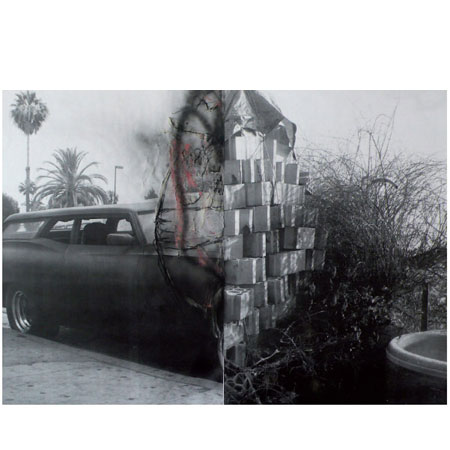
RITA ACKERMANN 'Marfa/Crash' June 7 � July 24, 2009 Opening: Saturday, June 6, 18.00 � 20.00 The gallery will be open Sunday, June 7 and Monday, June 8 Galerie Peter Kilchmann is pleased to announce the sixth solo exhibition by Rita Ackermann. The artist will be showing new big scale works on canvas she produced during her residency in Marfa, Texas these past months. The following text is written by the artist: marfa/crash parking accidents marfa is not normal. it�s an insane place that carries all the debuffetian values of savagery; instinct passion, mood, violence and madness. to stay there is like parking in the middle of a car crash. time stands still. marfa epitomizes a perfect point where time and space becomes one and substances collide. an intersection that only could be reached by a catastroph. there were a lot talks in marfa about speeding and racing. the "civilized" ones were afraid of pushing beyond the limits of the law, the "uncivilized" ones were building race cars to speed out of the law, out of civilization to help the civilized to feel human again. it's an insane place because it is a crash between the 2 sides of a split mind. it�s too human, raw and brutal. it�s unhuman because it makes one feel translucent with its light, space and peace. then it gets infected by the desert bug and becomes a ghost of creativity. cultural oasis in the desert where guns on the back seat of a pick up truck is necessary in case of a human size jack rabbit attack. there were all kinds of stories of accidents of drunk driving, fugitives and check points. there were ruins everywhere parking in the museum and in the back/ front yards of the ghost towns. some of these backyards looked rather like sculpture gardens or body part cementery of deceasing objects with a carefree stacking style, waiting to be reused, rebuilt, to be put back together to race again into the vanishing point where perfection can be reached only by the crash. the new body of work that i made there was as well the result of the crash. a crash between a single drawing (originally titled "get a job" that i brought down with me from new york city) and the marfa experience. when i chose the drawing i didn�t know how much sense it would make in this new environment. at last all i can say that there are no unnecessary accidents! The artist will be present at the opening. For photos and further information, please contact Annemarie Reichen at +41 44 278 10 10 or via email: [email protected] RITA ACKERMANN 'Marfa/Crash' 7. Juni � 24. Juli, 2009 Er�ffnung: Samstag, 6. Juni, 18.00 � 20.00 Uhr Die Galerie bleibt am Sonntag, 7. Juni und Montag, 8. Juni ge�ffnet Die Galerie Peter Kilchmann freut sich, die sechste Einzelausstellung von Rita Ackermann anzuk�ndigen. Die K�nstlerin pr�sentiert neue grossformatige Malerei, welche die letzten Monate w�hrend ihres Aufenthaltes in Marfa, Texas entstanden sind. Der folgende Text stammt von der K�nstlerin: marfa/crash parking accidents marfa is not normal. it�s an insane place that carries all the debuffetian values of savagery; instinct passion, mood, violence and madness. to stay there is like parking in the middle of a car crash. time stands still. marfa epitomizes a perfect point where time and space becomes one and substances collide. an intersection that only could be reached by a catastroph. there were a lot talks in marfa about speeding and racing. the "civilized" ones were afraid of pushing beyond the limits of the law, the "uncivilized" ones were building race cars to speed out of the law, out of civilization to help the civilized to feel human again. it's an insane place because it is a crash between the 2 sides of a split mind. it�s too human, raw and brutal. it�s unhuman because it makes one feel translucent with its light, space and peace. then it gets infected by the desert bug and becomes a ghost of creativity. cultural oasis in the desert where guns on the back seat of a pick up truck is necessary in case of a human size jack rabbit attack. there were all kinds of stories of accidents of drunk driving, fugitives and check points. there were ruins everywhere parking in the museum and in the back/ front yards of the ghost towns. some of these backyards looked rather like sculpture gardens or body part cementery of deceasing objects with a carefree stacking style, waiting to be reused, rebuilt, to be put back together to race again into the vanishing point where perfection can be reached only by the crash. the new body of work that i made there was as well the result of the crash. a crash between a single drawing (originally titled "get a job" that i brought down with me from new york city) and the marfa experience. when i chose the drawing i didn�t know how much sense it would make in this new environment. at last all i can say that there are no unnecessary accidents! Die K�nstlerin wird w�hrend der Er�ffnung anwesend sein. F�r Bildermaterial oder weitere Informationen kontaktieren sie bitte Annemarie Reichen unter +41 44 278 10 10 oder per email: [email protected] _______________________________________________________________________ DEUX PI�CES ART 40 Basel, booth C2, June 10 � 14, 2009 Gallery Peter Kilchmann, June 7 � July 24, 2009 Opening reception in the gallery, Saturday, June 6, 18:00 � 20:00 The idea behind the exhibition DEUX PI�CES is a dialogue that overcomes borders, between generations as well as between the local and the global. Starting point are five late Swiss artists � Adolf W�lfli, Emma Kunz, Karl Geiser, Mario Comensoli and Trudi Demut � who all accomplished a lot in their country but did not all achieve international recognition. We invited artists from our gallery to react to their works by creating new works or by choosing existing works that would go well with this project. The invited gallery artists are: Rita Ackermann, Francis Al�s, Michael Bauer, Raffi Kalenderian, Zilla Leutenegger, Jorge Macchi, Duncan Marquiss, Claudia & Julia M�ller, Fabian Marti, Adrian Paci, Bernd Ribbeck, Melanie Smith, Javier T�llez and Andro Wekua. DEUX PI�CES is the statement of a gallery intending to locate an international artist group as part of an older Swiss tradition. It is a plea for a careful mediation and a declaration of love to art. Whoever deals with art � be it artist, collector or gallery owner � is doing this primarily because of a strong passion. We all love art because we believe in its additional value, i.e. an ideal value that cannot be bought. Art makes our view more differentiated and enriches our life. Art is an offer. It functions without coercion and, yet, is compulsory. But in the overheated market-events of the last years this kind of liability has been more and more forgotten. Now, that the hot air has cooled and the view become clearer this tendency should be opposed emphatically. The exhibition will be on show almost simultaneously at our booth in Basel and in our smaller gallery space. The works of Adolf W�lfli, Emma Kunz and Karl Geiser belong to museums and to a private collector and are not for sale, whereas the works of Mario Comensoli and Trudi Demut belong to the respective estates and some are for sale. Most of the other pieces by the gallery artists are new works exclusively made for DEUX PI�CES. Adolf W�lfli was born in Berne in 1864 and died in 1930 in the Waldau psychiatric hospital in Berne. His psychiatrist Walter Morgenthaler dedicated his 1921 book �Ein Geisteskranker als K�nstler (A Mentally Ill Person as Artist)� to him, which took a schizophrenic patient seriously as an artist for the very first time. W�lflis� oeuvre consisting of poetry and pictures evades common aesthetic categories and became known to a broader audience only years after his death. Today, he is considered one of the most important artists of Art Brut. Emma Kunz (1892 - 1963) was working as a healer treating and advising people with the help of telepathy, prophecy and a pendulum. From 1938 on she developed her artistic work using the pendulum to create large drawings on scaled paper that were often geometrically strict and due to their subtle colours very graceful at the same time. Her work was reintroduced into the art world by Harald Szeemann. Karl Geiser was born in Berne in 1898. He worked mainly as sculptor but also made drawings, etchings and photographies. He was interested in the working classes, in scenes of the everyday life and in a real and direct feeling of life that he pictured in his figurative sculptures stylistically ranging between realism and classicism. He received numerous commissions for public sculptures, but depressions during the end of his life caused him problems in finishing the works. He was found dead in his studio in Zurich in 1957. Mario Comensoli (1922 -1993) used painting and drawing to critically interrogate social subjects during his whole life. For instance, he thematised and documented the life of the first migrant workers in the 1950s in Switzerland, the women�s movement and the youth riots in the 1970s and 1980s. When he painted workers in their working clothes in the 1960s he was accused of sympathy for social realism �a taboo at the climax of the Cold War. His work remains controversial to this day. The sculptor and painter Trudi Demut was born in Zurich in 1927 where she also died in 2000. She was a self-taught artist working with bronze and brass, but also with plaster, on canvas and paper. Trudi Demut opposed �women�s art�, nevertheless her art reminds one more of Meret Oppenheim or Louise Bourgeois than of her male contemporaries and her mythical poetical figures are of a fragile and a melancholic serenity. DEUX PI�CES ART 40 Basel, Stand C2, 10. � 14. Juni, 2009 Galerie Peter Kilchmann, 7. � 24. Juli 2009 Er�ffnung: Samstag, 6. Juni 18 � 20 Uhr Grundidee der Ausstellung �Deux Pi�ces� ist ein Dialog, der Grenzen sprengt, zwischen den Generationen ebenso wie zwischen dem Lokalen und dem Globalen. Ausgangspunkt sind f�nf verstorbene Schweizer K�nstler, die Grandioses geleistet, weltweit aber viel zu wenig bekannt sind. K�nstler unseres international zusammengesetzten Galerienprogrammes haben der Aufforderung Folge geleistet, auf ihre Werke zu reagieren und mit ihnen in einen Dialog zu treten. Herausgekommen sind Gegen�berstellungen, die von �berraschender N�he und erstaunlicher Vertrautheit erz�hlen. Der Blick unserer K�nstler stellt die ungebrochene Aktualit�t des Schaffens einer historischen K�nstlergeneration in den Fokus und l�dt dazu ein, ihre Qualit�t neu zu entdecken. �Deux Pi�ces� versteht sich als Statement einer Galerie, die eine international zusammengesetzte K�nstlerschaft als Teil einer langen Tradition in der Schweiz verorten will. Sie ist ein Pl�doyer f�r eine sorgf�ltige Vermittlung und eine Liebeserkl�rung an die Kunst. Wer sich um Kunst k�mmert, sei dies nun als Kunstschaffender, Sammler oder Vermittler, tut dies auch prim�r aufgrund einer grossen Leidenschaft. Wir alle lieben Kunst, weil wir an ihren Mehrwert glauben. An einen Mehrwert notabene, der ideeller Natur und nicht zu kaufen ist. Kunst macht unser Sehen differenzierter und unser Leben reicher. Kunst ist ein Angebot. Es funktioniert ohne jeden Zwang und ist doch verbindlich. Nur: Diese Verbindlichkeit ist im �berhitzten Marktgeschehen der vergangenen Jahre mehr und mehr vergessen gegangen. Dem gilt es nun, wo die heisse Luft verpufft und der Blick wieder etwas klarer ist, mit Nachdruck entgegenzutreten. Die Leitidee heisst: Back to the roots. Als Schweizer wurde unsere Liebe zur Kunst durch eine Reihe von Kunstschaffenden geweckt, die Grandioses geschaffen haben. Was Adolf W�lfli (1864 - 1930), Emma Kunz (1892 - 1963), Karl Geiser (1898 - 1957), Mario Comensoli (1922 - 1993), Trudi Demut (1927 -2000) bei aller Unterschiedlichkeit miteinander verbindet, ist ihre unbedingte Hingabe an die Kunst. Ihr Schaffen wurde von hohen Idealen und tiefen Sehns�chten geleitet. Dieses Unbedingte, Zwingende ist es auch, das uns bei der Zusammenstellung unseres eigenen Galerienprogrammes immer wieder anzog: Ganz offensichtlich gibt es in der Kunst Konstanten, die sich � trotz Innovation und Wandel � �ber Generationen erhalten. Die Werke von Adolf W�lfli, Emma Kunz und Karl Geiser, stammen aus institutionellem und privatem Besitz und sind unverk�uflich. Die Werke von Mario Comensoli und Trudi Demut stammen aus den jeweiligen Nachl�ssen und sind teilweise verk�uflich. Was die �brigen K�nstlerInnen betrifft, so handelt es sich bei den meisten Arbeiten um neu konzipierte Werke, die exklusiv f�r �Deux Pi�ces� geschaffen wurden. Adolf W�lfli wurde 1864 in Bern geboren und ist 1930 in der psychiatrischen Klinik Waldau in Bern gestorben. Sein Psychiater Walter Morgenthaler widmete ihm 1921 das Buch Ein Geisteskranker als K�nstler, das erstmals einen an Schizophrenie leidenden Patienten als K�nstler ernst nahm. Erst lange nach seinem Tod wurde sein bildnerisches und dichterisches Werk, das sich g�ngigen �sthetischen Kategorien entzieht, einem breiteren Publikum bekannt. W�lfli gilt als einer der wichtigsten Vertreter der Art Brut. Emma Kunz (1892 -1963) war Heilpraktikerin und K�nstlerin. Ihre geometrisch strengen und gleichzeitig in ihrer subtilen Farbigkeit sehr anmutigen Zeichnungen entstanden mithilfe eines Pendels auf grossen Millimeterpapieren. Karl Geiser wurde 1898 in Bern geboren und ist 1957 in Z�rich in seinem Atelier gestorben. Seine figurativen Plastiken liegen im Stil zwischen Realismus und Klassizismus. Er stellte vorzugsweise Menschen aus dem Alltagsleben dar. So z.B. �Velorennfahrer�, �Stehender Soldat�, oder �Mutter mit Kindern�. Mario Comensoli (1922 - 1993 in Z�rich). Als Maler und Zeichner setzte er sich lebenslang kritisch mit gesellschaftlichen Themen auseinander. Er thematisierte und dokumentierte z.B. das Leben der Immigranten in der Schweiz, die Jugendunruhen und die Frauenbewegung. Sein Werk wird bis heute sehr kontrovers diskutiert. Als er in den sechziger Jahren Arbeiter in blauer Kleidung malte, wurde ihm eine N�he zum Sozialistischen Realismus vorgeworfen, was, damals, auf dem H�hepunkt des kalten Krieges, sehr verp�nt war. Trudi Demut wurde 1927 in einfachen Verh�ltnissen in Z�rich geboren und ist dort im Jahr 2000 gestorben. Als Bildhauerin und Malerin war sie Autodidaktin. Sie arbeitete in Bronze und Messing, aber auch in Gips, auf Leinwand und auf Papier. Trudi Demut, die nichts von Frauenkunst hielt, mit einer Meret Oppenheim oder Louise Bourgeoi |
||||
re-title.com
International contemporary art
SIGN UP FOR NEWSLETTERS

 SIGN UP for ARTIST MEMBERSHIP
SIGN UP for GALLERY MEMBERSHIP
SIGN UP for ARTIST MEMBERSHIP
SIGN UP for GALLERY MEMBERSHIP
Click on the map to search the directory