|
Galerie Peter Kilchmann: Raffi Kalenderian - Memoranda Fabian Marti - End Egoic Mind - 29 May 2010 to 24 July 2010 Current Exhibition |
||||
|
Raffi Kalenderian - Memoranda
|
|||
|
||||
|
||||
|
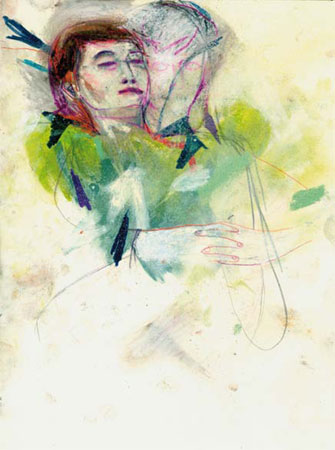
Raffi Kalenderian Memoranda 29th May � 24th July 2010 Opening: Friday, 28th May 6 p.m. � 8 p.m. Galerie Peter Kilchmann is pleased to present the second solo exhibition by American artist Raffi Kalenderian. Alongside paintings on canvas and paperworks, the exhibition �Memoranda� for the first time features paintings on wood. For the most part, Raffi Kalenderian depicts young people from his immediate environment. They often lie on a sofa or sit on a chair within a familiar surroundings. Some figures stand in gardens. Only in some of the works, is the person not painted as whole body. The drawing Untitled (Resting), for example, shows the face of a young man with his hands folded and eyes closed (see invitation). Next to the face, a second face can be made out, sketched with just a few lines. This second face seems to be on a different level and appears to be a soul become visible, as if it were proof of a different state of perception. Its eyes are open. In Kalenderian�s works everything plays on the foreground. There are no horizons and no perspective. The artist reveals his world directly to us, showing us his friends, as if he had no secrets. His friends often seem melancholic while their environment is very colourful. Colourful details of clothes, materials or furniture seem to be striving to attract the spectator�s attention and distract from the figures. We often encounter the figure Shanti. Shanti is the artist�s brother. He is painted as a young man, sometimes almost androgynous, sometimes like a tough guy. It remains uncertain whether Kalenderian wants to reveal something to us about Shanti, Frankie or Elizabeth with his paintings. None of the figures look directly at us, but all of them seem to be in contact with us. We are the witnesses of their existence. In Kate Wolf (Pink Green) a young woman is lying on a purple sofa. Her face is pale, her eyes are black and her head is resting on her arms. She is lying on her stomach with her legs dangling in the air. The painting is more than just a snapshot. It seems designed to freeze an eternal and timeless situation. It seems that Kalenderian idealises the features of the real Kate Wolf and endows the painting with autonomy. Doing this, he takes liberties which we perceive as formal pleasures. For example, when highlighting the green stripes on Kate Wolf�s pink skirt or when illustrating the sofa cushions that mould with the lines of the body or when stressing the wrinkles of her white T-shirt. Raffi Kalenderian encourages the spectator to get lost in those details and to become immersed into his own cosmos. "Memoranda", the title of the exhibition, can be likening portraiture to notes and memos kept for history, but not too specific to take away from someone's own unique experience. In fact Kalenderian�s works are, as the artists himself states, a proof or better an evidence of existence. Raffi Kalenderian (1981, born and living in Los Angeles) graduated in 2004 with a BFA from the University of California in Los Angeles. Within the scope of his exhibition, a catalogue will be published at Nieves Books, Zurich, with a text by Doug Harvey. Fabian Marti End Egoic Mind 29th May � 24th July 2010 Opening: Friday, 28th May 6 p.m. � 8 p.m. Galerie Peter Kilchmann is pleased to present the third solo exhibition of Swiss artist Fabian Marti. The exhibition rooms will be transformed into a domestic setting using simple wooden structures and the integration of objects such as carpets and photographs designed by the artist. The works can be interpreted in many ways. The installation as well as the exhibition title could be a reference to the Freudian therapy room with its couch, the carpets and sculptures. The sculpture, The Death of Joan Vollmer B., consists of a horizontal perforated chrome steel pipe that slowly turns around on its own axis. Lightbulbs are glowing in the inside of the pipe. A casual play of light and shadow is projected onto the walls. The sculpture alludes to the �Dreammachine� by Brion Gysin and William S. Borroughs. Their idea was that every American household should dispose of such a dream machine next to their television set in order to inspire their day dreams. Fabian Marti�s sculpture, however, has been shot at by a gun. It�s more monumental and tragic, as it is dedicated to William S. Borroughs� wife. Joan Vollmer B. was shot by her husband during their drunken performance of "William Tell�. Also, the African mask appears as the central motif among the sculptures and collages. Non Ho Sonno and Trauma from 2010 are plaster-masks that had been downloaded from a 3-D web database, then printed and varnished over with paint. The motif of the mask here is broken up by free forms, that Fabian Marti has applied digitally. Some of them are alienated with abstract forms. These works extremely compelling and raise questions about altered state of consciousness and the question of identity, as was the case in Freud�s therapy room. Composition 1950 constitutes a new treatment of the photogramme, but also of painting in general. It was created in the dark room. Within these works, Fabian Marti combines two foils: one with the familiar motif of �his� African masks and the other with a drawing that the artist created using Photoshop. The mask is an appropriation, while the �free� drawing expresses a close formal connection with a painting by Francis Picabia that goes by the same name Composition 1950. Fabian Marti refers to this series of photogrammes as time-travelling between modernity and the present. Fabian Marti belongs to a young generation of artists who question and reuse the authenticity of photography and sculpture. Instead of taking photographs of the world with a camera and forming sculptures with a chisel, he employs techniques such as scanners and printers or creates his pictures in the dark room without negatives. Fabian Marti (1979, Switzerland, living and working in Z�rich) studied photography at the Hochschule der K�nste in Z�rich (Zurich University of Fine Arts). His first catalogue has been published this year within the �Cahier d�Artiste� series alongside texts by Heike Munder and Daniel Baumann. He was awarded the �Manor� art prize of the canton of Zurich and as a result has been invited to hold a solo exhibition and publish a catalogue at the Kunstmuseum Winterthur in 2011. Over the past few years, the artist has held the following exhibitions: �ELM MR CL MYMULW�, Trudel Haus, Baden, �Ruins, Regrets and Visible Effects� with Piero Golia at Istituto Svizzero, Rome; �Der Garten der Pfade, die sich verzweigen�, curated by Heike Munder in the art room of Deutsche Bank, Salzburg; �The Eternal Flame�, curated by Sabine Schaschl and Burkhard Meltzer, in the Kunsthaus Baselland, ��pre mont� curated by Valentin Carron, in the Centre Culturel Suisse, Paris. Furthermore, his works have been on display in London in exhibition room 176 Zabludowicz Collection. Various interviews and press articles have been published on his works in "Artforum", "Mousse" and "Flash-Art" and can be viewed at the gallery. Galerie Peter Kilchmann July 27 - March 31, 2011 The gallery will relocate to its new address in the 'Diagonal' Building at Maag Areal in spring 2011, which will be a 5 minutes walk from the current address at L�wenbr�u. The new gallery will be in a refurbished building and will have around 500 m2 (around 5000 sft). This former manufacturing structure was built by Debrunner & Blankart Architects Zurich in 1940. The refurbishment is designed by Bl�ttler Dafflon Architects, Zurich. In the same building will move in Galerie Eva Presenhuber. The gallery will not have a permanent exhibition space until we move into the new building. We will be organizing special projects in the city of Zurich to be announced during this period. We will also participate this year at following art fairs: FRIEZE, FIAC and ARTISSIMA. During this period you can reach us by phone, email and post mail via our existing addres as our temporary offices will be close to the L�wenbr�u. |
||||
re-title.com
International contemporary art
SIGN UP FOR NEWSLETTERS

 SIGN UP for ARTIST MEMBERSHIP
SIGN UP for GALLERY MEMBERSHIP
SIGN UP for ARTIST MEMBERSHIP
SIGN UP for GALLERY MEMBERSHIP
Click on the map to search the directory