|
Georg Kargl Fine Arts: Andreas Fogarasi | Thomas Locher | Erwin Thorn - 17 Sept 2010 to 6 Nov 2010 Current Exhibition |
||||
|
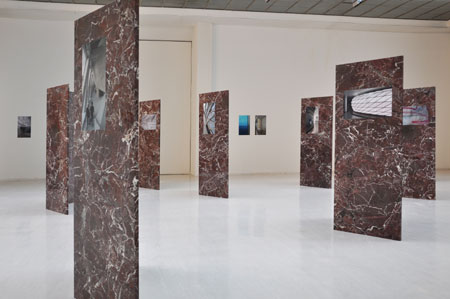
Andreas Fogarasi, Untitled (Wise Corners), 2010
marble sculptures, photos, 148,5 x 110 x 34 cm Courtesy Georg Kargl Fine Arts, Vienna |
|||
|
||||
|
||||
|
Andreas Fogarasi @ Georg Kargl Fine Arts / Thomas Locher @ Georg Kargl BOX / Erwin Thorn @ Georg Kargl Permanent ANDREAS FOGARASI Georgetown Georg Kargl Fine Arts Exhibition dates: September 17 - November 6, 2010 Georgetown: this is the title of Andreas Fogarasi�s second individual exhibition at Georg Kargl and his first extensive presentation in the gallery�s main space. The title not only serves as a reference and sign of respect for the gallerist and his constant efforts in the interest of the further development of his own institution as a brand and the (further) enhancement of Freihausvi ertel as a site of cultural diversity and identity. Georgetown is also one of the most popular place names around the world, especially in the US, a state of affairs that is due to English colonial history and the name of the then ruling kings. Fogarasi�s critical practice negotiates questions about the change of urban and public space, its image and our perception of it in spatial interventions, photographs, objects, or typographic explorations; the exhibition title is part of the concept. Distributed by way of diverse advertising media, printed on a sign over the entrance to the gallery, it suggests to the outside world something concealed that can be entered by walking through the three levels. Georgetown is both a presumptive claim and a critique at the same time. What strategies does a private company use to represent and market a region, a city, or an entire country, how does image formation work and what visual codes are used for it? In his project Public Brands, which he has been working on since 2003, Fogarasi takes a look at the logos, symbols, and slogans of regions and cities that, led by strategic economic considerations, try to distinguish themselves from one another by emphasizing unique characteristics. For example, in his videos Deutsche St�dte and La France Fogarasi has the logos of German cities and French regions, which he collected in meticulous research, pass by one another in alphabetical order. He not only points out how various identities of urban and local space are communicated by instrumentalizing graphically simplified versions of architecture, historical monuments, striking landscapes, or famous personalities for self-stylization. Fogarasi homogenized the logos by formatting the unified size and the reduction to black and white, and thus presents how the concept of branding that emerged in recent decades due to the compulsion to differentiate in face of the flood of advertising went to absurd extremes. The creation of images for public and private corporations, cities, and countries was had at the cost of the complexity ofthe object, and left behind chimerical stencils that are not well suited to transporting complexity or contradiction, or making their source clearly identifiable. In the series of drawings St�dte (Cities) Fogarasi uses typography that is always identifiable to engage with the abbreviated and condensed concepts and slogans used for cities. Die ewige Stadt (The Eternal City), Hauptstadt des 19. Jahrhunderts (Capital of the Nineteenth Century), City of Lights, City of Magic, Wine City, Beer City, Water City: the adjacency of clich�s and mythologizations that generate subjective desires and in their generalization could also make clear that images are instable and transferrable. Numerous works by Andreas Fogarasi engage with the question of the role of architecture in the competition among symbols of urban status. Due to the pressure of global competition among cities, architecture is increasingly subject to a logic of economic valuation. It is used to express the will towards representation of public and private corporations and cities and due to its symbolic referential power forms their image. The installation Wise Corners consists of a series of photographs of buildings placed on ten triangular marble objects that due to their massiveness and identical direction occupy the entire skylight room of the gallery like a defensive group, providing aperceptual experience that counters the usual spatial referential system. They are sculpture, monument, display, and architectural element at the same time, referring to representational architecture in its material. The photographs affixed to the marble objects never show an overall view of the buildings, but only elements whose focus is placed on materials, on superficial structures or visual axes. Fogarasi extracts and documents details, focusing on trivialities that due to their omnipresence are often lost beneath the threshold of conscious perception, condensing them to signs where form, concept, and theme are insolvably linked and as reference bind arrangements into a dense network of association. THOMAS LOCHER suspended Georg Kargl BOX Exhibition dates: September 17 � November 6 2010 In his fourth individual exhibition, his first at Georg Kargl BOX, Thomas Locher presents his new installation Suspended. The work is a textual, topological display hanging from the ceiling of the exhibition space, a spatial, object work about space, location, and placelessness. With this object, the artist picks up on earlier works and exhibition presentations that included the proposition that written or spoken language has a spatial impact and territorializing significance. Formally speaking, Suspended corresponds to a model to provide orientation, with arrows and pointers, with text and commentary, with a front and rear, with layers and overlaps, with side views and superimpositions. The spatial structure allows the beholder to see or to read the work from the �outside� and from the �inside,� to stand inside or outside the work, indeed in general to pose the question of where the inside or the outside might be. For the work itself tries to give form to the problematic of the undecidability of inside and outside of law. To that extent, the installation is more an arrangement of a lack of orientation. In Homo Sacer, G. Agamben describes the site of undecidability between law and violence, between validity and exception, between inside and outside using a spatial, topological model. Despite the permanent appeal and invocation of human rights, their suspension has become common practice in current policy making. People are systematically persecuted, expelled, or treated inhumanely without being able to claim their rights. Ever since their fundamental formulation, the refugee has been the central figure of human rights. Originally termed a �displaced person,� he is dependent on the arbitrary decision of a country ready to take him in, a permanent refugee without any claim to citizenship or any kind of legal security. The formulated claim to a certain right, to be able to assert rights, thus proves empty. Human rights are the rights of those who have no rights. The only asserted rights belong to the citizens of nation-states governed by the rule of law. Human rights thus prove to be paradoxical rights addressed at poor, not public, and apolitical individuals. In the legal format of the state of emergency, intended as a limited period in crisis situations, the political praxis of the suspending of basic rights finds its most intense expression. For he who controls the legal power to suspend the validity of law (for example, to declare a state of emergency), that is, to suspend law, places himself outside the law. Sovereign power is thus located both outside and inside the law. In this installation, the attempt is made to give form to the various contradictions and paradoxes of human rights. In so doing, the political power of sovereignty is not present in this work. It goes unmentioned; it is not directly illustrated or represented. But as an absent threat, it remains entirely real. Text: Thomas Locher Translation: Brian Currid ERWIN THORN APROPOS BLEI, in Anbetracht der W�rter, die Beredsamkeit der Folie Georg Kargl Permanent Exhibition dates: September 17, 2010 � January 5, 2011 At the exhibition space Georg Kargl Permanent we present a new work by Erwin Thorn in the exhibition Aropros Blein: Considering Words, the Eloquence of Foil. As the title already indicates, at issue here is an installation conceived especially for the space that is the result of an approach to lead as a material. In so doing, the artist playfully explored its composition as well as the perspective of perception. Just as in Thorn�s early works from the 1960s and 1970s, here too a curiosity about the execution of formal concepts, an interest in visual communication, as well as irony and humor are central to his work. The initial inspiration for his engagement with lead foil was a visit to an exhibition in 2005. In using the metal, Thorn empirically developed a new understanding of the material that lead him to conclude that it is a �material without memory.� It can be altered in shape without any resistance and metaphorically forgets its original form. At the same time, each change is inscribed in the five meter long lead foil; each intervention leaves its traces. With the various ways and forms in which lead can be used, in all its aggregate states, for issue at issue is ultimately the �eloquence� of the foil itself. This serves best as a reference for lead. The ultimate character of the work as it is presented now in the exhibition space is the result of a process of �regressive� revision and implies from the very start a certain degree of failure. The work of this artist, born in Vienna in 1930, can be located in the context of the conceptual avant-garde. Initially influenced by Karl Prantl, bythe mid-1960s he was soon participating in exhibitions from the realm of the ZERO group. All the same, Thorn�s work remained a very autonomous, singular position. His work has been on view at individual exhibitions at the Museum des 20. Jahrhunderts, Galerie im Taxispalsis in Innsbruck, and most recently at Georg Kargl BOX. Translation: Brian Currid Presscontact: Jane Weiss [email protected] +43-1-585 41 99 www.georgkargl.com |
||||
re-title.com
International contemporary art
SIGN UP FOR NEWSLETTERS

 SIGN UP for ARTIST MEMBERSHIP
SIGN UP for GALLERY MEMBERSHIP
SIGN UP for ARTIST MEMBERSHIP
SIGN UP for GALLERY MEMBERSHIP
Click on the map to search the directory