|
Gimpel Fils: Shana Moulton : Puzzle Saga Scottie Wilson : Greedies and Fishes - 14 May 2010 to 3 July 2010 Current Exhibition |
||||
|
Shana Moulton : Puzzle Saga
|
|||
|
||||
|
||||
|
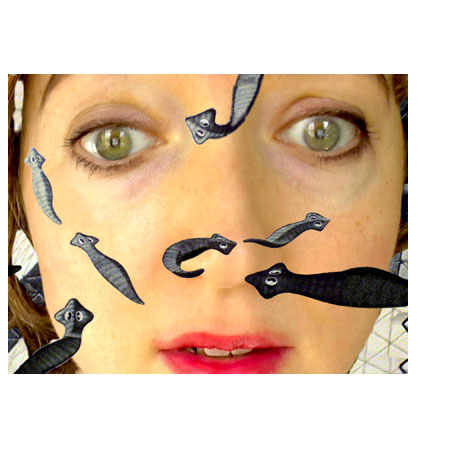
Shana Moulton Puzzle Saga 14 May � 3 July 2010 Private View: Thursday 13 May, 6-8pm Performance at 7pm Gimpel Fils is proud to present Puzzle Saga, the latest instalment in Shana Moulton�s ongoing series of short films and performances about Cynthia, an anxiety-ridden hypochondriac who searches for happiness and fulfilment through new-age remedies and self-help guides. Cynthia�s quest for healing and escape from the maladies that consume her are played out in narratives that are at once comic, surreal, joyful and melancholic. Over the course of ten video episodes and related installations and performances, Moulton�s Whispering Pines series has seen Cynthia assess her femininity via a singing sphinx; dance with abandon after a visit with Lady Nova, a woman with healing hands; and discover a rave in her attic after climbing a magical ladder that grew out of a flower arrangement. Through these weird and wonderful narratives Moulton probes various aspects of popular culture and art history, from cult religions and the commercialization of the hippy aesthetic to modern art�s relationship with transcendentalism and non-western spirituality. The belief that consumerism can enable fulfilment leads Cynthia to invest in useless kitsch products; Holding a mirror to society Moulton reveals the strangeness of reality and the idea that products, from cleansing pore strips to kinetic wall pictures, can make things better. Ultimately, we see that Cynthia has to purge herself of these items in order to achieve momentary enlightenment. The new work included in Puzzle Saga sees Cynthia bridge the gap between the prosaic, aesthetic, and supernatural; Addressing feminist issues, Moulton explores the simultaneous deification and subjugation of the female form. On entering the gallery visitors will be faced with two giant multi-coloured sphinxes guarding a darkened chamber. Passing through the key-hole doorway, a three screen projected installation will transport you into Cynthia�s fantastical world. During the private view on Thursday 13 May Shana Moulton will bring Cynthia and her extraordinary world to life through an innovative use of sets, props, costume and video. Shana Moulton was born in Oakhurst in California, and lives and works in New York. A graduate of the University of California Berkeley and Carnegie Mellon University, she has also attended the Skowhegan School of Painting and Sculpture and De Ateliers, Amsterdam. Solo exhibitions include Erratic Anthropologies, Art in General, New York (2010); Deterioration, they said, Migros Museum f�r Gegenwartskunst, Zurich (2009); 4x4, The Bluecoat, Liverpool (2009); Repetitive Stress Injuries, Pianissimo, Milan, Italy (2008); and Whispering Pines, Gimpel Fils Gallery, London (2007). Moulton has also participated in numerous festivals and screenings including: Performa 2009, New York; Art|Film at Art Basel, 2009; Latvian Centre for Contemporary Art (2009); Impakt Festival 2009, Utrecht; New York Underground Film Festival (2008); The Museum of Contemporary Art, Banjaluka (2008); and Museo Nacional Centro de Arte Reina Sof�a, Madrid (2007). Scottie Wilson Greedies and Fishes 14 May � 3 July 2010 Private View: Thursday 13 May, 6-8pm Scottie Wilson (1888-1972) has been associated with a number of art historical categories: Surrealism, Art Brut, primitive, na�ve, and folk art. However, none of these terms fully describes or explains the magical and fantastical work of this self-taught artist. Born Louis Freeman in London, Scottie Wilson was brought up in Glasgow and left school aged nine. In Glasgow, he sold newspapers and worked as a market trader before joining the Army, serving in India, South Africa, and on the western front during the First World War. Having absconded from the Black and Tans in the early 1920s because he could not, with good conscience, carry out his military orders, it is believed that Wilson hid in Ireland for 13 years before making his way to Canada in the mid-1930s. It was in Canada that he changed his name and started drawing. Whilst running a second-hand shop in Toronto he started making structured linear drawings of imagined and natural forms, using a fountain pen. Wilson�s work was well received in Canada, and he found a number of influential supporters. He returned to Britain early in 1945, settling in Kilburn, London, where he lived until his death. Wilson, who was always known as �Scottie� (to the extent that Gimpel Fils� alphabetizes his work under �S� rather than �W�), was variously described as a visionary, a working class genius, an innocent, a magician, and a homespun philosopher. The �Scottie� persona is central to understanding of his artworks, especially since much of what is known about his biography is a consequence of his own self mythologizing. Throughout his life he only revealed small amounts or fragments of information about himself, leaving reporters, interviewers and critics to fabricate the rest. Wilson took delight in these misconceptions that identified him as a type of noble savage and he recognized this his eccentricities assured him a place within London�s art world. His drawings are composites of vegetation, abstract patterns, architecture and animals. Intimate in scale, they can be divided into three distinct types: those structured according a central roundel, within which scenes constructed, such as in the work Night Fishpond; those organised symmetrically, or nearly symmetrically, around a central vertical axis, such as his Untitled tree form; and finally the banded landscapes in which the picture plane is divided into horizontal zones, each comprising architecture, water and fish, or vegetation, as in Duck sitting on a Rock. Using a small range of materials (pen and ink; coloured pencils and wax crayons) Wilson developed a refined sense of colour and line. An inventory of his hatching technique described his mark making in terms of short lines arranged at angles; triangulated forms, twisted ropes; overlapping shoals, wavy forms, teeth and scales. Scottie used these different components to build images; but unlike traditional hatching that articulates areas of light and shade, defining volume and space, Wilson�s used the technique to create decorative pattern. Flattening his imagery, his work engages the surface and does not give any sense of depth. This graphic style, and his subjects of animals, flowers, and mask-like faces, has been attributed to a number of influences: a fountain in Glasgow remembered from childhood; the lace curtains of his family home; the Asian art and architecture that he saw during his military postings in India in the 1910s; Haida totem poles seen during his visits to Canada�s west coast in the 1930s. To this list we could add the Celtic knots and zoomorphic designs that he may have seen during his time in Ireland. During the 1960s, Scottie developed an overarching thematic for his motifs: the battle between good and evil. According to most interpretations, the natural forms (flowers, birds and fish) represented goodness and truth, whereas the human elements represented the negative, destructive and harmful in the world. Some of these human figures were named �Evils� and others �Greedies�. Gimpel Fils first exhibited Scottie Wilson's work in a group show in 1949 alongside William Gear, Louis le Brocquy, Victor Pasmore, William Scott, and others. His work was collected by Pablo Picasso, Jean Dubuffet, Andre Breton and Roland Penrose and can be found in the Tate Collection, London; The National Gallery of Scotland, Edinburgh; The Collection de l'Art Brut, Lausanne; the National Gallery of Canada, Ottawa; Museum of Modern Art, New York and many other museums worldwide. For further details please contact the gallery. Tel: +44 (0)20 7493 2488 Fax: +44 (0)20 7629 5732 www.gimpelfils.com [email protected] |
||||
re-title.com
International contemporary art
SIGN UP FOR NEWSLETTERS

 SIGN UP for ARTIST MEMBERSHIP
SIGN UP for GALLERY MEMBERSHIP
SIGN UP for ARTIST MEMBERSHIP
SIGN UP for GALLERY MEMBERSHIP
Click on the map to search the directory