|
Hammelehle und Ahrens: Stephan Jung - 28 Jan 2011 to 26 Mar 2011 Current Exhibition |
||||
|
Stephan Jung
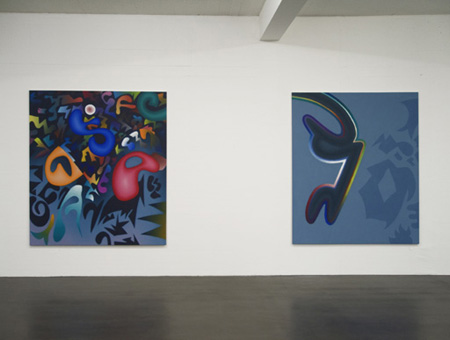
installation view Galerie Hammelehle und Ahrens, Cologne 2011 |
|||
|
||||
|
||||
|
Despite the fact that this involves an artist who paints and his paintings, it would a waste of effort to approach the paintings via the painting operation. Stephan Jung is not interested in painting except as a means to an end and his paintings are not picturesque. They are not improvisations, there are no competing coatings and motives superimposed, no action-orientated superimposition, juxtaposition or interwovenness, in other words no ascertainable painting activism. His way of painting can be compared with the flat copying or imitating of the photo-realists. Painting becomes a variable game with colour and motif by means of a frame. Established parameters such as technical procedures, limitation to certain motifs and standardised formats, on which new motif cut-outs are tuned, make series possible where colours, structures and forms change in fine and hardly perceptible gradations. The same thing is always different and diversified. The sum of the parameters produce the style which has become typical for Jung. An artificial extract from reality is copied whose more or less abstract structures and processes are imitated and woven into something new, the object depicted. In order to best transfer or transform the seductive and polished aesthetics of shaped glass, metal and other materials and objects into the next medium, the picture, Jung uses photos, printed media and household utensils as models. There are models for practically all pictures, including those whose shape and structure textures seem like pure inventions - colourful, shadow-casting of light or bright colour spots which seem to absorb ornamental linkages without depiction content out of their own rules. The painted picture frees itself from the model, whether a photo or a concrete object, and becomes independent of it. Abstraction arises from distortion. This is why Jung�s pictures move around in a zone between realism and abstraction. The definitive lies in seeing and in the surface, in the difference between object and picture, the non-hierarchical iconography of the mundane. Jung decides on an enlargement of the cut-out detail in order to keep the view narrow and concentrated on precisely that cut-out. To do so, he zooms the model onto an overly dimensioned multiplicity, just as you turn the volume of music up or down on a stereo. Jung makes things louder, larger. The enlarged little cut-out becomes a close-up, undistanced and immediate and appears, by doing so, in a new corporeality, dimension and presence. And yet, even the most expansive format and the loudest colours keep their distance with their dynamic surface. They clearly appeal but they remain value-free, they move in indifferent space and render allocation of meaning superfluous. �You have to have a plethora in order to see emptiness� (Jung). Pictures denuded of and liberated from values could just as well look different. Jung empties sensation pictures attentively and perseveringly. A technical medium used by Jung reinforces this impression. It is haziness which lays itself over the contours of almost all the pictures like a veil: the sfumato, stemming from the experience that, at a greater distance, light and air intrude between the viewer�s eye and the bodies and thus deprive the contours of their sharpness. Painting smoky contours produces enhanced plastic interfusion and nuanced spatial continuity through light and creates unsatisfying distance precisely because sharpness is lacking. What is there wants to please. It is optically seductive where on a very dark or highly bright background, for instance, a radiating red blends into yellow via a thin orange, where pure complementary colours slowly move floating in their shadows, the shape �yields itself� up to its rules as if it were poured in liquid or crystalline. Colourful �daytime� pictures against a bright background alternate with black-and-white pictures which only differ by their degrees of brightness and which generate different moods. And one always comes to think of light. Reflection and absorption as dialectical processes between material properties and radiation. Optics as the study of visible light �pertaining to what is seen� appears to be projected onto the surface of the canvas and reminds one of synthetically created images of the most variegated origin, kaleidoscopic-abstract spectacles of light. The pictures are charged in their inner logic between colour effect and super-dimensional fragmentary. Ordinary things become visible from displaced vantage points and their defined and habitual significance is lost. The perpetual network of relationships between light and shadow/darkness reminds one of the polarities and dualism of night and day, for instance, or good and evil, spirit and matter. Or of Hegel�s definition of light as �matter�s existing, generalised self� or of the tradition of Western art which very early made a subject out of colour as a function of light. Jung�s pictures are an eccentric expression and they are without any compulsory position. Stephan Jung�s pictures simulate without symbolism pseudo-realistic spaces, bodies, transparency and sources of light. Since Stephan Jung�s pictures as an artistic product make use of colour, canvas, brush, etc they are able to record the quality of transient visual routines from all domains of the optical environment without having to renounce claim to permanence. And they remain surfaces - open projection surfaces. Giti Nourbakhsch in Cat. "Stephan Jung", Galerie Hammelehle und Ahrens, Stuttgart 1997 |
||||
re-title.com
International contemporary art
SIGN UP FOR NEWSLETTERS

 SIGN UP for ARTIST MEMBERSHIP
SIGN UP for GALLERY MEMBERSHIP
SIGN UP for ARTIST MEMBERSHIP
SIGN UP for GALLERY MEMBERSHIP
Click on the map to search the directory