|
Hauser & Wirth Zurich: Hans Arp - Ovi Bimba - 11 June 2012 to 21 July 2012 Current Exhibition |
||||
|
� 2012, ProLitteris, Z�rich
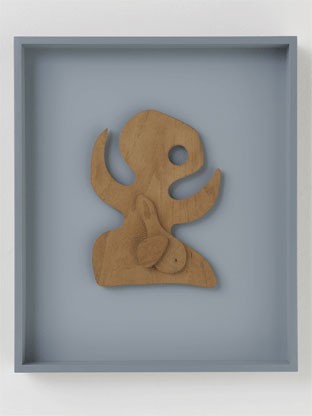
Courtesy Private Collection, Switzerland Photo: Stefan Altenburger Photography Z�rich |
|||
|
||||
|
Hans Arp Ovi Bimba Hauser & Wirth Zürich 11 June – 21 July 2012 Opening: Sunday 10 June 11 am – 5 pm For its first exhibition back at the newly renovated Löwenbräu brewery building, Hauser & Wirth is proud to present 'Ovi Bimba', a major exhibition of important and rarely seen works by painter, sculptor, poet and Dada pioneer, Hans Arp. Curated by renowned Dada scholar Juri Steiner, 'Ovi Bimba' features over seventy works ranging from wood reliefs and collages to lithographs and bronze sculptures. The exhibition positions these diverse pieces alongside those of Arp's fellow artists, including his wife, Sophie Taeuber-Arp. In addition to providing a selective overview of Arp's enigmatic practice, 'Ovi Bimba' furthers the gallery's longstanding commitment to presenting museum-quality exhibitions of contemporary and modern masters. Focusing his attention on everyday objects, Arp created his own unique 'object language' using a nonsensical vocabulary: plate, fork, knife, clock, tie, moustache, lips, breasts. With a playful hand he juggled the dominant art currents of the early 20th century, combining seemingly contradictory geometric and organic formal idioms with the artistic '-isms' of his epoch. 'Ovi Bimba' explores the development of Arp's 'object language', tracing the artist's practice from the first decade of the 20th century to the 1950s and focusing upon his time in Zurich where he co-founded the Dada movement in 1916. Focusing his attention on everyday objects, Arp created his own unique 'object language' using a nonsensical vocabulary: plate, fork, knife, clock, tie, moustache, lips, breasts. With a playful hand he juggled the dominant art currents of the early 20th century, combining seemingly contradictory geometric and organic formal idioms with the artistic '-isms' of his epoch. 'Ovi Bimba' explores the development of Arp's 'object language', tracing the artist's practice from the first decade of the 20th century to the 1950s and focusing upon his time in Zurich where he co-founded the Dada movement in 1916. Turning his back on the increasingly modernised, turn of the century society, Arp created biomorphic works whose organic, amoeboid forms highlighted his fascination with the physiological processes of procreation, growth and death and counteracted the rectilinear structures of Cubism. Arp studied the mineral, vegetable, and animal worlds for inspiration and, in works such as the wooden sculpture 'Plan Surélevé dit "Tables-forêts"' (c. 1926 – 1931) and Full Copyright and Courtesy Credits: Arnold Newman Jean Arp, New York City 1949 Gelatin silver print 34.6 x 23.3 cm © 2012, ProLitteris, Zurich Courtesy Kicken Berlin Ovi Bimba Plywood 1919 39.5 x 23 cm © 2012, ProLitteris, Zurich Courtesy Private Collection, Switzerland Photo: Stefan Altenburger Photography Zürich Plan Surélevé dit "Tables-forêts" circa 1926 – 1931 Oak wood construction 41.3 x 64.1 x 61.9 cm © 2012, ProLitteris, Zurich Courtesy Private Collection Photo: Stefan Altenburger Photography Zürich Forthcoming exhibitions: Guillermo Kuitca 1 June – 28 July 2012 Hauser & Wirth London, Savile Row Caro Niederer 27 June – 27 July 2012 Hauser & Wirth New York Paul McCarthy 'Propos' 1 September – 20 October 2012 Hauser & Wirth Zürich Press Contact: Kristina McLean, [email protected] +44 207 183 3577 Maria de Lamerens, [email protected] +44 207 255 8990 www.facebook.com/hauserwirth www.twitter.com/hauserwirth www.youtube.com/hauserwirth1 the relief, 'Rencontre (Encounter)' (1934), Arp documented the evolution of an imaginary world. Combined with his late bronze sculptures from the 1950s, these works sought to give form to natural forces – clotting, hardening, congealing and fusing – all of which were symbols of eternal cycles in nature for Arp. In the 1930s, the Zurich-based art historian Carola Giedion-Welcker recognised the relevance of Arp's vision of nature, and saw in his works the 'invisible made visible, the search for a visual language capable of capturing the spiritual realms beyond the world of appearances'. Arp's innovative and influential practice prefigured the Fluxus movement, inspired artists such as Anthony Caro and Joan Miró, and made way for the great contemporary performance artists. Born to a German father and a French mother in 1886, Arp studied briefly in Germany and Paris and then, just as World War I was beginning, moved to Switzerland where he played a crucial role in the beginnings of the Dada movement. Also known for his experimentation with Surrealism and Constructivism, Arp developed a multifaceted practice including painting, collage, sculpture, reliefs, print and poetry. Works by Arp are shown in numerous major institutions internationally, including the Guggenheim Museum, New York NY; Museum of Modern Art, New York NY; Tate Modern, London, England; Centre Georges Pompidou, Paris, France; Kunstmuseum Basel, Switzerland; Kunsthaus Zürich, Switzerland; San Francisco Museum of Modern Art, San Francisco CA; and Hirshhorn Museum and Sculpture Garden, Washington DC. Juri Steiner is a Swiss-based art historian, freelance curator and expert on Dadaism. From 2007 to 2010, Steiner was director of Zentrum Paul Klee. Prior to this position, he co-curated the Swiss Pavilion at the World's Fair in Japan (2005); and oversaw the Arteplage mobile du Jura at the Swiss National Exposition, Expo.02 (2000 – 2002). Steiner has co-edited numerous exhibition catalogues and scholarly publications on classical, modern, and contemporary art and is a member of Swiss Television's Literaturclub and Sternstunde Philosophie. Juri Steiner is a Swiss-based art historian, freelance curator and expert on Dadaism. From 2007 to 2010, Steiner was director of Zentrum Paul Klee. Prior to this position, he co-curated the Swiss Pavilion at the World's Fair in Japan (2005); and oversaw the Arteplage mobile du Jura at the Swiss National Exposition, Expo.02 (2000 – 2002). Steiner has co-edited numerous exhibition catalogues and scholarly publications on classical, modern, and contemporary art and is a member of Swiss Television's Literaturclub and Sternstunde Philosophie. |
||||
|
||||
re-title.com
International contemporary art
SIGN UP FOR NEWSLETTERS

 SIGN UP for ARTIST MEMBERSHIP
SIGN UP for GALLERY MEMBERSHIP
SIGN UP for ARTIST MEMBERSHIP
SIGN UP for GALLERY MEMBERSHIP
Click on the map to search the directory