|
Hauser & Wirth Zurich: BERLINDE DE BRUYCKERE | DJORDJE OZBOLT - Tell them I said something... - 13 June 2010 to 24 July 2010 Current Exhibition |
||||
|
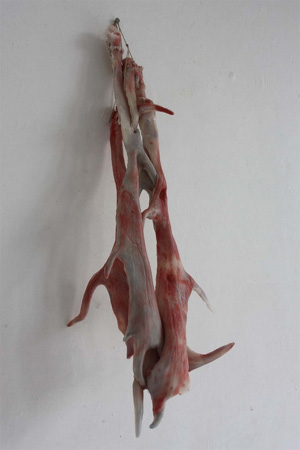
Romeu my deer, IV, 2010, 2010
Wax, epoxy, iron, string, 84 x 31 x 19 cm / 33 1/8 x 12 1/4 x 7 1/2 in � Berlinde De Bruyckere courtesy of the artist and Hauser & Wirth |
|||
|
||||
|
||||
|
BERLINDE DE BRUYCKERE 13 June � 24 July 2010 Opening: Saturday 12 June 6 � 8 pm Horse, deer and man metamorphose in Berlinde De Bruyckere�s exhibition for Hauser & Wirth Zurich. De Bruyckere�s work deals with death and transfiguration and looks to stories and art of the past to address anxieties that remain current. Her sculptures accomplish an almost alchemical transformation of wax into flesh, and out of this fantastical realism she creates intolerably mutated bodies: figures lack heads, borrow and reconfigure anatomies, become amorphous, vegetal and abstract. Their distortions emphasise our own fragile existence. �I want to show how helpless a body can be,� De Bruyckere has said. �Which is nothing you have to be afraid of � it can be something beautiful.� Antlers, a new motif for the Flemish artist, summon the fate of Act�on who was turned into a stag by the Goddess Diana before swiftly being torn to death by his own hounds. Preternaturally delicate and raw, pairs of antlers are suspended by string from the gallery walls. Blood red, mottled white and sinuous, they are utterly unlike the clich�d hunting trophies mounted in baronial halls. Flowing downwards and growing together as though protecting one another, these pairs seem sensitive and still alive; one wears bandages � an intimation of human feeling lying within these abstract animal forms. Two other pieces in the exhibition use the same technique: a horse, sliced in two lengthways and hung vertically in a vitrine; and an elongated human figure whose resting body twists into a fleshy landscape that admits no head. The latter is dignified despite its deformity and has been granted a pillow to cushion its legs. Its emaciated form calls to mind Renaissance depictions of Christ taken from the cross, as well as more contemporary horrors such as concentration camp victims or the distorted bodies of famine sufferers. The horse imagines death on a large scale. Headless and hoofless, pale and translucent, its vertical carcasses are anthropomorphic, resembling swollen human figures whilst also calling to mind Rembrandt�s �Flayed Ox� and Soutine�s ox torsos. Another horse�s torn body, cast in iron, rises dramatically from a table. Iron is a new material for De Bruyckere and was chosen to convey �the heaviness of death�. The horse�s unyielding weight and emptied body contrast brutally with the malleable vulnerability of the waxen forms. Bringing unlike things together, De Bruyckere tests sculpture�s potential to recuperate and heal, using materials and motifs to create an increasingly complex language of empathy and suffering. DJORDJE OZBOLT - Tell them I said something... 13 June � 24 July 2010, Hauser & Wirth Z�rich Opening: Saturday 12 June 6 � 8 pm Hauser & Wirth Zurich is delighted to announce its first solo exhibition of works by London-based artist, Djordje Ozbolt. The exhibition will feature a selection of Ozbolt�s large and small-scale paintings replete with intricate detail and satirical humour. Works such as �Postcolonial Discourse�, which portrays a Delft bowl heaped with raw meat balanced on the head of an African sculpture in a tropical yet gloomy landscape, raise questions surrounding culture, colonialism and identity. Meanwhile �The Madness of Comrade Lenin� shows a traditional portrait of Bolshevik leader Vladimir Ilyich Lenin painted with a muted palette. In contrast to the serious expression and gravitas of Lenin, a Communist flag and an acid-house smiley-face are super-imposed on to the subject�s pupils. Both canvasses are exemplary of Ozbolt�s witty and unconventional approach, which results in collage-like images. In his work Ozbolt merges experiences from his frequent travels with subject matter from a vast array of references ranging from religious iconography to pastiches of still lifes; from political propaganda to pop-culture and kitsch. Seemingly incongruous symbols are seamlessly melded in Ozbolt�s fantastical paintings, merging diverse sources into a single compact, and sometimes macabre, narrative. Ozbolt has described his artistic process as �restless�. His work gives him the freedom to effortlessly transition between different techniques, styles and topics with surrealist flair, creating his own distinct and darkly comical image of the world. |
||||
re-title.com
International contemporary art
SIGN UP FOR NEWSLETTERS

 SIGN UP for ARTIST MEMBERSHIP
SIGN UP for GALLERY MEMBERSHIP
SIGN UP for ARTIST MEMBERSHIP
SIGN UP for GALLERY MEMBERSHIP
Click on the map to search the directory