|
Meyer Riegger Berlin: Je est un autre - 18 Sept 2009 to 7 Nov 2009 Current Exhibition |
||||
|
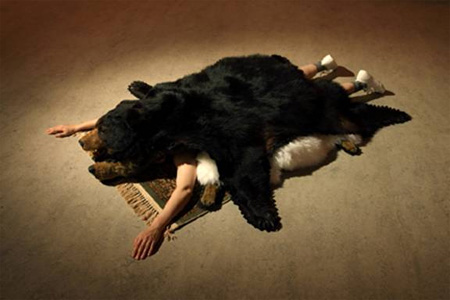
Jamie Isenstein, Rug Rug Rug Rug Rug, 2009
Bear, Sheep, Wolf, Woman, Rug Dimensions variable |
|||
|
||||
|
||||
|
Je est un autre 18.09.-07.11.2009 A group show with Heike Aum�ller, Uwe Henneken, Jamie Isenstein, Eva Kotatkova, J�n Man�u�ka and Jonathan Monk, as well as a concert by Kammerflimmer Kollektief We are pleased to present the group show �Je est un autre�, featuring works by the six contemporary artists Heike Aum�ller, Uwe Henneken, Jamie Isenstein, Eva Kotatkova, J�n Mancusca and Jonathan Monk who work in different media with a surrealist appropriation of figuration. Painting, installation art, film and performance included in the exhibition will be further complimented by a concert by the group Kammerflimmer Kollektief (Heike Aum�ller, Johannes Frisch and Thomas Weber) which will occur in our gallery space on Friday, the 25.9.2009 at 8 pm. Parallel to this exhibition we will be presenting two further artistic stances at our fair stand at the Art Forum Berlin: Daniel Roth and J�n Man�u�ka, whose assemblage-like installation pieces there fall into line with the concept of the group show. This open curatorial form allows correlations among the featured positions that shift between visual arts, music and film to develop, and guarantees freedom beyond the specific medium for an encounter with each of the very individual formal languages. Based on self-reflection, the pieces that are juxtaposed within the show deal with perception, formation and breakage of identity, sometimes in a humorous way. The title �Je est un autre� leads back to a letter written in the year 1871 by the poet Arthur Rimbaud addressed to the litt�rateur Paul Demeny, wherein Rimbaud discloses his idea of the new function of the poet as a creator, magician and seer. The phrase drafted in this letter �Car je est un autre � For I is another� characterises his concept of a self through the dissolution of all senses, a magnitude composed of fragments, which resembles an oscillation between form and formlessness. Arthur Rimbaud sees this shattered self embodied in poetic articulation as a melodic-rhythmic scoring of thought, which � as an overcoming of a self-image cleaving to the merely physical � warrants the recognition of social reality. Jamie Isenstein shows how the body itself can become a part and the object of an artistic work in her performance �Rug Rug Rug Rug Rug�. Intermittently during the complete duration of the exhibition the artist lies face-down on a rug, for an amount of time defined by herself, her body covered with a series of animal skins � wolf, sheep, bear. Along the lines of Aesop's fable �The Wolf in Sheep's Clothing� or also in reference to the quote made popular by Thomas Hobbes �Homo Homini Lupus Est � Man is a wolf to man.�, Isenstein not only caricatures the fluctuation of truth and deception in an outward gesture, she also simultaneously masks and demasks. With the addition of a sign reading �Will return� as is used to announce shop opening hours that proclaims the artist's absence, Jamie Isenstein's work shifts between performance, still life and sculpture. The paintings by Uwe Henneken form a series of self-portraits ranging from figurative to abstract, in which he personifies himself through the appropriation of foreign poses and roles. The painter draws on cultural and political, literary and art-historical contexts, which serve him as fictive templates and synonyms and encompass a morphology of personality and history. The figures (such as the Schlemihl) that appear in an altered context, are cited � sometimes from his own paintings � and refer to innovators, outsiders or rebels who resist categorisation and were occupied with the constitution of imperial structures and the renunciation of limitations in an conceptual, idealising way. In the painting �Reite den Tiger�, which refers to Julius Evola's book �Cavalcare la Tigre � Ride the Tiger�, Henneken not only transforms the metaphor inherent to the book for a model of thought that disregards the self, but also counteracts the ambivalent thought structure of the anti-modernist Dadaist Evola as an antagonism of the self. The drawing-, sculpture-, and performance-based �House Arrest� piece by the artist Eva Kotatkova handles possible forms of self-cognition: In testing and performing diffuse poses and gestures the artist generated a series of objects - enhanced by sketches � which developed into surrealist apparatuses and installations. Books, furniture, as well as constructions out of wood and metal form a body of sculptural work, which react with an abundance of free-hanging caricatured drawings, conveying subtle instructions to the viewer. Kototkava exposes the self as a model-like husk that � girthed by the corset of her installation � questions a subject-affirmative positioning of the self. While Rimbaud ascribes musical attributes to mere language, in Heike Aum�ller's video pieces �Absence� and �Blindlings� the acoustics of a wordless improvised action form the composition of the portrayed scene. The silently acting, usually masked protagonists � whose bodies serve as instruments for the respective sequence of action � do not let any individual traits become visible outside of the grotesque events. The interior in which Aum�ller places the figures, however, is unique: The given field of view shows a temporarily appropriated room from which ultimately the partially improvised performance emerges, and that dissolves in its function as a stage after the implementation of an abstruse scene. The palimpsest-like, ongoing overwriting and deleting of the previously existent is ultimately bolstered by the music and concert by Kammerflimmer Kollektief. The trio, founded in 1996 by Thomas Weber as an extension and alliance of visual arts and music will be playing on Friday during the week of Art Forum in our gallery. With instruments such as electric guitar, percussion, Himalayan reed organ and expressive, non-linguistic vocals, the group creates a nonverbal, synthetic musical blanket of sound, which is based on a score but sustained by improvisation, offering the listener a meandering audio-composition between searching for, clutching onto and disappearance of the present, voiced in the form of sound. In Jonathan Monk's self-referential works, the artist refers to pre-existent form concepts, which he applies concretely to his person and distorts. In the photo series �Kiss Alive� he painted his face according to the make-up codex of the hard rock band Kiss, disguising his identity beyond recognition behind a symbolically charged masquerade of colour. For the photographic piece �Everything in the World That Has Ever Been Seen� Monk in turn reproduced a photographic portrait of Giuseppe Penone, in which he added two convex, shiny earring pins over the eyes (instead of Penone's reflecting contact lenses) - these mirror the gallery space as well as the observer. Daniel Roth links imagined and real spaces � through the transformation of materiality and space � in his installation �Glaswaldsee� at our fair stand at the Artforum Berlin: using the media of drawing and photography the artist joins together documented and remembered viewpoints, which he presents as an associative picture sequence. According to the viewer's position, these images are mirrored in the surface of a floor sculpture that fits together the individual pieces into a narrative strand in the viewers perception � as an extension of the room and a projection surface at the same time. By contrast, J�n Man�u�ka creates a signature-like description of space with his associatively arranged linguistic and pictorial fragments. The installation presented at Artforum �Bange vor dem zuerst Ausgedachten (Fear What is Made up First)� shows a series of objects similar to showcases, which sound out the filmstrips arranged in front of light sources within them as the body of an episodically presented narrative. Man�u�ka's objects, interiors and image-like sentences create a dramaturgy that condenses into fictive, cinematic sequences in the viewers imagination. This becomes evident in the 16 mm film �Double� that is being shown in our gallery, in which parallel strands of narrative overlap and revolve around the doppelganger theme. Christina Irrgang Translation Zoe Miller |
||||
re-title.com
International contemporary art
SIGN UP FOR NEWSLETTERS

 SIGN UP for ARTIST MEMBERSHIP
SIGN UP for GALLERY MEMBERSHIP
SIGN UP for ARTIST MEMBERSHIP
SIGN UP for GALLERY MEMBERSHIP
Click on the map to search the directory