|
Galerie Nordenhake Berlin: STANLEY WHITNEY - YELLOW, NOON AND NIGHT - 3 Nov 2012 to 12 Jan 2013 Current Exhibition |
||||
|
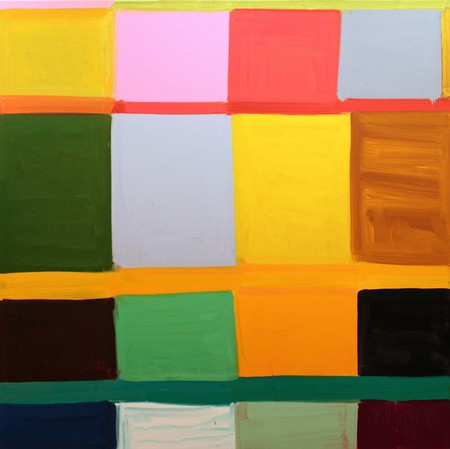
STANLEY WHITNEY, Yellow, Noon and Night, 2012
oil on linen 152 x 152 cm |
|||
|
||||
|
STANLEY WHITNEY YELLOW, NOON AND NIGHT Opening, Friday, November 2, 18:00-20:30 Galerie Nordenhake is pleased to present Yellow, Noon and Night–the first solo-exhibition of US-American painter Stanley Whitney in Germany. For almost thirty years Whitney has been exploring two central aspects of abstract painting: Colour and structure. The exhibition will show new works as well as paintings from the past eight years. The title of the exhibition, which is also the title of one of Whitney’s paintings, is, like most of his paintings, inspired by music, poetry and his love of reading: In this case by a blues song called Morning, Noon and Night. For the title Stanley Whitney simply replaced the word “Morning” with “Yellow” to introduce the aspect of colour. And the title also emphasises rhythm as a parameter that is essential to Whitney’s work: Whereas rhythm is central to Jazz and Blues, it is the colour that makes the beat in Whitney’s paintings. Colour is what structures the paintings. For a long time Whitney has been working with square canvasses of different sizes, which he structures with up to four unequal bands consisting of one or more lines the width of a paintbrush. Starting from the top left–almost like writing a text–he fills the bands with a series of non-uniform rectangles and squares of different colour. This process, which ends at the bottom right of the canvas, can be repeated two or three times. The choice of colour is intuitive and the result of the painting process which is unpredictable an unknown. Whitney works with the system of “call-and-response”, which is a principle used across multiple disciplines, and in music is typical in spirituals, gospels, blues and jazz. He paints one colour and then decides which colour responds to the first one. This very simple principle results in the fact that the same colour is almost never used twice and the colours become more and more complex. And yet, Whitney’s paintings seem easy, almost effortless. They are playful and strictly formal at the same time. This is similar to Jazz–which seems easy–as Whitney explains: “As if you could just get up and play the instruments, that there’s no struggle with how it’s done. It’s like Coltrane using a simple melody. I just use a simple square”. Despite their complex colour scheme Whitney’s compositions are always harmonic and show his joy for colour and composition. They are rhythmic, melodic, and intense. „The idea is sound through colour, creating a polyrhythm and confronting something very beautiful with a lot of humanity to see something that you think you know but then realize you don’t“ (Stanley Whitney). Stanley Whitney was born in 1946 in Philadelphia and currently lives and works in New York and Solignano, Italy. His works have been featured in numerous international exhibitions since the early seventies. His work was part of the 50th Venice Biennale (2003) in the project Utopia Station, and was also shown in the Dakar Biennal (2004). Museum exhibitions include the National Academy Museum, New York (2012), the Nelson-Atkins Museum of Art, Kansas City (2008), the University of Dayton, Dayton, Ohio (1991), the Pennsylvania Academy of Fine Arts, Philadelphia (1985), the Brooklyn Academy of Music (1983), the Alternative Museum, New York (1981), the Studio Museum in Harlem (1981) and the Aldrich Museum of Contemporary Art, Ridgefield (1976). He is the recipient of the John Guggenheim Fellowship (1996) and Pollock-Krasner Fellowship (2002) as well as winning the First Robert De Niro Sr. Prize in Painting (2011). Parallel to Whitney’s show French artist JEAN-BAPTISTE BOUVET will present Everything that has a name in our space on the first floor. Exhibition Period: November 3, 2012 – January 12, 2013 Opening Times: Tuesday – Saturday 11:00 – 18:00 Please contact the gallery for further information and press images - STANLEY WHITNEY YELLOW, NOON AND NIGHT Die Galerie Nordenhake präsentiert mit der Ausstellung Yellow, Noon and Night die erste Einzelausstellung des US-Amerikanischen Künstlers Stanley Whitney in Deutschland. Whitney erkundet seit nahezu 30 Jahren zwei wesentliche Aspekte abstrakter Malerei: Farbe und Struktur. Die Ausstellung zeigt neue Malereien wie auch Bilder aus den letzten acht Jahren. Der Titel der Ausstellung und das gleichnamige Bild sind – wie viele von Whitneys Arbeiten – stark beeinflusst durch Musik, Poesie und Literatur: In diesem Fall bezieht sich der Titel auf den Blues Song Morning, Noon and Night. Für seinen Titel ersetzte Whitney lediglich „Morning“ durch „Yellow“, um einerseits die Farbe ins Spiel zu bringen, andererseits den Rhythmus des Songtitels nicht zu verändern. Rhythmus spielt eine entscheidende Rolle in Whitneys Arbeiten: Ebenso wie der Rhythmus einen Song strukturiert und insbesondere für Blues oder Jazz grundlegend ist, ist es die Farbe, die in Whitneys Arbeiten den Takt angibt. Die Farbe strukturiert das Bild. Seit langer Zeit schon arbeitet Whitney auf quadratischen Leinwänden unterschiedlicher Größe, die er mit einer oder mehren Pinsellinien horizontal unterteilt. Von links oben beginnend — fast wie beim Schreiben eines Textes — reiht er uneinheitliche Rechtecke und Quadrate verschiedener Farben aneinander. Dieses Vorgehen, das in der unteren rechten Ecke der Leinwand endet, kann zwei- bis dreimal wiederholt werden. Die Farbwahl ist intuitiv und das Ergebnis des Malprozesses, welcher letztlich unbekannt und unvorhersehbar ist. Whitney arbeitet mit dem „call-and-response“-Prinzip, welches in vielen Disziplinen genutzt wird und in der Musik bei Spirituals, Gospels, Blues und Jazz typisch ist. Er malt eine Farbfläche und entscheidet dann welche Farbe darauf antworten könnte. Dieses einfache System führt dazu, dass ein Farbton selten zweimal vorkommt und die Farben immer komplexer werden. Dabei sind Whitneys Werke sowohl spielerisch als auch streng formal. Sie scheinen geradezu einfach, fast mühelos. Es ist ähnlich wie beim Jazz, der leicht erscheint – wie Whitney erklärt – so als ob man einfach aufstehen könnte um die Instrumente selber zu spielen: „Es ist so als ob Coltrane eine einfache Melodie verwendet; ich verwende ein einfaches Quadrat.“ Trotz ihrer komplexen Farbstruktur sind Whitneys Bilder immer harmonisch und zelebrieren seine Freude an Farbe und Komposition. Sie sind rhythmisch, melodisch und intensiv. „Die Idee ist es, Klang durch Farbe herzustellen, Polyrhythmik zu erzeugen und etwas sehr Schönes großer Menschlichkeit gegenüberzustellen, um etwas wahrzunehmen, von dem man glaubt, dass man es kennt, aber dann zu begreifen, dass es nicht so ist“ (Stanley Whitney). Stanley Whitney (*1946 in Philadelphia) lebt und arbeitet in New York und in Solignano, Italien. Seit den siebziger Jahren waren seine Arbeiten in zahlreichen internationalen Ausstellungen zu sehen. 2003 waren sie auf der 50. Biennale in Venedig als Teil des Projektes „Utopia Station“, sowie auf der Dakar Biennale 2004 zu sehen. Seine Arbeiten wurden außerdem in verschiedenen Einzel- und Gruppenausstellungen in Museen wie dem National Academy Museum, New York (2012), dem Nelson-Atkins Museum of Art, Kansas City (2008), der University of Dayton, Dayton, Ohio (1991), der Pennsylvania Academy of Fine Arts, Philadelphia (1985), der Brooklyn Academy of Music (1983), dem Alternative Museum New York (1981), dem Studio Museum in Harlem (1981) und dem Aldrich Museum of Contemporary Art (1976) gezeigt. Whitney ist Preisträger des Guggenheim Fellowships (1996), des Pollock-Krasner Fellowship (2002) sowie des ersten Robert De Niro Sr. Price for Painting (2011). Parallel zu Whitneys Ausstellung zeigt der französische Künstler JEAN-BAPTISTE BOUVET Everything that has a name in unseren Räumen im ersten Stock. Ausstellungsdauer: 3. November 2012 – 12. Januar 2013 Öffnungszeiten: Dienstag – Samstag 11:00 – 18:00 Bitte kontaktieren Sie die Galerie für weitere Informationen und Pressebilder |
||||
|
||||
re-title.com
International contemporary art
SIGN UP FOR NEWSLETTERS

 SIGN UP for ARTIST MEMBERSHIP
SIGN UP for GALLERY MEMBERSHIP
SIGN UP for ARTIST MEMBERSHIP
SIGN UP for GALLERY MEMBERSHIP
Click on the map to search the directory