|
Volker Diehl: SUSAN HEFUNA - HEFUNA / HEFUNA - 20 June 2009 to 19 Sept 2009 Current Exhibition |
||||
|
SUSAN HEFUNA
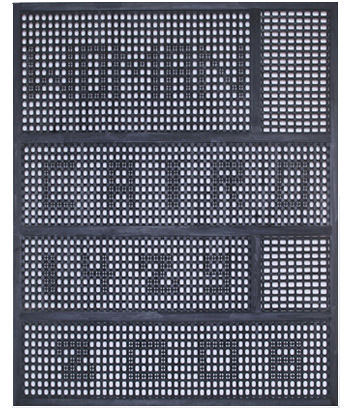
Woman Cairo, 2008 Holz, Tinte, 261x212cm |
|||
|
||||
|
||||
|
SUSAN HEFUNA HEFUNA / HEFUNA OPENING: June 19, 2009, 7 P.M. June 20 - August 1, 2009 Tuesday - Saturday, 11 A.M. - 6 P.M. GALERIE VOLKER DIEHL is pleased to announce the first solo exhibition of Susan Hefuna hosted in its Berlin gallery. The artist will show a combination of drawings and sculptures, with the focal point of the exhibition being her wooden and newly bronze casted Mashrabiya sculptures. As well for the first time her new wooden masks series will be exhibited. Susan Hefuna, a globalised artist builds a bridge between the Western and the Arabic cultures. She has internalized the two extremes the �foreign� and the �intimate�, raised in both countries: the Egyptian and German. She is therefore strongly connected to both cultures, which has crucially influenced her work. Hefuna�s drawings develop a three-dimensional impact, which consist of several super-imposed layers of tracing paper. Their layered arrangement and ambiguity imply many options of interpretation, going from European lattice designs to Arabic Mashrabiyas or to cityscapes including social and political comments. The drawings from the series �ANAgram� for the first time contain letters; �ANA� meaning �I� in Arabic, can be read forwards and backwards thus forming a mystery or an analogy to the human identity. Hefuna�s drawings which are produced in New York, are inspired by the city skyline. Abstract structures of both organic and architectural nature emerge. Susan Hefuna�s working process is determined by a high degree of concentration and meditation. A selection of the artist�s drawings can currently be viewed at the Venice Biennale in the exhibition �Making Worlds� at the Palazzo delle Esposizioni della Biennale in the Giardini and Arsenale. Traditionally, Mashrabiyas protect the inner from the outside world by filtering the light, passing the air and through the possibility to observe without beeing seen. A Mashrabiya therefore creates a permeable wall - the separation between the inside and outside, Mashrabiyas allow for only one viewing direction, namely from inside to outside, playing with the idea of the hidden and the invisible. Hefuna integrates words in her Mashrabiya sculptures, which the spectator can read from both sides. She opens a dialogue, and by including words in a Western language into a traditional Mashrabiya she ads a foreign element, which breaks the traditional function of a Mashrabiya. At the same time, she re-defines her role as a woman: while the traditional Mashrabiya was used to hide the woman, Susan Hefuna makes visible. The varied reactions to her Mashrabiyas, demonstrate that their interpretation and perception also depend on the context in which they are presented. Susan Hefuna�s work is also featured at the following venues in 2009: currently: Venice Biennale upcoming: Taswir - Pictorial Mappings of Islam and Modernity, Martin Gropius Bau Berlin Africaines, 2nd Panafrican Festival Algiers Jameel Art Prize, Victoria and Albert Museum, London |
||||
re-title.com
International contemporary art
SIGN UP FOR NEWSLETTERS

 SIGN UP for ARTIST MEMBERSHIP
SIGN UP for GALLERY MEMBERSHIP
SIGN UP for ARTIST MEMBERSHIP
SIGN UP for GALLERY MEMBERSHIP
Click on the map to search the directory