|
Beers.Lambert: WHEN WE DEAD AWAKEN - 2 Feb 2012 to 26 Feb 2012 Current Exhibition |
||||
|
|
|||
|
||||
|
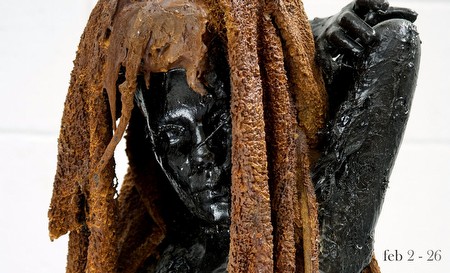
when we dead awaken February 2 - 26, 2012 PRIVATE VIEWThursday, 2 February, 6-9pm VASILIS ASIMAKOPOLOUS | AARON HOLZ | JOHN NIELSEN | ANJA RONACHER When We Dead Awaken appropriates its name from playwright Henrik Ibsen's final play, which debuted at London's Haymarket Theater 1899. The exhibition consciously explores melodramatic themes within the play, including adoration, petrification, and fascination, but also engages with the myth of the artist as 'tortured genius' and the idea that the creation of art is a relentless, inspired, personal, and physical struggle. The exhibition expands upon certain ideas that intersect throughout both the play and Ibsen's real-life: where art imitates life, and where the role of both creator and creation are questioned. The title, 'When We Dead Awaken' is taken from a line in the play in which the protagonist, the sculptor Rubek, on a journey into the mountainside, departs from his wife when confronted by the return of his estranged, ghostlike muse. The play mirrors Ibsen's own life quite consciously, by commenting on Rubek's inability to lead a fulfilled life since the creation of his masterpiece, and paradoxically, his muse's inability for her own purpose in life after her soul 'entered' the divine artwork. As Ibsen's final play, the work suggests the blurred divide betweeh the idea of the artist as genius, the pursuit of the artist to continuously create, and the relationship between the inanimate and the inspired. For this exhibition, work was chosen that illustrates the themes that occur throughout the play, but also that very self-consciously occur extra-diegetically to the work, through reflexive acknowledgement of the parrallels between art, life, narrative, and mythology (both real and imagined). For instance, in the case of Ibsen's relationship to his writings, his real-life struggle as a playwright is mirrored throughout. The works on display retain this critical element of self-awareness, never fully shedding their cognizance as material, fictitious, and artificial structures. In fact, in the case of sculptors Vasilis Asimakopolous and John Nielsen, both consciously play with this divide; their works triumph aspects of their own materiality that purposefully keep the viewer at a distance. Other works, such as those by Austrian photographer Anja Ronacher, exhibit awareness of the 'artifice of creation', incorporating elements of Classicism while asserting themselves as purposely void of subject-matter, or alternatively, as subject matter that has been displaced, in which Grecian friezes and billowing backdrops take centre-stage as the de/re-contextualized subject matter of her recent photography. With a further nod to Classicism and the sculptural form, the paintings of American painter Aaron Holz depict half-cast, semi-mythological figures that appear in constant struggle within the painting but also upon the surface of the work, blending in and out of one another and their painterly surroundings, with lurid yet subdued colour and a finite attention to detail. Such simple acknowledgements by each of the four contributing artists simultaneously adopt the themes found within the play, but paradoxically (as is also evidenced by Ibsen's fictitious and beleaguered doppelganger, Rubek) refute these classifications in equal measure. While Asimakopolous' The Itch might be considered the most obvious nod to the play, not only because it draws strong parallels to the sculpture that (the fictitious) Rubek describes as his masterpiece - a woman surging from the pits of death in ascent to heaven - it also exhibits the severity, intensity, and darkness that permeates Ibsen's (and, for that matter, Rubek's) work... However, as is evidenced by all artists on exhibit, the works establish a rejection of any one-dimensional explanation: each artist's handling of their work counterbalances Ibsen's tendency for melodrama through a preference for presentation and sheer materiality, providing commentary on issues that penetrate deeper than fiction and include the greater socio-political issues, and also by retaining a strong awareness of experimentation and exploration throughout the creative process. VASILIS ASIMAKOPOLOUS (b. 1980, Greece). Vasilis Asimakopoulos' (b. 1982, Greece) recent solo exhibitions include Dunes of Aspartame, Gallerie Bannwarth, Paris (2011); Sorbic Acid, Umbrella Gallery, Leeds, (2010); and an forthcoming solo exhibition with Beers.Lambert in 2012. Group exhibitions include RCA Show, Royal College of Art, London (2011); Mostyn Open, Llandudno, Wales (2011); Creekside Open, Deptford X, London, (2011); Gloom'less, Gallerie Bannwarth, Paris (2010); and Designers Of The Future, Victoria & Albert Museum, London (2010). He is recipient of the Mostyn Open Award 2010; and received a 2009 Fellow (bursary) from the Royal British Society of Sculptors in London. He is a 2011 sculpture graduate from London's Royal College of Art; he lives and works in London, England and Athens, Greece. AARON HOLZ (b.1972, USA). Aaron Holz' solo exhibitions include A Heart's Hot Shell, RARE Gallery, New York, New York (2011); Of Heads & Hands, Focus Gallery, Sheldon Museum of Art, Lincoln, USA (2010). Portraits, Kimmel Harding Nelson Center for the Arts, Nebraska City, USA (2009); Takedown, Rourke Art Museum, Moorhead, Minnesota, USA (2009). Group exhibitions and Projects include After School Special, University Art Museum, Albany, New York (2011); What Would Dante Do? Rourke Art Museum, Moorhead, Minnesota, USA (2011); Single Fare, 224 Grand, Brooklyn, New York, (2010); and Face Forward, LeRoy Neiman Gallery, New York, New York, (2009), He is recipient of the Harold & Esther Edgerton Assistant Professor of Painting Award (2009); and the Nebraska Artists Council Distinguished Artist Award (2007). His work has been published in the New York Times, Lincoln Journal Star, and NY Arts Magazine. He holds a Master's degree from University at Albany, New York, and lives and works in the United States. JOHN NIELSEN (b. 1984, UK). John Nielsen exhibitions includ Started, NTK Gallery, Pragure, (2011); Display, 27ad Gallery, Bergamo, Italy, (2011); Startpoint Award, GASK, Chech Republic, (2011); Show, Royal college of Art, London, (2010); Revolver, Penzance Art Gallery, (2009). His awards include The Kenith Armitage sculpture award, 2010; The Madame Tussards Sculpture Award, 2010; and the Dennis Mitchel Sculpture award, 2008. He was included in the prestigious Catlin Art Guide, (2010). He holds an MA in Fine Art from London's Royal College of Art, (2010). He lives and works in London. ANJA RONACHER (b. 1979, Austria). Anja Ronacher’s recent exhibitions include JCE (Jeune Création Européenne) Platform for Young European Artists, Salzburg, Austria (2011); The Body Resembles a Sentence, (with Robert Gruber), Kunstraum Pro Arte Hallein, Austria, (2011); Körpercodes, Museum der Moderne, Salzburg, Austria (2010); Sweet Anticipation, curated by Övü Durmusoglu, Salzburger Kunstverein, Austria (2010). Previous exhibitions include On Various Impossible Bodies, with Robert Gruber, Austrian Cultural Forum, Warsaw, Poland (2010); Fullframe, Volksgartenpavillon, Graz, Austria (2009); Antirealism, Adele C Gallery, Rome, also ERBA, Besançon, France, and Guangzhou Academy of Fine Arts, Guangzhou China (2008�]2009); LA Video Library, ART LA, Los Angeles, (2009); Det andet rum, NLH space, Copenhagen, Denmark (2008); and Show RCA at Royal College of Art, London (2008). She is recipient of a production grant from the Austrian Minstry of Culture, UK, and numerous grants from the Federal State Government of Salzburg (2008, 2009, 2010). Her work has been published in the Magenta Foundation’s Flash Forward (2007); and the Leica Photography Prize (2007). She holds an MA in photography from the Royal College of Art, London. She lives and works in Austria. |
||||
|
||||
re-title.com
International contemporary art
SIGN UP FOR NEWSLETTERS

 SIGN UP for ARTIST MEMBERSHIP
SIGN UP for GALLERY MEMBERSHIP
SIGN UP for ARTIST MEMBERSHIP
SIGN UP for GALLERY MEMBERSHIP
Click on the map to search the directory