|
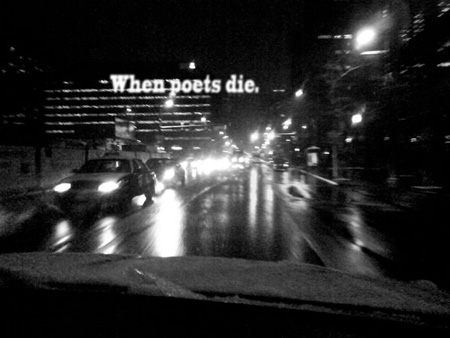
Galerie Anita Beckers: WHEN POETS DIE. NIGHT FALLS, DAY BREAKS - 10 Feb 2011 to 2 Apr 2011 Current Exhibition |
||||
|
Florian Heinke
|
|||
|
||||
|
Scroll down for English version "WHEN POETS DIE." FLORIAN HEINKE, JULIA OSCHATZ, STEFAN PFEIFFER & ANIKA ROSENBERG 10. Februar - 2. April 2011 Auf den Arbeiten von Florian Heinke (*1981) , meist �berdimensionale Malerei, verbindet sich stets Schrift und Bild. Mit schwarzer Farbe werden die urspr�nglichsten Themen der Menschheit auf Leinwand gebannt: Liebe, Leidenschaft und Tod. Mit der von Heinke erfundenen Stilrichtung �Black Pop� vereint der Maler plakative Botschaften und allgemein gehaltene Aussagen mit Bildelementen seiner pers�nlichen Jugendkultur. Als Protagonist taucht der K�nstler selbst immer wieder auf: Mal das Abbild des K�nstlers, dessen K�rper ebenfalls von t�towierten Schriftz�gen �berzogen ist, mal als Schriftzug, der gleichzeitig Marke und Signatur ist. Die K�nstlerin Julia Oschatz (*1970) besch�ftigt sich inhaltlich ebenso mit den Themen �Landschaft� oder �Identit�t� und setzt diese ebenfalls in abgedunkelten Farbt�nen gehaltenen Malerei, Zeichnungen und auch in Videoinstallationen um. Julia Oschatz spielt auf unterschiedlichen Ebenen mit der Projektion menschlicher Gef�hle in der Natur. Ein Wesen mit Tierkopf und Menschenk�rper taucht in unterschiedlichsten Naturszenarien auf. Es entstehen Projektionsfl�chen f�r alles, was Klischee-vorstellungen des Romantischen und Tragischen n�hren k�nnte. Die K�nstlerin bewegt sich somit nahe an Grenzbereichen zur fiktiven, phantastischen und raumgreifenden Wirklichkeit. Als Grenzfl�chen dienen Leinwand und Bildschirm, um Projektionen von Wesen erscheinen zu lassen, die sich in imagin�ren R�umen verteilen. Julia Oschatz' Kunstfigur jedenfalls wandert durch imagin�re und durch vertraute Welten, durch Naturlandschaften und Zeichen(t)r�ume, durch klaustrophobische Zwangswelten und idyllische Panoramen. In den Collagen von Stefan Pfeiffer (*1981) wird der menschliche K�rper oft merkw�rdigen Szenarien ausgesetzt. Aus Fotos oder Zeitungsartikeln ausgeschnitten, wird er vom K�nstler manipuliert: �bermalt, seinem urspr�nglichen Hintergrund beraubt, teilweise �berklebt und in einen neuen Zusammenhang gebracht, der der Logik des K�nstlers entspricht. Bei den �berwiegend ungegenst�ndlichen Malereien schafft der K�nstler eigene Welten, wo Dinge kombiniert werden, die sonst nicht zusammen finden. �Ein wichtiger Aspekt meiner Arbeitsweise ist, dass mich der Wahrheitsgehalt einer gefundenen Information nur auf einem pers�nlichen Level interessiert. Es ist die Behauptung, der Grad zwischen Phantasterei und Tatsache, die mich treibt und am�siert, ein wertungsfreies Vakuum, aus dem eine neue Realit�t entstehen kann.� (Stefan Pfeiffer, 2010) Die K�nstlerin Anika Rosenberg (*1981) inszeniert sich als jede der in die Erz�hlung involvierten Figuren, als Spionin, als erfolgreiche Erfinderin, als Kosmonautin und als Auftragskiller. F�r ihr komplexes Ausstellungskonstrukt, das mit den Medien Fotografie, Zeichnung, Text und Video arbeitet, verwendet sie Anleihen aus g�ngigen Motiven des Science-Fiction Genres, reale M�glichkeiten werden mit fiktionalen Spekulationen angereichert. F�r ihr Motivrepertoire bedient sich die K�nstlerin dabei aus verschiedenen historischen Ereignissen, fiktiven Vorlagen und dem zeitgen�ssischen Diskurs zur Kunsttheorie mit Ideen, Motiven und Material. (Text: Claudia Olbrych) "WHEN POETS DIE." FLORIAN HEINKE, JULIA OSCHATZ, STEFAN PFEIFFER & ANIKA ROSENBERG 10. February - 2. April 2011 The work of Florian Heinke (b. 1981), mostly oversized painting, usually combines text and image. Through black colour, the painter captures themes of humanity such as love, passion and death. Invented by Heinke, his style "Black Pop" combines bold messages with general statements and image elements of his personal youth culture. The artist appears again and again as protagonist in his art: sometimes the image of the artist, whose body is also covered with tattooed lettering, sometimes as a logo, a brand and a signature. The artist Julia Oschatz (b. 1970) deals with the issues of "landscape" and "identity" in paintings held in dark colours, drawings and video installations. Julia Oschatz plays on different levels with the projection of human feelings in nature. A creature with animal head and human body appears in various natural scenes. These projections feed romantic and tragic stereotypes. The artist moves thus close to the border areas of the imaginary, the fantastic and the expansive reality. The canvas and screen serve as interfaces to allow the appearance of projections of beings spread in imaginary spaces. Julia Oschatz 's fictional characters move through imaginary and familiar worlds, natural landscapes and drawing spaces, through forced claustrophobic worlds and idyllic scenery. In the collages by Stefan Pfeiffer (b. 1981) the human body is often exposed to strange scenarios. The artist manipulates cut outs of photos and newspaper articles, painting them over, robbing them of their original background, placed in a new context that corresponds to his logic. In the predominantly non-representational paintings, the artist creates his own worlds where things are combined together and not to be found elsewhere. "An important aspect of the way I work is that I am interested in the veracity of information found only on a personal level. It is the claim that the line between fantasy and fact, which drives me and amuses me, can be a vacuum free of misconceptions, from which a new reality can arise. "(Stefan Pfeiffer, 2010) The artist Anika Rosenberg (b. 1981) presents herself as each of the figures involved in the story, as a spy, a successful inventor, as a cosmonaut and as a contract killer. For her complex exhibition concept which works with the media, photography, drawing, text and video, borrowing from major themes of the science fiction genre, in which real opportunities are enriched with fictional speculation. For her repertoire of motifs, the artist uses various historical events, fictional templates and the contemporary discourse on art theory together with ideas, motifs and materials. (Text: Claudia Olbrych) "Night falls, day breaks" EVA TEPPE 10. Februar � 2. April 2011 In der Ausstellung "Night falls, day breaks" zeigt Eva Teppe im Videospace der Galerie neben Stereographien Ihre Videoinstallation "Shinjuku Twilight". Die Arbeiten entstanden w�hrend ihres Aufenthalts in Tokio. �Der K�nstlerin waren auf der Stra�e herumliegende Menschen, vornehmlich M�nner, aufgefallen, wenn sie um 5 Uhr morgens die dann schlie�enden Clubs und Bars verlie�. Die offensichtlich v�llig ersch�pften Menschen waren keineswegs Obdachlose, sondern hatten sich nur tempor�r auf der Stra�e niedergelassen. Eine merkw�rdige, faszinierende Situation, denn genau zu jener Tageszeit begann auch der morgendliche �ffentliche Verkehr und die ersten Berufst�tigen waren wieder auf dem Weg zu ihrer Arbeit. Aus diesem Grund hat die Serie von Eva Teppe auch den Titel �Twilight� bekommen � um genau jenen Moment des Dazwischen zu beschreiben. F�r die K�nstlerin ist dies nicht das erste Mal, dass sie sich mit dem Thema des (leblosen) K�rpers besch�ftigt. Vor sieben Jahren arbeitete sie mit K�rperteilen von Animationspuppen, die sie auf der Stra�e und im Wald inszenierte, was an die ber�hmte Fotoserie des Surrealisten Hans Bellmer erinnert. Ein surrealistischer Zug liegt auch den Fotos von Eva Teppe aus Tokio zugrunde. Dieser verst�rkt sich noch durch die Systematik der Aufnahmen. In allen ist die Grundlinie auf gleicher H�he, die aufgenommenen Personen liegt wie gef�llt da, fast in der Tradition des Christo scorto von Mantegna, der ebenfalls in extremer perspektivischer Verk�rzung dargestellt ist. Eva Teppe hat ein Gesp�r f�r die Skurrilit�t der Gro�stadt und ihrer Bewohner. Eine formale �hnlichkeit ist auch zu einer anderen Arbeit vorhanden, die sie in New York machte. Mit der Kamera nahm sie im Central Park wie beil�ufig Menschen auf, die auf der Wiese lagerten.� (Text von Nicola Kuhn) Zur Ausstellung findet die Buchpr�sentation von Eva Teppes neuem monografischem Katalog statt. Der Katalog ist im Kerber Verlag erschienen und wurde von der hessischen Kulturstiftung gef�rdert. www.evateppe.com "Night falls, day breaks" EVA TEPPE February 10 � April 2, 2011 In the exhibition "Night falls, day breaks" at the video space of the gallery, Eva Teppe shows next to stereography her video installation "Shinjuku Twilight". The work was produced during her stay in Tokyo. "The artist noticed the people lying around on the street, mostly men who left the clubs and bars after closing at 5 clock in the morning. The obviously completely exhausted people were not homeless, but had temporarily settled on the road. A strange, fascinating situation, because that at that time of day also began the morning public transportation and the first working people were on the way to their work. For this reason, Eva Teppe�s series has gotten the title "Twilight" describing exactly that moment in between. For the artist, this is not the first time that she deals with the issue of the (lifeless) body. Seven years ago she worked with body parts of animated dolls that she created on the street and in the woods, reminiscent of the famous series of photographs by the Surrealist Hans Bellmer. A surrealistic flair can also be seen in the photos of Eva Teppe from Tokyo. This is exacerbated by the systematic of the shots. In all, the base line is at the same height, the captured persons lie there like, almost in the tradition of Christo scorto by Mantegna, represented in an extreme foreshortened way. Eva Teppe has a sense of the absurdity of the city and its inhabitants. A formal similarity also happens in another work, which she has made made in New York. With her camera she casually shot in Central Park the people who were camping on the lawn. " (Text by Nicola Kuhn) The book presentation of Eva Teppes monographic new catalogue will take place for occasion of the exhibition. The catalogue is published by Kerber Verlag and was funded by the Hessian Cultural Foundation. |
||||
re-title.com
International contemporary art
SIGN UP FOR NEWSLETTERS

 SIGN UP for ARTIST MEMBERSHIP
SIGN UP for GALLERY MEMBERSHIP
SIGN UP for ARTIST MEMBERSHIP
SIGN UP for GALLERY MEMBERSHIP
Click on the map to search the directory