|
Galerie R�diger Sch�ttle: Candida H�fer | David Claerbout - 26 Mar 2010 to 8 May 2010 Current Exhibition |
||||
|
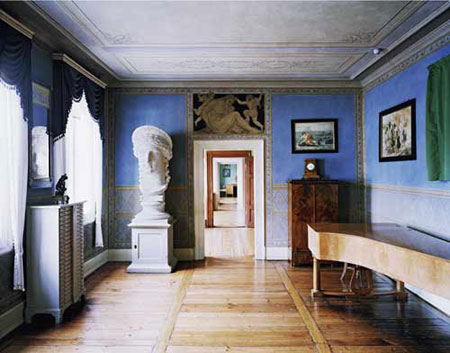
Candida H�fer, Goethe-Nationalmuseum Weimar II, 2006
C-Print, 200 x 250 cm, 6/ 6 Image � Candida H�fer, courtesy Galerie R�diger Sch�ttle |
|||
|
||||
|
||||
|
English Below Candida H�fer David Claerbout 26. M�rz bis 8. Mai 2010 Er�ffnung: Donnerstag, 25. M�rz 2010, 19�21 Uhr Candida H�fer Candida H�fer z�hlt unumstritten zu den f�hrenden internationalen Fotok�nstlerinnen der Gegenwart. Thema ihrer Arbeiten sind zumeist menschenleere Innenr�ume von k�nstlerischer und kultureller Bedeutung - Orte des Wissens, der Bildung und des Kunstgenusses wie Bibliotheken und Museen, repr�sentative S�le irdischer und himmlischer Macht in Pal�sten und Kirchen oder kulturelle Begegnungsst�tten wie die Foyers und Zuschauers�le der bekannten Theater und Opernh�user. Candida H�fers gro�formatige Fotografien sind meist betont sachlich konzipiert. Ihre Motive entwickelt sie bevorzugt aus der Zentralperspektive heraus oder sie f�hrt die Kamera in eine Art ideale Diagonale. Im Vordergrund steht dabei nicht der Wiedererkennungseffekt der prominenten R�ume, sondern vielmehr die durch die Wahl des Bildausschnitts sich ergebende bildnerische Gestaltung. Was auf den ersten Blick in seiner Perfektion zun�chst unspektakul�r erscheint, enth�llt bei genauerer Betrachtung ein die Architektur durchdringendes Ordnungssystem, das bis in die Tiefe des Bildes pr�zise wiedergegeben wird. Zuf�llig eingestreute Attribute wie ein liegen gebliebenes Buch, ein stehen gebliebener Eimer oder eine verschobene Absperrung durchbrechen die strikte Ordnung und verweisen auf die eben noch da gewesene Pr�senz des Menschen. Titelbild der Ausstellung ist das bekannte Junozimmer des Goethe-Nationalmuseums in Weimar. Augenfang des museal anmutenden Wohnsalons ist die gro�e Gipsportraitb�ste einer r�mischen Kaiserin, vormals bekannt als Juno Ludovisi. In strenger Komposition stellt uns Candida H�fer dieses lichte und klare menschenleere Zimmer vor und l�sst in ihm den Geist der Aufkl�rung nahezu sp�rbar werden. Einen Schwerpunkt der Ausstellung bilden Arbeiten aus Paris, Versailles und Fontainebleau. Zum mittlerweile eigenst�ndigen Genre der Museumsfotografie z�hlen Candida H�fers 2005 entstandenen Aufnahmen des Louvre. Das urspr�ngliche K�nigsschloss und sp�tere Museum war immer wieder ein beliebtes Motiv f�r K�nstler. Candida H�fer konzentriert sich auf einige der Galerien des bekannten Schlosses und Museums, darunter die Grande Galerie als von oben belichtete Zentralachse des Louvre, den Karyatidensaal und weitere S�le f�r Skulptur und Malerei. Motive aus der Op�ra Garnier z�hlen zu einer Reihe von Arbeiten, die sich den beiden gro�en Pariser Opernh�usern Palais Garnier und der Op�ra Bastille widmen. Die Ausstellung zeigt einige ausgew�hlte Werke aus dem Palais Garnier, darunter die monumentale Treppe und den in Rot und Gold gestalteten Zuschauerraum, Schaupl�tze triumphaler Repr�sentation im Stil des Second Empire. Candida H�fer, geboren 1944 in Eberswalde, studierte in den sp�ten 1970er und fr�hen 1980er Jahren an der D�sseldorfer Akademie Fotografie bei Bernd Becher. Sie lebt in K�ln. David Claerbout The American Room (second movement) Der belgische K�nstler David Claerbout kn�pft in seinen Arbeiten Verbindungen zwischen den Medien Fotografie und Film, er l�st deren Grenzen auf und hinterfragt die spezifischen Charakteristika des fotografischen und filmischen Bildes: statische Fotografien werden animiert, bewegte Filmbilder verlangsamt oder zum Stillstand gebracht. Ein scheinbar wirklichkeitsgetreues Raum-Zeit-Kontinuum erweist sich als subtil digital bearbeitet und ver�ndert und stellt die klassischen Erwartungen an das jeweilige Medium in Frage. Auch seine neue Film- und Soundinstallation �The American Room (second movement)�, die im Erdgeschoss der Galerie R�diger Sch�ttle pr�sentiert wird, vermittelt dem Betrachter ein eindrucksvolles audio-visuelles Erlebnis voller beunruhigender und �berraschender Elemente. �The American Room (second movement)� zeigt das Publikum eines in intimer Atmosph�re abgehaltenen Konzerts. Die langsame Kamerafahrt durch den Raum und die surround-Soundinstallation unterst�tzen das Gef�hl des Betrachters und Zuh�rers, sich scheinbar inmitten des Konzertsaals zu befinden. Irritierend ist das Verh�ltnis zwischen Bewegung und Stillstand: w�hrend sich die Kamera durch den Raum bewegt, verharren die Personen regungslos. Ein Eindruck, der durch technische Raffinesse entsteht, denn die Szenerie ist komplett digital komponiert: die Personen sind nicht gefilmt sondern durch Fotos dreidimensional �gescannt� worden, die Kamerabewegung am Computer aufbereitet. Die eingespielte Musik vermittelt durch ihren Rhythmus wiederum das Empfinden von Bewegung. �In the American Room the relation between movement and stillness is being translated very literally into the relation between breathing and holding the breath. The moments in which we hear the singer are also those moments in which she is offscreen - moments as long as a breath can hold.� David Claerbout David Claerbout wurde 1967 in Kortrijk, Belgien, geboren. Urspr�nglich studierte er Malerei an der Nationalen Hochschule der Sch�nen K�nste Antwerpen, bevor er sich nach seinem Studium der Fotografie und der Filmkunst widmete. Heute lebt und arbeitet er in Antwerpen. Im Herbst 2010 wird die Pinakothek der Moderne in M�nchen eine gro�e Einzelausstellung pr�sentieren. english version Candida H�fer David Claerbout 26th March until 8th May 2010 Opening: Thursday, 25th March 2010, 7.00�9.00 p.m. Candida H�fer Candida H�fer is undisputedly one of the leading international artist photographers of the present day. Her themes are mostly deserted interiors of artistic and cultural significance � places of knowledge, education and art appreciation, such as libraries and museums, prestigious interiors of palaces and churches, of edifices of secular and religious power, or places of cultural exchange, such as the foyers and auditoriums of famous theatres and opera houses. Candida H�fer�s large-format photographs are mostly objective in character. She prefers to use central perspective for her motifs or guides her camera into a kind of ideal diagonal. It is not the recognition effect of these prominent interiors that comes first and foremost in her work but rather the composition resulting from the choice of detail. What at first glance seems, by reason of its sheer perfection, to be entirely unspectacular turns out upon closer scrutiny to be a system of order inherent within the entire architecture, a system that recurs with rhythmical precision throughout the photographic image, from its foreground into its depths. Attributes distributed at random, such as a book left lying around, a forgotten bucket or a pushed-aside barrier, disturb the strictness of the system and tell us that people were present only moments before. The title image of the exhibition is the famous Juno Room of the National Goethe Museum in Weimar. The eye-catching feature of this imposing interior is the Juno Ludovisi, a large plaster of Paris bust of Antonia Minor as the Roman goddess Juno. Candida H�fer shows this bright and empty room in a composition of extreme severity and clarity, almost tangibly evoking the spirit of the Enlightenment. One of the focal points of the exhibition are Candida H�fer�s photographs from Paris, Versailles and Fontainebleau. Her photographs of the Louvre, taken in 2005, count among the gems of museum photography, which is meanwhile a genre in its own right. Originally a royal palace, the Louvre museum has forever been a favourite motif of artists. Candida H�fer has concentrated on just a few of its galleries, including the Grande Galerie as the top-lit central axis of the building, the Salle des Caryatides and other rooms and galleries of painting and sculpture. Motifs from the Op�ra Garnier belong to a series of works devoted to the two large Parisian opera houses Palais Garnier and the Op�ra Bastille. The exhibition shows a few selected works from the Palais Garnier, including the monumental staircase and the red and gold auditorium � scenes of triumphant representations in the style of the Second Empire. Candida H�fer, born in Eberswalde in 1944, studied photography under Bernd Becher at the D�sseldorf Art Academy during the late 1970s and early 1980s. She lives in Cologne. David Claerbout The Amercan Room (second movement) The works of Belgian artist David Claerbout interlink the media of photography and film, dissolving the barriers that separate them and calling in question the specific characteristics of the photographic and filmic image: static photographs are animated, while moving cinematographic images are slowed down or even brought to a standstill. A seemingly realistic spatiotemporal continuum turns out to have been subtly manipulated and changed by digital means, thus compromising the respectiveclassic expectations of these media.Claerbout�s new film and sound installation �The American Room (second movement)�, which will be presented on the ground floor of the R�diger Sch�ttle Gallery, is no exception, for it involves the viewer in an exciting audio-visual experience full of surprising and disquieting ingredients. �The American Room (second movement)� shows a concert held in the intimate atmosphere of a small concert room. The slow movement of the camera through the room and the Dolby-surround sound installation strengthen the viewer�s and listener�s feeling that they themselves are in the middle of the concert room. What irritates the viewer is the relation between movement and stillness: while the camera moves through the room, the people in the audience remain absolutely motionless.The impression results from a high degree of technical ingenuity, for the scene has been composited completely digitally: the people in the audience have not been filmed but photographed from all sides against a bluescreen to create a three-dimensional effect and then cut out and placed digitally in a photographed space. The movement of the camera was then processed on a computer with the aid of an editing program. The music of the soundtrack in turn conveys a sense of movement through its rhythm. �In The American Room the relation between movement and stillness is being translated very literally into the relation between breathing and holding the breath. The moments in which we hear the singer are also those moments in which she is offscreen - moments as long as a breath can hold.� David Claerbout David Claerbout was born in Kortrijk, Belgium, in 1967. He first studied painting at the Royal Academy of Fine Arts in Antwerp and then, after completing his studies, devoted himself to photography and cinematography. He now lives and works in Antwerp. A large solo exhibition at the Pinakothek der Moderne in Munich is planned for autumn 2010. |
||||
re-title.com
International contemporary art
SIGN UP FOR NEWSLETTERS

 SIGN UP for ARTIST MEMBERSHIP
SIGN UP for GALLERY MEMBERSHIP
SIGN UP for ARTIST MEMBERSHIP
SIGN UP for GALLERY MEMBERSHIP
Click on the map to search the directory