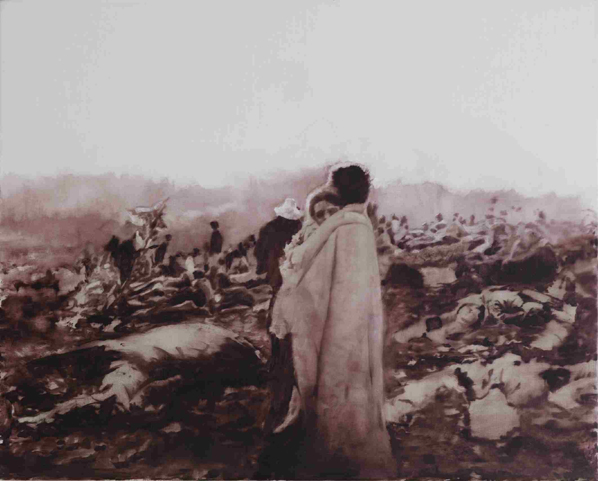
Jan De Cock
JKO Romantik VII
Acrylic, wood, plastic, metal, sand
255 x 289 cm
2012
Courtesy of Galeria Filomena Soares, Lisbon
JAN DE COCKJacqueline Kennedy Onassis: A Commercial Exhibition 10 November - 12 January 2013
Galeria Filomena Soares has the pleasure to present the first solo show in Portugal of the Belgian artist JAN DE COCK (Brussels, 1976), titled JACQUELINE KENNEDY ONASSIS: A Commercial Exhibition. The show will open at Thursday, November 15th 9:30 pm, with the presence of the artist and will be on display until January 12th, 2013.
The exhibit works were presented this year at Staatliche Kunsthalle of Baden-Baden, Germany, titled JACQUELINE KENNEDY ONASSIS: A Romantic Exhibition. The artist creates his works using a very particular \"modus operandi\". The improvisation of suggestive referents interacting with the constant denial of specific concepts and materials, allow him a space of extreme intellectual freedom of artistic discourse. A series of sculptures named as Romantik (Romance) consists of large structures measuring nearly three meters, over which are accurately added different layers of wood and other industrially produced materials. The works recall attention to the artist's earlier "expansive-objects", but now seem to have been pushed against the wall, as bas-reliefs. A series of sculptures Krise (Crisis), placed in front of the previous, reproduces fragments of other architectural element. Stairs, small furniture or pedestals that still seem to be part of the artist's studio are constituent parts of the sculptures. By compressing three-dimensional spaces into bas-reliefs the artist decreases the distance between the studio and the gallery, transforming both into one space. Other elements - architectural ornaments, beads, small decorative elements, wooden modules, floors, several colors paint, or the traces of a plaster cast - reappear in different works. Some elements recur in new ways so that the viewer is forced to decode the small differences and variations in several sculptures compositions that are part of the same series. Thus, the viewer falters from one fragment to another in search of the stable narrative and conscious interpretation. Maybe it's this endless demand for something unattainable that artist suggests a possible mapping of decadent contemporary society.
At time of the exhibition in Germany, Frank Vende Veire wrote a short essay titled "Jacqueline" which is reproduced here:
"Every epoch has its dreams and bestows these dreams onto the next generation. It as if it were projected against the firmament. One of the brightest constellations that twinkled in the firmament of that age we call \"the Sixties\" was Jacqueline Kennedy Onassis (1929-1994). This exhibition approaches Jacqueline (\"Jackie\") as an emblematic figure, embodying the slumbering promise and the beliefs of her age, but no less the latent threats and perils that the era brought. The Sixties are often derided as a time characterised by naivety and a reckless lust for life, but it begs the question, have the following decades revealed anything more than an alternation between desolate emptiness and manic parody?
In the post-war years, while transcendent values lost their appeal and hold over the masses, they were more and more haunted by the desire that had, for ages been the privilege of a decadent elite, proud of its uselessness: to lead an intense life, rich in experiences. A large, emerging middle class had the opportunity to be stylish and to dress well, to travel and to immerse themselves in new cultures, to meet and to themselves become fascinating, imaginative people, to enrich their lives with the arts and literature, sometimes to become artists themselves, to attend events and to cast off the shackles of petty bourgeois morality, to seek challenging opportunities for renewal and development - in short, to be original. As a girl Jacqueline vowed never to be a housewife, she had a physical aversion to boring people and was always conspicuously original. She had the "je ne sais quoi" that people try to pin down using such words as, "class", "style", "charisma", "presence" and "aura". She had an inimitable style that always sets in motion the machinery of imitation. She had an especially highly evolved knowledge of how to use that machinery. Instinctively, she again and again found the environment where her qualities could best be displayed to her imitators: in the shadow of power. One finds the space here to manoeuvre and thrive in a way that the powerful themselves never can. A minimum of originality produces the maximum effect. With a modest gesture Jacqueline could move half the world, with a mere garment start a worldwide trend. Jacqueline owed her charisma to her modesty. A million eyes were upon her because she was the master of their unanswerable gaze. She became an empty mirror of herself, reflecting her own image. Her appearance was impersonal and indefinite enough to become a blank screen. In her refusal of originality she became a much discussed mystery, a fleeting departure point where all of the conflicting desires of the age reached a moment of saturation. Perhaps there was, in that point, just like in the eye of the storm, a total and deadly silence.
An inextricable entanglement of a deep yearning for that which is of lasting value and a sense of carefree frivolity, of a longing for authenticity and a proliferation of simulations, of the petty bourgeois cult of the family and cosmopolitan sensibility, of painstaking (re) construction of self-image and the spontaneous lust for life, of an obsession with security and desire for surrender, of (art) historical interests and cheap nostalgia, of revolutionary fervour and the posturing of stylised rebels - that was the Sixties, and in this exhibition this era looks back at us as "Jacqueline Kennedy Onassis".
The creators of this show had a single standard: They imagined a Jacqueline who, beyond every vain image she had of herself (above all of their own, vain perceptions of), would have recognised and in this exhibition - and would have loved herself."
GALERIA FILOMENA SOARESRua da Manutenção – 80
1900-321 Lisbon
Portugal
T: +351 218624122
GALERIA FILOMENA SOARES
Read On... GALERIA FILOMENA SOARES, Lisbon